
A Trader's Guide to Extrinsic Value Option Profits
If a stock moves past your strike, the option can be assigned — meaning you'll have to sell (in a call) or buy (in a put). Knowing the assignment probability ahead of time is key to managing risk.
Posted by
 John Clarke
Related reading
A Step-by-Step Covered Calls Example for Consistent Income
Unlock consistent income with our step-by-step covered calls example. This guide breaks down the strategy, risks, and outcomes to help you trade confidently.
Long Call and Short Put The Ultimate Synthetic Stock Guide
Unlock the power of the long call and short put strategy. This guide explains how synthetic long stock works, its benefits, risks, and how to execute it.
What is a Call Spread? A Clear Guide to Bull and Bear Spreads
What is a call spread? Discover how bull and bear spreads limit risk and sharpen your options trading strategy.
What good is an option contract if the stock hasn't even hit the strike price? Plenty, it turns out. That "what if" potential is exactly what gives an option its extrinsic value.
Think of it like buying a hot concert ticket months in advance. You're not just paying for the seat; you're paying a premium for the chance that the show becomes the talk of the town, making your ticket way more valuable than what you paid for it. That extra bit you paid for the possibility is extrinsic value.
What Is Extrinsic Value in an Option
Every option's price—its premium—is a mash-up of two different things. There’s the tangible, in-the-moment value it holds right now (intrinsic value), and then there’s everything else. That "everything else" is its extrinsic value.
Often called time value, this is the part of the premium traders are willing to pay for the uncertainty and opportunity baked into the contract. It’s the speculative fuel that gives an out-of-the-money option any value at all. Without it, OTM options would be worthless.
The Sum of Two Parts
The formula here is refreshingly simple: an option's total premium is just its two value components added together.
- Intrinsic Value: This is the option's real, immediate worth if you exercised it on the spot. For a call option, it's how far the stock price is above the strike. For a put, it's how far it is below.
- Extrinsic Value: This is the rest of the premium. It represents the market’s collective bet on what could happen between now and expiration, factoring in time, volatility, and how close the option is to being profitable.
Let's say a call option has a total premium of $10. If the stock is trading $6 above the strike, its intrinsic value is $6. The remaining $4 is all extrinsic value—the market's price for hope and potential. For a deeper dive, check out our guide on intrinsic vs. extrinsic option value.
Extrinsic value peaks for at-the-money options, where the strike price is nearly identical to the stock price. Why? Because that’s where the outcome is most uncertain, and the potential for a big move in either direction is at its highest.
But this value doesn't last forever. It melts away as the expiration date gets closer, a process every option seller knows as theta decay. This decay isn't linear; it speeds up dramatically in the final weeks and days. Learning to manage extrinsic value is a core skill for any options trader, but it's the lifeblood for sellers who pocket this decay as profit.
The Core Drivers of Extrinsic Value
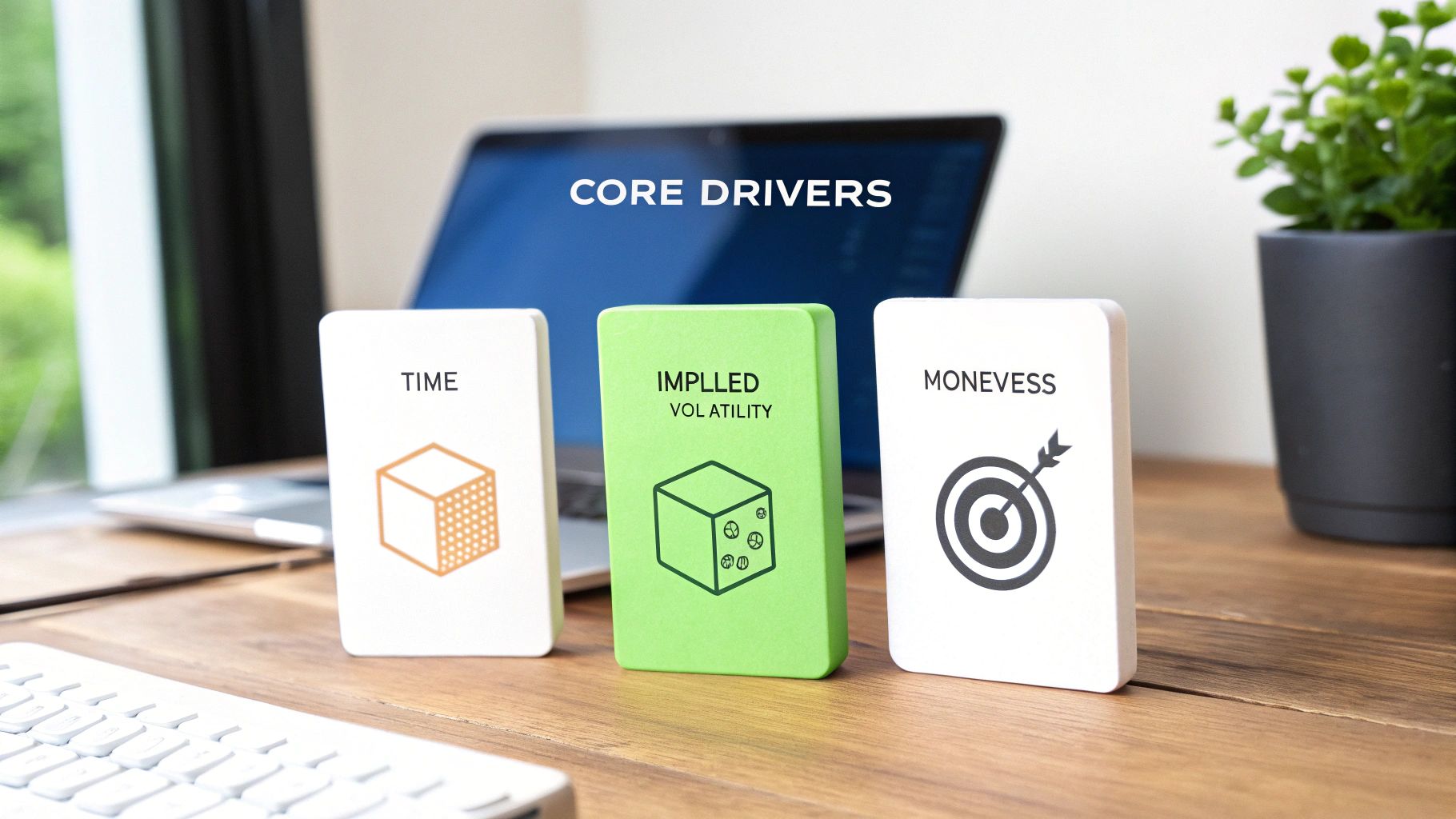
The premium you pay for an option isn't just pulled out of thin air. It’s shaped by three powerful, interconnected forces that every trader needs to get a handle on. These drivers dictate how much "what if" potential is priced into a contract, and they influence everything from your entry price to your final profit.
Think of an option’s extrinsic value like a melting ice cube. The size of that cube and how fast it shrinks depends entirely on these three factors.
Time to Expiration: The Melting Ice Cube
Time is the easiest driver to understand. The more time an option has until it expires, the more chances the underlying stock has to make a big move in your favor. It’s a longer runway for your trade to take off.
That's why an option with six months left will have a lot more extrinsic value than one expiring next week, all else being equal. But this value is always bleeding away in a process called time decay, or theta. And it’s not a slow, steady drip—the decay accelerates dramatically as the expiration date gets closer, especially in the final 30-45 days.
Implied Volatility: The Fear and Greed Gauge
Implied volatility (IV) is basically the market's best guess of how much a stock's price will swing in the future. You can think of it as a "fear and greed gauge." When the market gets jittery or excited, IV shoots up. When things are calm and predictable, IV drops.
Higher implied volatility directly pumps up an option’s extrinsic value. Why? Because bigger potential price swings mean there's a better chance—even for an option way out-of-the-money—to end up profitable. Traders are willing to pay a higher premium for that increased potential.
Key Takeaway: An increase in implied volatility can raise an option's price even if the underlying stock doesn’t move an inch.
Just look at the market turbulence of early 2020. The implied volatility of options on major indexes went through the roof, dramatically inflating their extrinsic value as traders priced in massive uncertainty.
Moneyness: The Peak of Uncertainty
Moneyness just describes where an option's strike price is sitting relative to the current stock price. It falls into one of three buckets:
- In-the-Money (ITM): The option already has intrinsic value.
- Out-of-the-Money (OTM): The option has zero intrinsic value right now.
- At-the-Money (ATM): The strike price is nearly identical to the stock price.
Here’s the surprising part: at-the-money options have the most extrinsic value. They sit right at the peak of uncertainty. The outcome is basically a coin flip, which means the potential for the option to swing deep into profitability is at its absolute highest.
On the other hand, deep ITM and far OTM options have much lower extrinsic value because their outcomes are far more predictable.
The table below breaks down how these three drivers work together to determine an option’s extrinsic value.
How Key Factors Influence Extrinsic Value
| Factor | Impact on Extrinsic Value | Reason |
|---|---|---|
| Time to Expiration | Increases as time to expiration increases | More time provides more opportunity for the underlying stock to make a favorable move. |
| Implied Volatility (IV) | Increases as IV increases | Higher anticipated price swings boost the option's potential to become profitable. |
| Moneyness | Highest for at-the-money (ATM) options | ATM options face the greatest uncertainty, giving them the highest potential for a large move. |
Understanding how time, volatility, and moneyness interact is fundamental. If you want to dive deeper into how volatility specifically gets priced into an option's premium, check out our guide on what Vega is in options trading.
Calculating Extrinsic Value Like a Pro
Moving from theory to practice is way simpler than you might think. The whole calculation for extrinsic value boils down to one clean formula that isolates the "what if" part of an option's price.
The Formula:
Extrinsic Value = Option Premium – Intrinsic Value
That's it. You just subtract what an option is worth right now (its intrinsic value) from what you pay for it (the premium). What’s left over is the value of its future potential.
To really get this, let's walk through three different scenarios using a fictional company, TechCorp Inc. (TCORP), which is currently trading at $100 per share.
Example 1: The In-the-Money (ITM) Call Option
Imagine you're eyeing a TCORP call option with a $95 strike price that expires in 60 days. Because the stock price ($100) is already above the strike price ($95), this option is in-the-money.
Let’s say its total premium is $8.
- Intrinsic Value: $100 (Stock Price) - $95 (Strike Price) = $5
- Extrinsic Value: $8 (Premium) - $5 (Intrinsic Value) = $3
So, that $8 premium is made of two parts: $5 in real, tangible value you could cash in on immediately, and $3 in pure extrinsic value. Traders are paying that extra $3 for the 60 days of potential for TCORP to climb even higher.
Example 2: The At-the-Money (ATM) Call Option
Now, let's look at a TCORP call with a $100 strike price, also expiring in 60 days. Since the strike and the stock price are the same, it's sitting right at-the-money. This option is trading for a premium of $5.50.
- Intrinsic Value: $100 (Stock Price) - $100 (Strike Price) = $0
- Extrinsic Value: $5.50 (Premium) - $0 (Intrinsic Value) = $5.50
See how the extrinsic value is highest here? That's because the outcome is the most uncertain. The entire $5.50 premium is pure hope and time, representing the market's price for what’s essentially a coin-flip chance of a big move up.
Example 3: The Out-of-the-Money (OTM) Call Option
Finally, let's check out an out-of-the-money TCORP call with a $105 strike price and a 60-day expiration. The stock needs to jump more than $5 just for this option to break even at expiration. It’s trading for a $2.50 premium.
- Intrinsic Value: Since the stock price is below the strike, the intrinsic value is $0.
- Extrinsic Value: $2.50 (Premium) - $0 (Intrinsic Value) = $2.50
For any OTM option, its entire premium is extrinsic value. That $2.50 is what traders are willing to pay for the possibility—the long shot—that TCORP stock rallies past $105 before time runs out.
Getting a handle on these components is a huge step, and you can learn more about how to calculate an option premium in our detailed guide.
How Option Sellers Profit from Extrinsic Value
For an option buyer, extrinsic value is a melting ice cube. Every second that ticks by, their potential profit shrinks a little more. But flip the coin, and that same melting cube is exactly how an option seller makes money.
When you sell a covered call or a cash-secured put, you’re not just trading stocks. You're selling time. And your best friend in this trade is time decay.
You get paid a premium the moment you sell an option, and that premium is loaded with extrinsic value. The game is simple: let that extrinsic value decay to zero by the expiration date. If it does, you pocket the entire premium, pure and simple.
This is how you can turn the extrinsic value option from a wild bet into a steady stream of income.
The Seller's Sweet Spot
The real art of selling options is finding the perfect balance between the premium you collect and the time you have to wait. Selling an option that expires tomorrow? Sure, it’s safe, but the payout will be tiny. Selling one that expires a year from now? You’ll get a fat premium, but your capital is tied up for ages, exposed to a whole year's worth of market drama.
So where’s the sweet spot? Most experienced traders will point you to options with 30 to 45 days until expiration (DTE).
This timeframe is the magic window because it's where time decay (theta) really starts to pick up speed. An option's value bleeds away slowly at first, but in that final month, it's like it falls off a cliff. This is perfect for the seller, maximizing your return in a relatively short period.
By sticking to this window, sellers can collect premium month after month, effectively compounding their returns as the extrinsic value on their sold contracts vanishes into thin air.
Choosing the Right Strike Price
Picking your strike price is all about a strategic trade-off between how much money you want to make and how much risk you're willing to take. The closer your strike is to the stock's current price (at-the-money), the more extrinsic value it has, which means a bigger premium for you.
But there’s a catch. A bigger premium also means a higher chance the option ends up in-the-money, leading to assignment. That’s when you’re forced to either sell your shares (for a covered call) or buy shares (for a cash-secured put).
Here's how sellers generally think about it:
- Go for Higher Income: Sell at-the-money (ATM) or just slightly out-of-the-money (OTM) options. These have the most extrinsic value and pay the most. It’s a more aggressive play because the odds of assignment are higher.
- Play for Higher Safety: Sell options that are further out-of-the-money (OTM). The premium you collect will be smaller, but the probability of the option expiring worthless is much, much higher. This is a more conservative route for traders focused on generating income while protecting their capital.
Ultimately, it comes down to what you want to achieve. Are you trying to maximize your monthly income, or would you be perfectly happy getting assigned the shares at the price you chose? Once you get a feel for the relationship between a strike's moneyness and its extrinsic value, you can pick strikes that fit your goals and risk tolerance like a glove, turning time decay into your own personal ATM.
Visualizing How Time Decay Works
Reading about extrinsic value is one thing, but seeing how it behaves is another. Abstract concepts like time decay really click into place when you can visualize them. A couple of key charts perfectly illustrate how the extrinsic value option sellers rely on for income really works.
This infographic nails the core relationship between the two main drivers of an option seller's profit: time decay and volatility.
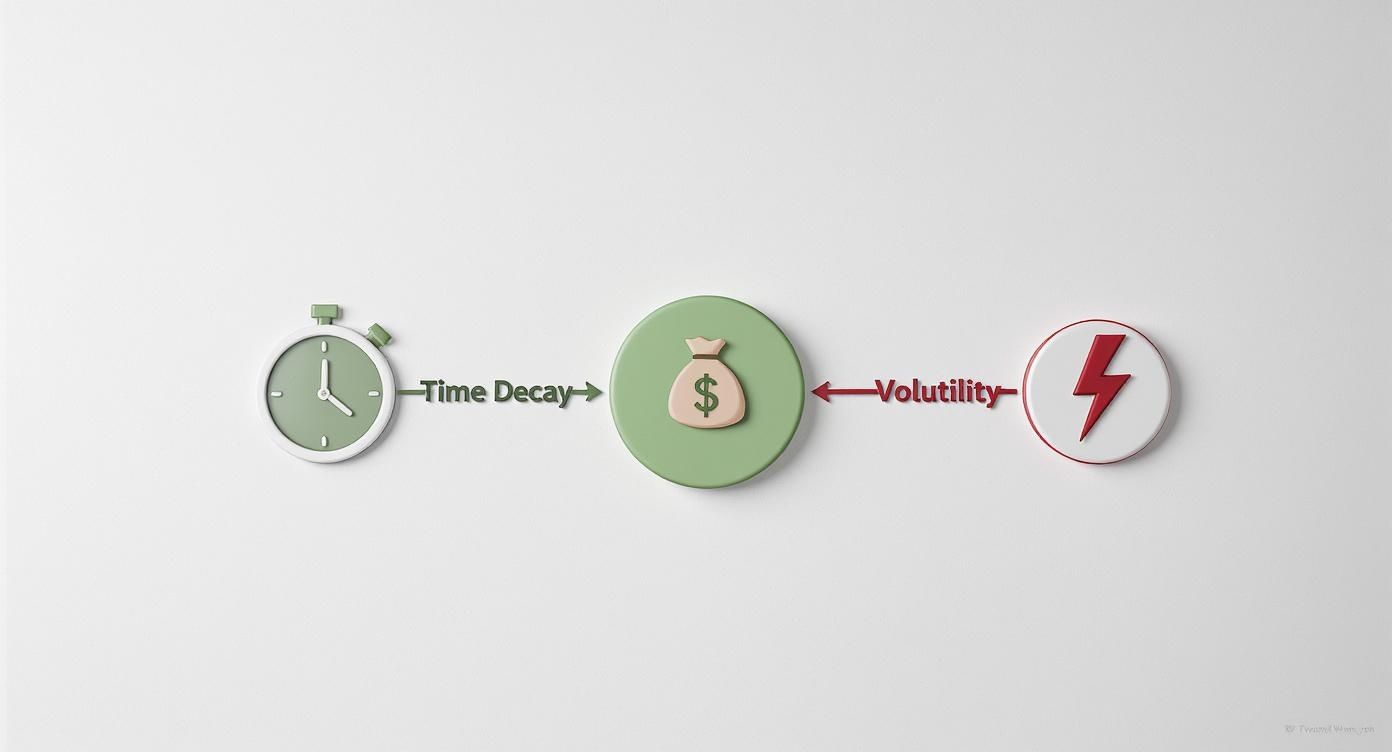
As the graphic shows, both the clock ticking down and shifts in market uncertainty directly impact your bottom line when selling options. Now, let’s explore these forces through two powerful visual models.
The Time Decay Curve (Theta Curve)
Imagine plotting an option's extrinsic value against the time left until it expires. What you get isn't a straight, predictable line sloping downward. Instead, it forms a distinct curve, often called the "theta curve."
For the first few months of an option's life, its value erodes very, very slowly. But as it gets into that final 30-45 day window, the slope gets much steeper. The value practically falls off a cliff, losing premium at a much faster rate with each passing day.
This accelerated decay is exactly why so many option sellers focus on contracts with roughly one month to expiration. It’s the sweet spot where you can still collect a decent premium and benefit from the fastest rate of time decay.
This visual makes it crystal clear: time is an option seller’s greatest ally, especially inside that final 45-day countdown.
The Moneyness Bell Curve
Now, let's look at extrinsic value from a different angle: moneyness. If you were to plot the amount of extrinsic value across various strike prices for the same expiration date, you’d see a perfect bell curve emerge.
The peak of this curve—the point of maximum extrinsic value—is always right at-the-money (ATM). This is where the uncertainty about the stock's final destination is highest, so traders are willing to pay the biggest premium for that potential.
As you move away from the ATM strike in either direction, the curve slopes downward.
- Deep in-the-money (ITM) options have very little extrinsic value because their outcome is almost a sure thing. Their price is nearly all intrinsic value.
- Far out-of-the-money (OTM) options also have little extrinsic value. The probability of them finishing in the money is so low that traders won’t pay much for such a long shot.
This bell curve instantly shows you where the most "time premium" is concentrated. Option sellers can use this to pick strike prices that perfectly match their income goals and risk tolerance—whether that means targeting the high-premium peak or playing it safer on the lower-premium slopes.
Extrinsic Value Profile At-A-Glance
To make this even clearer, let's break down how extrinsic value behaves at different moneyness levels for a call option. This table gives you a quick snapshot of the trade-offs at each point on the bell curve.
| Option Status (Moneyness) | Intrinsic Value | Extrinsic Value Level | Primary Appeal To |
|---|---|---|---|
| Deep In-the-Money (ITM) | High | Very Low | Buyers looking for stock-like exposure. |
| At-the-Money (ATM) | Zero | Maximum | Sellers targeting the highest premium income. |
| Far Out-of-the-Money (OTM) | Zero | Very Low | Sellers prioritizing a low probability of assignment. |
As you can see, the ATM strike is the sweet spot for maximizing extrinsic value, making it a prime target for income-focused sellers. Meanwhile, OTM strikes offer a safer, though less lucrative, alternative for those who want to keep their shares.
Frequently Asked Questions About Extrinsic Value
When you're getting the hang of options, a few questions always pop up, especially around a moving target like extrinsic value. Let's run through some of the most common ones to make sure the core concepts we've covered really stick.
Think of this as a quick-fire round to clear up any confusion. Each answer digs into how extrinsic value actually behaves in the real world of trading.
Can an Option Have Zero Extrinsic Value?
Yep, it absolutely can. But this almost exclusively happens at the exact moment of expiration. For its entire life leading up to that final bell, an option will have at least some extrinsic value, even if it's just a penny or two.
Why? Because at expiration, all the "what if" scenarios are over. The uncertainty is gone. The option’s value is stripped down to its pure intrinsic worth. If a contract is out-of-the-money when the clock runs out, both its intrinsic and extrinsic value hit zero.
Why Do At-the-Money Options Have the Most Extrinsic Value?
At-the-money (ATM) options are where uncertainty is at its peak, and that’s why they command the highest extrinsic value. When a stock is trading right at the strike price, the outcome is basically a coin toss—it could just as easily rip higher as it could drop lower.
Traders are willing to pay the highest premium for this 50/50 shot at a significant profit. Deep in-the-money and far out-of-the-money options have more predictable outcomes, so their extrinsic value is much lower.
This is exactly why option sellers love at-the-money strikes. They offer the juiciest time premium for the taking.
Do Both Calls and Puts Have Extrinsic Value?
They sure do. The concept of extrinsic value is universal to all options, whether you're trading a call or a put. The same three drivers we've discussed—time, volatility, and moneyness—are at the wheel for both.
It doesn't matter if you're betting on a stock to go up (with a call) or down (with a put). The portion of the premium you're paying for time and potential is calculated the same way.
- For a Call: You're paying a premium for the chance the stock will rally well past your strike price.
- For a Put: You're paying a premium for the chance the stock will fall far below your strike price.
In both cases, that premium paid for pure potential is the extrinsic value.
How Do Interest Rates Impact Extrinsic Value?
This one is a bit more subtle, but interest rates do play a role. Their influence comes through one of the lesser-known option Greeks called Rho. While time decay and volatility are the big-ticket items, interest rates quietly affect the carrying cost of the underlying stock.
Generally, higher interest rates tend to give call options a slight boost in extrinsic value. The logic is that buying a call is a capital-efficient way to get exposure to a stock without buying the shares outright. When rates are high, the cash you save by not buying the stock is worth more.
On the flip side, higher interest rates usually nudge the extrinsic value of put options a little lower. It's a minor factor compared to theta and vega, but it's baked into the complex models that price options accurately.
Ready to stop guessing and start making data-driven decisions? Strike Price gives you the real-time probability metrics you need to master selling options for income. See which strikes offer the best balance of premium and safety, and get alerts before risks emerge. Start your journey to consistent income at https://strikeprice.app.