
A Step-by-Step Covered Calls Example for Consistent Income
If a stock moves past your strike, the option can be assigned — meaning you'll have to sell (in a call) or buy (in a put). Knowing the assignment probability ahead of time is key to managing risk.
Posted by
 John Clarke
Related reading
Long Call and Short Put The Ultimate Synthetic Stock Guide
Unlock the power of the long call and short put strategy. This guide explains how synthetic long stock works, its benefits, risks, and how to execute it.
What is a Call Spread? A Clear Guide to Bull and Bear Spreads
What is a call spread? Discover how bull and bear spreads limit risk and sharpen your options trading strategy.
A Guide to the Covered Call Options Strategy for Income
Learn the covered call options strategy with our step-by-step guide. Discover how to generate consistent income, manage risk, and make data-driven decisions.
Before we jump into a detailed trade example, let's break down the core idea behind a covered call. At its heart, it's a popular options strategy that lets you generate immediate cash from stocks you already own, simply by selling someone the right to buy them from you at a set price.
What Is a Covered Call? A Simple Landlord Analogy

The easiest way to think about it is this: owning 100 shares of a stock is like owning a rental property. Selling a covered call is just you acting as the landlord for those shares.
You're essentially "renting out" the option to buy your house to a tenant (the option buyer). This agreement is called a call option. It gives the tenant the right—but not the obligation—to purchase your house at an agreed-upon price (the strike price) by a specific date (the expiration date).
Collecting Your Rent Payment
For giving them this right, the tenant pays you a non-refundable deposit. In the options world, we call this payment the premium. This is cash in your pocket, right away, and it's yours to keep no matter what the tenant decides to do. The premium is the entire point of the covered call strategy.
The "covered" part just means you already own the house (the 100 shares). Your promise to sell is covered by your ownership, making it a much more conservative strategy than, say, selling an option on a house you don't even own. You can get the full rundown in our definition of a covered call guide.
Breaking Down the Key Players
To really make sense of the upcoming example, let's connect the dots of our analogy:
- The House: Your 100 shares of a stock. One options contract almost always covers 100 shares.
- The Tenant: The option buyer, who pays you for the right to potentially buy your shares.
- The Rental Agreement: The call option contract, which lays out the price and timeframe.
- The Rent: The premium, which is the cash you collect upfront for selling the contract.
The big idea is simple: you're generating income from an asset you already hold, just like a landlord collects rent. You get paid today for your willingness to potentially sell your shares at a higher price in the future.
This analogy gives us a solid foundation. Now, let's leave the world of real estate and see how this plays out in the stock market with a real trade.
Theory is one thing, but seeing a trade play out with real numbers makes all the difference. Let’s walk through a classic covered call example using a stock everyone knows: Apple Inc. (AAPL).
Remember, the first rule of covered calls is you have to own the shares first. You need at least 100 shares for every call contract you want to sell. This is the "covered" part—the shares you own act as collateral for your promise to sell.
Setting Up the Trade
Let's say you already own 100 shares of AAPL. You bought them a while back at $180 per share, so your initial investment is $18,000.
You're feeling pretty neutral on the stock for the next month. You don't see it skyrocketing, but you don't think it's going to tank either. Instead of just letting those shares sit there, you decide to put them to work and generate some income. It’s the perfect setup for a covered call.
So, you pull up the options chain for AAPL on your brokerage platform. You have two decisions to make:
- Expiration Date: You pick a date about 30 days out. This is a sweet spot—it gives the trade time to work while also letting you benefit from accelerating time decay as expiration gets closer.
- Strike Price: You need to pick a price above the current stock price, which is known as an "out-of-the-money" strike. You settle on the $190 strike price.
By selling this call, you're making a simple agreement: "I am willing to sell my 100 shares of AAPL for $190 each at any point in the next 30 days."
Collecting Your Premium
The best part? You get paid instantly for making this promise. This payment is called the premium. For this specific $190 call option, the premium is $2.50 per share.
Since every options contract controls 100 shares, the cash that hits your account is:
$2.50 (premium per share) x 100 shares = $250
This $250 is yours to keep, deposited right into your brokerage account. Think of it as collecting rent on your stock.
Key Insight: The moment you sell that call, you've locked in a return. That premium is yours, no matter what AAPL's stock does next.
Figuring Out Your Break-Even Point
Because you've collected that $250 premium, your risk on the trade has changed. That $2.50 per share acts as a buffer if the stock price starts to drop.
Your new break-even price is easy to calculate. Just subtract the premium you received from the price you originally paid for the stock:
$180 (your cost) - $2.50 (premium) = $177.50
This means AAPL could fall all the way to $177.50 per share before your position as a whole (stock + option premium) starts showing an unrealized loss. The premium gives you a nice cushion.
Defining Your Maximum Profit
The one trade-off with a covered call is that you cap your potential upside. But the good news is, your maximum possible profit is crystal clear from day one.
It’s a simple combination of your potential capital gain plus the premium you already pocketed.
- Capital Gain: The difference between the strike price and your purchase price ($190 - $180 = $10 per share).
- Premium Income: The cash you collected ($2.50 per share).
Add them together, and your maximum profit is $12.50 per share. For your 100 shares, that's a total potential profit of $1,250.
To make it even clearer, here is a complete summary of our AAPL covered call trade.
AAPL Covered Call Trade Breakdown
| Metric | Calculation | Value |
|---|---|---|
| Initial Stock Cost | 100 shares x $180/share | $18,000 |
| Strike Price | Selected from options chain | $190 |
| Premium Collected | 1 contract x 100 x $2.50 | $250 |
| Break-Even Price | $180 - $2.50 | $177.50 |
| Maximum Profit | (($190 - $180) + $2.50) x 100 | $1,250 |
This table lays out all the key numbers for our trade. Now that the position is open, let's look at what could happen as we get closer to the expiration date.
Analyzing the Three Possible Trade Outcomes
Once you’ve sold your call, the trade is on. All you have to do is wait for the expiration date to see how things shake out. Every covered call, including our AAPL example, ends in one of three ways. Each one has a different financial result, so let’s walk through them.
This graphic breaks down the essential numbers from our AAPL trade that will decide which way it goes.
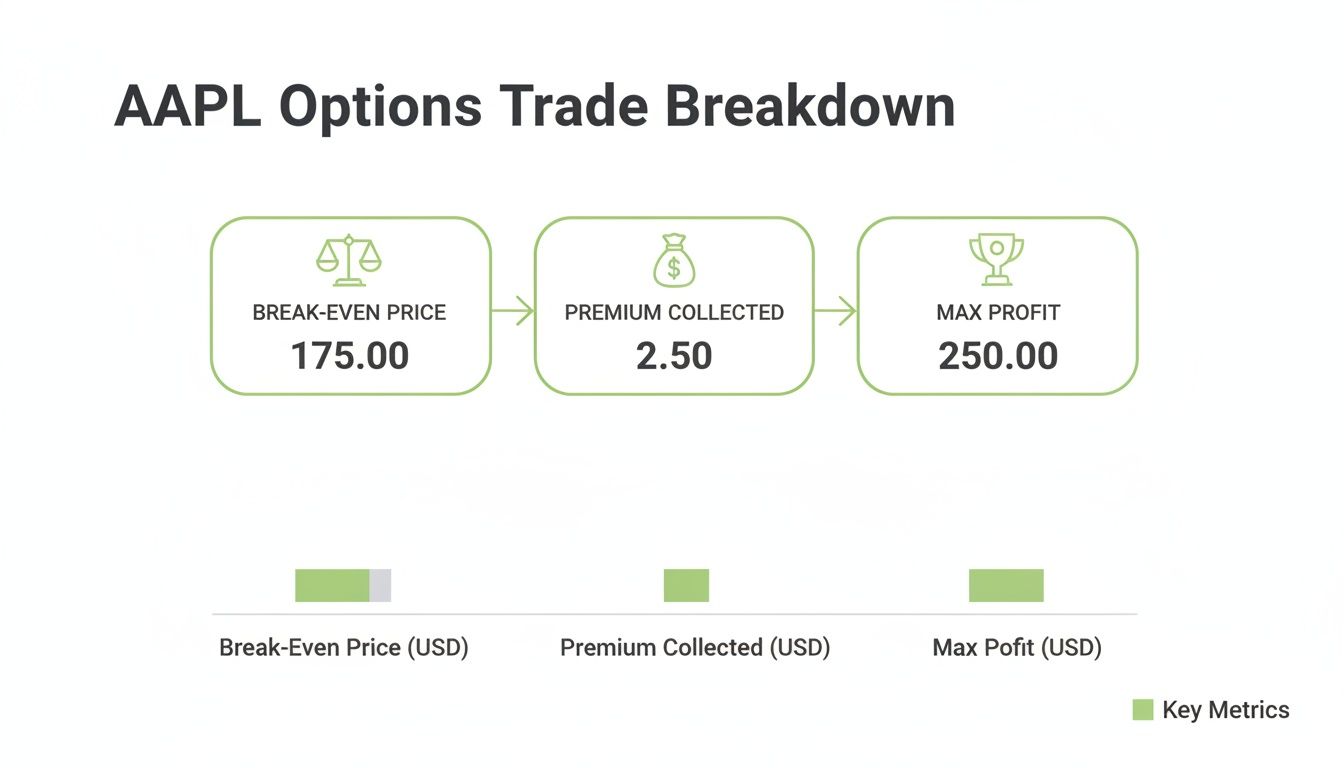
It’s a clear look at how the premium you collect directly impacts both your break-even price and your max profit.
Outcome 1: The Ideal Scenario (Stock Stays Below the Strike Price)
This is the outcome most covered call sellers are rooting for. On the expiration date, AAPL is trading at any price below the $190 strike price.
Let’s say AAPL closes at $188 per share.
Because the stock is trading for less than the strike price, the call option you sold is "out-of-the-money." It makes zero sense for the buyer to use their option to buy your shares for $190 when they can just grab them on the open market for $188.
- The option expires worthless. The buyer is out the premium they paid, and you’re off the hook.
- You keep the entire $250 premium. This is pure profit from the options side of the trade.
- You keep your 100 shares of AAPL. Now you’re free to turn around and sell another covered call for the next month, repeating the process.
This is the bread and butter of the covered call strategy: generating a little extra income while you hold a stock you plan on keeping anyway.
Outcome 2: Assignment (Stock Goes Above the Strike Price)
Now, what happens if AAPL has a good month? Imagine on expiration day, the stock is trading at $195 per share, which is well above your $190 strike price.
The option is now "in-the-money." The buyer will absolutely exercise their right to buy your shares for $190—it's a great deal for them since the stock is actually worth $195. This process is called assignment.
Your 100 shares of AAPL are automatically sold from your account at the agreed-upon $190 strike price. This is exactly what you signed up for when you sold the call.
Don’t panic, this isn't a bad thing at all. It just means you’ve hit your maximum possible profit on this trade.
- Capital Gain on the Stock: You sell your shares at $190, which is $10 more than the $180 you paid. That’s a $1,000 gain.
- Premium Income: You also get to keep the $250 premium from the start.
- Total Profit: $1,000 (gain) + $250 (premium) = $1,250.
You’ve successfully locked in your best-case-scenario profit. The only real "downside" here is the opportunity cost—you missed out on the extra $5 per share of profit between $190 and $195.
Outcome 3: The Primary Risk (Stock Price Falls)
This is where the main risk of holding the stock comes into play. What happens if AAPL’s price takes a dive? Let's say that by expiration, the stock has dropped to $175 per share.
Just like in the first scenario, the $190 strike price is way above the market price, so the option expires worthless. You get to keep the $250 premium, no strings attached.
The catch? Your underlying shares have lost value. Your original $18,000 investment (100 shares at $180) is now only worth $17,500. That's an unrealized loss of $500 on the stock itself.
But the premium you collected helps soften that blow.
- Stock Loss: -$500
- Premium Gain: +$250
- Net Unrealized Loss: -$250
The premium acted as a small cushion, but it couldn't erase the loss from the stock dropping. This is why you should only ever write covered calls on stocks you’re perfectly fine holding for the long haul.
How to Choose the Right Strike Price
The single most important decision you'll make in any covered call trade is picking the strike price. This one choice directly controls the trade-off between the income you collect and the odds of having your shares sold away.
Think of it like setting the rent for a property you own. A higher rent brings in more cash, but it might also mean someone buys the property from you sooner than you'd like.
So how do we move beyond just guessing? We use a key options metric called Delta.
While Delta has a more technical definition, for our purposes, you can think of it as a rough estimate of the probability that your option will finish in-the-money. In other words, Delta gives you the approximate chance your shares will be called away at expiration.
Using Delta to Match Your Goal
Knowing this probability is a game-changer. It lets you tailor every single trade to what you want to accomplish. Is your goal to rake in as much premium as possible, or is it more important to hang onto your shares? The strike price you choose will reflect that priority.
You really have two main approaches:
Goal: Keep Your Shares. If you want to increase the odds of keeping your stock, you’d sell a call with a low Delta, maybe around 0.20. This tells you there's roughly a 20% chance of your shares being assigned. The premium you collect will be smaller, but the likelihood of the option expiring worthless (letting you keep both the cash and the stock) is much higher.
Goal: Maximize Your Income. If your primary mission is to generate cash, you’d pick a strike closer to the current stock price, which comes with a higher Delta—say, 0.40. This translates to an approximate 40% chance of assignment. You’ll collect a much fatter premium, but you have to be okay with a greater likelihood of selling your shares.
Key Takeaway: There’s no single "best" strike price. The right choice depends entirely on your goal for that specific trade. A lower Delta favors keeping your shares, while a higher Delta favors generating more immediate income.
This simple shift in thinking transforms your covered call strategy from a blind guess into a strategic, probability-based decision. By looking at the Delta, you can instantly see the risk-reward balance of any potential strike.
The premium you collect is your direct compensation for the probability of assignment you’re willing to accept.
If you really want to get a handle on this, a great next step is learning how time and volatility play into an option's price. We break this down in our guide on extrinsic option value, which is a critical piece of the puzzle for making smarter trades.
How Covered Calls Perform in Different Markets
A covered call isn't a "set it and forget it" strategy. Its effectiveness lives and dies by the market's mood, so knowing how it behaves in different environments is critical for setting the right expectations.
This strategy really shines in some conditions and can be a major drag in others. Let’s break down the three main scenarios you’ll run into.
Thriving in Sideways Markets
A sideways, or range-bound, market is the absolute sweet spot for a covered call strategy. This is when a stock isn't making any big moves up or down but just bounces around within a predictable channel.
When a stock is trading flat, you can sell call options month after month, collecting premiums like clockwork. Because the stock never rallies strongly enough to blow past your strike price, the options you sell just keep expiring worthless. This lets you pocket the full premium and hang onto your shares, ready to do it all over again.
This is where the real income power of the strategy comes alive. For example, during a classic flat period from January to October 2004, covered call indices blew past the S&P 500 by capitalizing on this exact dynamic. You can see the data for yourself in this S&P 500 covered call performance report.
Providing a Cushion in Bear Markets
When the market gets ugly and stocks start to fall, a covered call can offer a small but welcome cushion. The premium you collect right at the start of the trade acts as a direct discount on your stock's cost basis.
Think of it this way: if a stock you own drops by $5 per share, but you collected a $2 per share premium, your net loss is only $3 per share. This little buffer helps you lose less than someone who was just buying and holding during a modest dip.
Important Note: This premium is only a partial shield. If the market really tanks, the losses on your stock will almost certainly overwhelm the small income you made from the call. You're still exposed to the primary risk of owning the stock.
Capping Gains in Bull Markets
Here’s the big trade-off. The main weakness of a covered call strategy gets exposed in a roaring bull market. When a stock is ripping higher and soars past your strike price, your profit potential is capped.
As we saw in our covered calls example earlier, your shares will get called away at the strike price. You completely miss out on any of the gains the stock makes beyond that point.
This opportunity cost is the price you pay for receiving that upfront premium. The strategy forces you to sell a winning stock early, preventing you from riding its full momentum upward. It’s the fundamental give-and-take you agree to when you sell the call.
Common Questions About Covered Calls
Even after walking through a detailed covered calls example, a few practical questions almost always pop up. Let's tackle some of the most common ones to give you a clearer picture of how these trades work in the real world.
Getting comfortable with these scenarios before you place a trade is key. It helps you manage your positions with confidence and avoid any unwelcome surprises down the road.
What Happens If My Covered Call Is Assigned Early?
It's rare, but it happens. Early assignment is most likely to occur with dividend-paying stocks right before their ex-dividend date, as the buyer wants to capture the payout.
If your call gets assigned early, the process is exactly the same as assignment at expiration: your 100 shares are automatically sold at the strike price you agreed to. Your profit is locked in right then and there. This isn't a bad thing at all—it just means you realized your maximum possible profit on the trade ahead of schedule.
Can I Lose More Money Than the Premium I Received?
Yes, absolutely. This is the single most important risk to understand with covered calls. The premium you collect only provides a small cushion against a drop in the stock's price. Your real risk is tied to owning the underlying 100 shares.
If the stock tanks, your losses on the shares can easily wipe out the small premium you collected. Remember, a covered call doesn't protect you from a falling stock; it just softens the blow a tiny bit. For a deeper look, check out our guide on the primary covered call risks and how to handle them.
Key Insight: The strategy's main vulnerability is a sharp decline in the underlying stock's price. Only use this strategy on stocks you are comfortable holding through periods of volatility.
How Do I Keep My Shares If the Stock Rises?
So, you sold a call, but the stock is rallying hard and you've changed your mind—you want to keep your shares. In many cases, you can "roll" the position. This is a common management technique that involves two simultaneous trades:
- Buy to Close: First, you buy back the short call you originally sold. Since the stock went up, you'll likely do this for a loss.
- Sell to Open: At the same time, you sell a new call option with a higher strike price and a later expiration date.
The goal is to execute this for a "net credit," which means the cash you get from selling the new option is more than what you paid to buy back the old one. This lets you keep your shares, gives them more room to run up to the new strike, and puts a little extra cash in your pocket.
Ready to stop guessing and start making data-driven decisions? Strike Price provides real-time probability metrics for every strike, helping you balance income and risk with precision. Turn your covered call strategy into a consistent income engine. Explore Strike Price today and see what informed trading can do for you.