
What is a Call Spread? A Clear Guide to Bull and Bear Spreads
If a stock moves past your strike, the option can be assigned — meaning you'll have to sell (in a call) or buy (in a put). Knowing the assignment probability ahead of time is key to managing risk.
Posted by
 John Clarke
Related reading
A Step-by-Step Covered Calls Example for Consistent Income
Unlock consistent income with our step-by-step covered calls example. This guide breaks down the strategy, risks, and outcomes to help you trade confidently.
Long Call and Short Put The Ultimate Synthetic Stock Guide
Unlock the power of the long call and short put strategy. This guide explains how synthetic long stock works, its benefits, risks, and how to execute it.
A Guide to the Covered Call Options Strategy for Income
Learn the covered call options strategy with our step-by-step guide. Discover how to generate consistent income, manage risk, and make data-driven decisions.
A call spread is an options strategy where you buy one call option while simultaneously selling another on the same stock, with the same expiration date. Think of it as placing a bet on a stock's direction but with a built-in safety net that defines your maximum profit and loss right from the start.
Understanding Call Spreads
Let's say you think a stock is going to rise, but you're hesitant about the high cost and unlimited risk of buying a simple call option. This is exactly where a call spread comes in handy. By combining two call options, you create a defined-risk position that lowers your upfront cost and puts a firm cap on your potential loss. You're essentially creating a specific "profit window" for your trade.
This strategy isn't a one-size-fits-all tool; it’s actually quite versatile. The two main types let you shape your trade to fit your market outlook:
- Bull Call Spread: You use this when you expect a stock's price to go up moderately. It involves buying a call with a lower strike price and selling one with a higher strike.
- Bear Call Spread: This is for when you expect a stock's price to fall or just trade sideways. It involves selling a call with a lower strike price and buying one with a higher strike for protection.
This structured approach has become increasingly popular because of its risk-management benefits. In fact, data showed that by 2020, vertical spreads made up over 25% of multi-leg options volume in major indices—a huge jump from just 15% in 2010.
For a deeper dive into the mechanics of spreads in general, check out our guide on what is an options spread.
How the Bull Call Spread Works
So you’re bullish on a stock, but maybe not “bet the farm” bullish. You think it’s heading up, but you want a strategy with less cash on the line and a built-in safety net. That’s exactly where the bull call spread shines.
Instead of just buying a call option and hoping for a massive rally, this approach puts clear boundaries on your potential profit and your potential loss. It’s perfect for when you’re expecting a moderate rise in the stock's price.
The setup is pretty simple: you buy one call option at a lower strike price while simultaneously selling another call option at a higher strike price. Both options need to have the same expiration date. This creates a net debit, meaning you pay a small premium to get into the trade. Here's the best part: that initial payment is the absolute most you can lose. No surprises.
This infographic breaks down the two main ways you can structure a call spread.
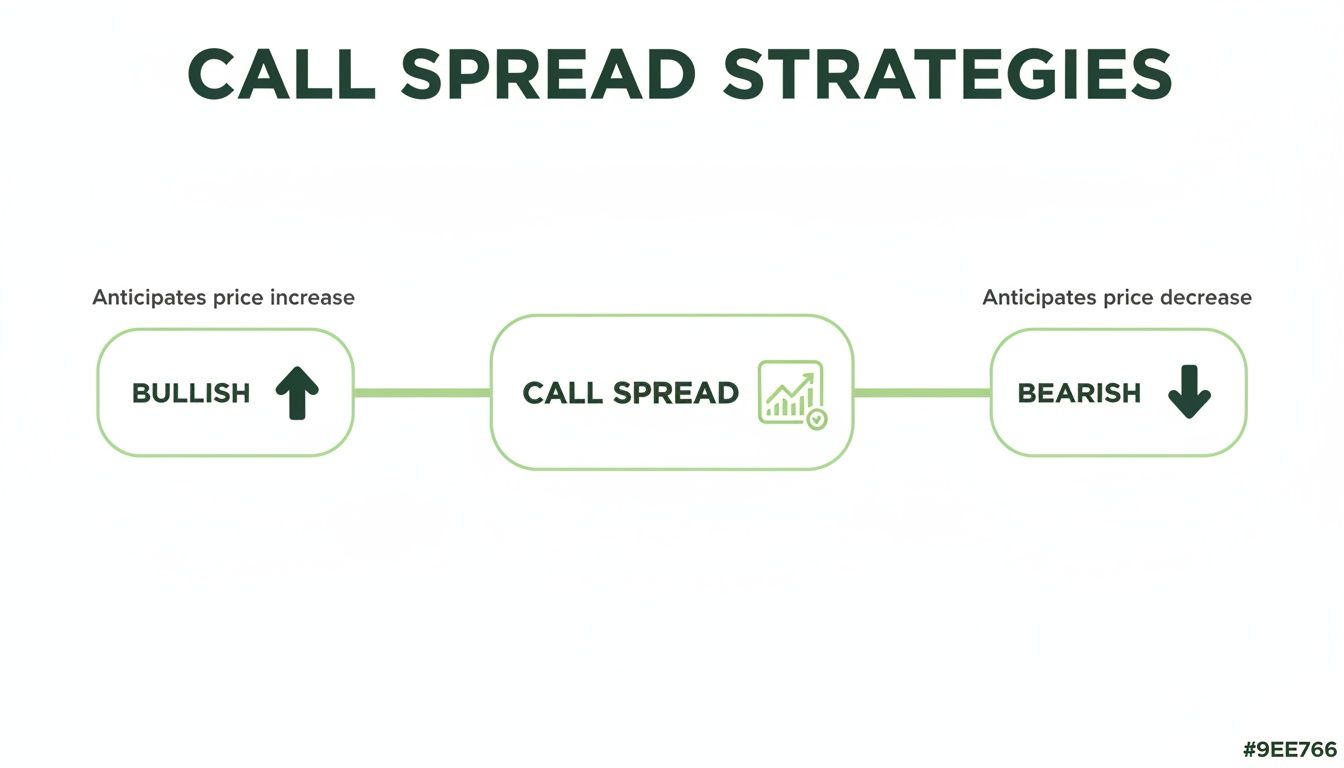
As you can see, call spreads aren't just for bulls. You can set them up for a bearish outlook, too, giving you a defined-risk way to trade your forecast, no matter which way you think the market is headed.
Calculating Your Profit and Loss
Let's walk through a real-world example to see how the numbers play out. Imagine XYZ stock is trading at $102 a share, and you think it has room to climb over the next month. You decide to open a bull call spread:
- Buy to Open: One XYZ $100 call for a $3.50 premium ($350 total).
- Sell to Open: One XYZ $110 call for a $1.00 premium ($100 total).
Your net debit is the difference between what you paid and what you collected: $3.50 - $1.00 = $2.50. This means your total out-of-pocket cost to enter the position is $250.
Key Takeaway: With a bull call spread, your maximum loss is always limited to the initial net debit you paid. In this case, your risk is capped at $250, which gives you a lot more peace of mind than the higher cost of buying a single, unprotected call option.
Finding Your Breakeven Point
So, where do you start making money? Your breakeven price is the point where you cross from red to green. To find it, just add the net debit to the strike price of the call you bought.
- Breakeven Price: $100 (Lower Strike) + $2.50 (Net Debit) = $102.50
If XYZ stock closes anywhere above $102.50 on expiration day, your trade is a winner.
Your maximum profit happens if the stock price closes at or above the higher strike price ($110) at expiration. The profit is simply the difference between the two strike prices, minus your initial cost.
- Maximum Profit: ($110 - $100) - $2.50 = $7.50, or $750 per spread.
This strategy isn't just about managing costs; it can also tilt the odds in your favor. Data from bullish trends between 2020 and 2023 showed that well-structured bull call spreads on S&P 500 stocks had an average probability of profit of 65%. That's a solid improvement over the 55% probability for just buying a single long call.
By capping both risk and reward, the bull call spread gives you a balanced way to trade upward stock movements. If you want to dive deeper into how debit and credit spreads stack up, check out our guide on credit spreads vs debit spreads.
How the Bear Call Spread Works
While the bull call spread is built for rising stocks, the bear call spread is your go-to strategy for the exact opposite. It's a fantastic play when you think a stock is headed for a pullback or just going to trade sideways for a while.
Better yet, this is a credit spread. That means you get paid cash upfront just for opening the position. Your goal is for the stock to stay below a certain price, letting the options you sold expire worthless. If they do, that initial credit is 100% yours to keep.
Constructing the Bear Call Spread
Putting on a bear call spread involves two moves at once, both using call options with the same expiration date.
- Sell to Open: First, you sell a call option with a lower strike price. This is where you collect your premium income.
- Buy to Open: At the same time, you buy another call option with a higher strike price. Think of this as your insurance policy—it caps your potential loss if the stock suddenly takes off.
The absolute most you can make on a bear call spread is the net credit you pocket when you open the trade. You win when both options expire worthless, letting you keep that entire upfront premium.
The sold call is the engine of this trade. To get a better handle on its mechanics, it’s worth learning more about the risks and rewards of a standalone short call option.
A Practical Example of the Bear Call Spread
Let's imagine stock QRS is trading at $48 a share. You're pretty confident it won't break above $50 in the next month, so you decide to set up a bear call spread.
- Sell to Open: One QRS $50 call, for which you collect a $1.80 premium ($180).
- Buy to Open: One QRS $55 call, which costs you a $0.50 premium ($50).
Your net credit is the difference between the cash you brought in and the cash you paid out: $1.80 - $0.50 = $1.30. That translates to an immediate $130 credit to your account. This is also your maximum possible profit on the trade.
Calculating Your Breakeven and Maximum Loss
Your breakeven point is the line in the sand where your profit flips to a loss. To find it, just add the net credit you received to the strike price of the call you sold.
- Breakeven Price: $50 (Short Strike) + $1.30 (Net Credit) = $51.30
As long as QRS closes below $51.30 at expiration, you’ll make money. Your maximum loss kicks in only if the stock rallies past the strike price of the call you bought ($55).
- Maximum Loss: ($55 - $50) - $1.30 = $3.70, or $370 per spread.
This built-in risk protection is what makes the bear call spread so powerful. It’s a smart way to generate income from a neutral-to-bearish outlook, letting you profit from time decay even if the stock doesn't move an inch.
Comparing Call Spreads to Other Strategies
To really see the genius of a call spread, you have to put it side-by-side with other common options trades. Each strategy has its own personality, offering a unique mix of risk, reward, and the amount of cash you need to get started. Comparing them shows you exactly what you gain—and what you give up—when you choose a spread.
This is why so many traders love the defined-risk nature of spreads. Sure, other strategies might dangle the carrot of unlimited profit, but they often come with much higher costs or, worse, unlimited risk. That’s just not a good fit for every trader or every market.
Strategy Comparison: Bull Call Spread vs. Long Call vs. Covered Call
Let's break down how a bull call spread stacks up against buying a single call or writing a covered call. This table gives you a quick, at-a-glance view to help you decide which tool is right for the job.
| Attribute | Bull Call Spread | Single Long Call | Covered Call |
|---|---|---|---|
| Market Outlook | Moderately Bullish | Very Bullish | Neutral to Moderately Bullish |
| Profit Potential | Capped | Unlimited | Capped |
| Risk | Limited to Net Premium Paid | Limited to Premium Paid | High (Potential stock loss) |
| Upfront Cost | Low (Net Debit) | High (Full Premium) | Very High (Cost of 100 shares) |
| Primary Goal | Profit from a modest price rise with low cost and defined risk. | Profit from a significant price rise with high reward potential. | Generate income from existing stock holdings. |
As you can see, the bull call spread occupies a strategic middle ground. It's a capital-efficient way to make a bullish bet without the high cost of a single call or the massive capital outlay of a covered call. It’s all about trading away unlimited upside for a significantly smaller, well-defined risk.
Bull Call Spread vs. Buying a Single Call
The most direct comparison is putting a bull call spread up against simply buying a single long call. Both are bullish bets, but they come from completely different philosophies on risk.
Let's say you think a stock is going to pop. You could just buy a call option, giving you the right to buy the stock at a set price. This move gives you theoretically unlimited profit if the stock goes to the moon. The problem? It costs more upfront, and if you're wrong, you lose 100% of that premium.
A bull call spread offers a smarter trade-off. By selling a higher-strike call against the one you bought, you instantly lower your out-of-pocket cost. This makes the trade cheaper to get into and, crucially, caps your maximum loss to that smaller net premium. The catch, of course, is that you also cap your maximum profit.
The Core Trade-Off: A single long call offers unlimited upside for a higher cost and higher risk. A bull call spread limits your potential profit but dramatically lowers your entry cost and defines your maximum loss from day one.
Bear Call Spread vs. Selling a Naked Call
Now, let's flip to the bearish side. A bear call spread is a world away from selling a "naked" call, which is easily one of the riskiest moves in the options playbook.
When you sell a naked call, you’re selling a call option without owning the 100 shares to back it up. You collect a premium and cross your fingers that the stock stays below the strike price. The terrifying part is what happens if you're wrong—if the stock skyrockets, your potential losses are literally infinite. A surprise rally could wipe you out.
This is where a bear call spread is a lifesaver. By buying a higher-strike call for protection, you put a hard ceiling on your potential loss. No matter how high that stock climbs, your risk is strictly limited to the difference between the strike prices (minus the credit you took in). You still collect a premium, but you can actually sleep at night.
Bear Call Spread vs. a Covered Call
Finally, a bear call spread can be used to generate income, much like a covered call, but with one massive advantage: capital efficiency.
- Covered Call: To run this play, you first have to own 100 shares of the stock. That’s a huge chunk of capital tied up in one position.
- Bear Call Spread: You can open a bear call spread without owning a single share. The only capital required is the margin to cover your maximum potential loss—which is a fraction of the cost of buying 100 shares.
This makes the bear call spread an incredibly efficient way to earn income from a neutral-to-bearish outlook without locking up a huge amount of cash in stock.
While we've focused on call spreads here, they're just one piece of the puzzle. To see how they fit into the bigger picture, it’s worth exploring other common options trading strategies.
Key Factors That Influence Your Call Spread

Knowing the basic setup of a call spread is one thing. Actually trading them well means understanding the market forces working for—or against—you.
Three variables are the real engine of your trade: time decay, implied volatility, and the width of your strikes. Master these, and you'll have a serious edge. These aren't just textbook terms; they directly hit your spread's price and its odds of finishing in the money.
The Impact of Time Decay (Theta)
Time is a huge factor in any options trade, and we measure its effect with a metric called Theta. Think of Theta as a slow, steady leak in an option's value. Every single day that passes, an option loses a tiny bit of its worth, even if the stock price doesn't budge.
Whether this daily decay helps or hurts your call spread depends entirely on the type of spread you're running.
- Bear Call Spread (Credit): Time decay is your best friend. You collected a premium to open the trade, so your goal is for the options to lose value and expire worthless. Theta is what makes that happen, chipping away at the spread’s value each day.
- Bull Call Spread (Debit): Time decay is the enemy. You paid to get into the trade, so you need the spread to gain value. Theta works against you here, slowly eroding your position's value and making it that much harder to turn a profit.
Understanding Implied Volatility (Vega)
Implied volatility, or IV, is the market’s best guess on how much a stock’s price will swing in the future. It’s basically a measure of uncertainty. When IV is high, options get more expensive. When it's low, they get cheaper.
This has a massive effect on call spreads. High volatility can jack up the price of long calls by 30-50%, completely changing the math on a debit spread.
But you can also use volatility to your advantage. High IV means you can collect a much larger premium when you sell a bear call spread, boosting your potential profit if you're right. To learn more, check out these insights on how volatility impacts options pricing from InsiderFinance.io.
Key Insight: For a bear call spread, sell when implied volatility is high to pocket a bigger premium. For a bull call spread, buy when implied volatility is low to keep your entry cost down.
The Role of Strike Width
The distance between your long and short strike prices is the final piece of the puzzle. It’s what directly controls your risk-reward profile. Think of adjusting the "width" like changing gears on a bike—you can go for slow and steady or fast and risky.
- Narrow Spreads: Spreads with strikes close together (like $100 and $105) have a lower maximum profit, but they also limit your maximum loss. These are the more conservative plays.
- Wider Spreads: Spreads with strikes far apart (like $100 and $115) offer a much higher potential profit, but they also come with a bigger potential loss—and a higher upfront cost for debit spreads.
Choosing the right width lets you tailor the trade to your exact risk tolerance. It's the ultimate control knob for your call spread, letting you decide precisely how much you’re willing to put on the line for a specific potential return.
Common Questions About Call Spreads
Even after you get the hang of the mechanics, a few practical questions always pop up when you're about to place your first real call spread trade. Let's walk through them so you can trade with confidence and avoid some common rookie mistakes.
When Is the Best Time to Use a Call Spread?
This all comes down to your read on the market. There's no single "best" time, just the right time for the right strategy.
A bull call spread is your go-to when you're feeling moderately bullish on a stock. You think it’s going to go up, but you're not expecting an explosive, moonshot rally. It's a fantastic, low-cost way to get in on that expected move without a huge upfront investment.
A bear call spread shines when you're moderately bearish or even just neutral. Maybe you think a stock will just chop around sideways or drift down a bit. This strategy lets you collect premium and generate income from your belief that the stock will stay below a certain price.
What Happens If My Short Call Is Assigned Early?
Early assignment is a real possibility, especially if your short call gets deep in-the-money as you get closer to expiration. If it happens, you'll suddenly find yourself short 100 shares of the stock for every contract assigned.
But don't panic. Your long call is your built-in safety net. You can almost always fix the situation by simply exercising your long call, which gets you the shares you need to cover that short stock position. Another option is to just close out the entire spread. Most modern brokers are very good at handling this and won't let you end up in a risky naked short position.
Can I Close a Call Spread Before Expiration?
Absolutely—and most of the time, you probably should. The vast majority of experienced traders close their spreads before the final bell rings on expiration day.
Treating this as a core part of your risk management lets you lock in profits or cut your losses without dealing with the chaos of the last day. For a bull call spread, you'd sell the spread once it's gained value. For a bear call spread, you'd buy it back for less than the credit you pocketed upfront. Closing early is how you avoid last-minute price swings and assignment headaches.
Ready to trade call spreads with more confidence? Strike Price gives you real-time probability metrics for every strike, helping you balance safety and premium income. Make smarter, data-driven decisions and stop guessing. Get started with Strike Price today.