
Long Call and Short Put The Ultimate Synthetic Stock Guide
If a stock moves past your strike, the option can be assigned — meaning you'll have to sell (in a call) or buy (in a put). Knowing the assignment probability ahead of time is key to managing risk.
Posted by
 John Clarke
Related reading
A Step-by-Step Covered Calls Example for Consistent Income
Unlock consistent income with our step-by-step covered calls example. This guide breaks down the strategy, risks, and outcomes to help you trade confidently.
What is a Call Spread? A Clear Guide to Bull and Bear Spreads
What is a call spread? Discover how bull and bear spreads limit risk and sharpen your options trading strategy.
A Guide to the Covered Call Options Strategy for Income
Learn the covered call options strategy with our step-by-step guide. Discover how to generate consistent income, manage risk, and make data-driven decisions.
Ever heard of a long call and short put? On their own, they're standard options trades. But when you combine them, you create something powerful: a "synthetic long stock" position. It’s a clever way to perfectly mimic the risk and reward of owning 100 shares of a stock, often without the hefty price tag.
For traders looking to express a bullish view with more efficiency, this strategy is a game-changer.
Unlocking Stock Ownership Without the Stock
Let's say you want to own 100 shares of a stock trading at $200. That’s a $20,000 commitment right out of the gate. But what if you could get the exact same profit and loss profile for just a fraction of that cost? That's the whole idea behind a synthetic long stock.
Here's how it works: you simultaneously buy a call option and sell a put option, both with the same strike price and expiration date. The result is a position that behaves just like owning the underlying shares. You get the same unlimited upside if the stock rallies and take on similar downside risk if it falls.
This completely changes how you can approach market exposure. Instead of tying up a huge chunk of your capital in one stock, you can use the nimbleness of options to get the job done. It's especially useful for:
- Capital Efficiency: Get exposure to high-priced stocks without needing a massive upfront investment.
- Strategic Flexibility: Jump in and out of a stock-like position with the liquidity of the options market.
- Risk Management: Your entry point and potential obligations are clearly defined from the very beginning.
Combining a long call and short put creates a synthetic long stock position. It mimics the payoff of owning shares outright but with much lower capital needs. When you use the same strike and expiration, this duo replicates long stock exposure, giving you unlimited upside while setting your effective purchase price. The team at tastylive has a great piece on how these positions stack up.
In essence, you're agreeing to buy the stock at the strike price (the short put) while also owning the right to buy it at that same price (the long call). The two positions work in tandem to create a single, powerful trade. If you're new to this, getting a handle on how options trading works is a fantastic starting point before diving deeper.
Understanding Each Piece of the Puzzle

Before we can see how a long call and short put work together, we need to break them down and understand what they do on their own. Each has its own purpose, risk profile, and market outlook. Think of them as individual ingredients that, when combined correctly, create a powerful new recipe for expressing a bullish view.
First up is the long call, probably the most straightforward bullish trade in the options playbook. When you buy a call option, you’re buying the right, but not the obligation, to purchase 100 shares of a stock at a set price — the strike price — before it expires.
You pay a premium for this right, and that premium is the absolute most you can lose. It's like putting a non-refundable deposit on a house you think is about to jump in value. If the price skyrockets, you get to buy it for cheap. If it doesn't, you only lose your deposit.
The Long Call: A Bet on the Upside
A long call is a pure play on a stock's upward momentum. Your profit potential is, in theory, unlimited because there’s no ceiling on how high a stock can go. The catch? Time is working against you.
- Premium Dynamics: The cost of the call (the premium) is your total risk. For the trade to turn a profit, the stock needs to climb above your strike price plus the premium you paid.
- Time Decay: Every single day that goes by, the option bleeds a little bit of value. This is called time decay, or theta. So, the stock doesn't just need to go up; it needs to do it before the clock runs out.
- Best Use Case: Traders jump on long calls when they expect a big, relatively quick move higher in a stock's price.
The Short Put: An Obligation for Income
Now, let's flip the script and look at the short put. When you sell a put, you take on the obligation to buy 100 shares of a stock at the strike price if the option owner decides to exercise it. For taking on this commitment, you get paid a premium right upfront.
This is also a bullish strategy, just a more conservative flavor of it. A put seller is betting the stock will stay above the strike price until expiration. If it does, the option expires worthless, and they pocket the entire premium as profit.
Think of it like telling your neighbor you'll buy their car for $10,000 if they can't sell it for more by next month, and they pay you $200 for that guarantee. If they find a better offer, you just keep the $200. If not, you have to buy the car for $10,000, just like you promised.
A key distinction lies in rights versus obligations. A long call gives the buyer control and the right to act, capping their risk at the premium paid. A short put requires the seller to take on an obligation in exchange for income, with a risk profile similar to owning stock.
The mechanics of a short put are totally different from a long call:
- Premium Dynamics: The premium you collect is your maximum potential profit. You’re getting paid to take on risk.
- Risk Profile: Your downside is substantial. You could be forced to buy a stock at the strike price even if it has cratered far below that value in the open market.
- Time Decay: Here, time decay is your best friend. Every day that passes makes the option you sold a little less valuable, bringing you one step closer to keeping the full premium.
With these two components defined, we can now dig into the fascinating relationship that allows a long call and a short put to perfectly mimic owning the stock itself.
How Two Options Replicate One Stock
At the heart of the long call and short put strategy is a powerful concept called put-call parity. This isn't just some abstract financial theory; it’s the mathematical engine that proves combining these two options creates a position that behaves exactly like owning stock. It’s the formula that powers the “synthetic” magic.
Put-call parity shows that a call option's value, minus a put option's value at the same strike, is financially equivalent to the stock price minus the strike price. In plain English, it means you can perfectly mirror the financial outcome of owning 100 shares by using a specific combination of options, often for a fraction of the cost.
This relationship allows a trader to create a "synthetic" long stock position with a risk/reward profile that is identical to holding 100 shares, all without the huge capital outlay.
A Step-by-Step Numerical Example
Let's make this real. Imagine a stock, let's call it Stock A, is currently trading at exactly $100 per share. You're bullish and want the same exposure as owning 100 shares.
Instead of shelling out $10,000 (100 shares x $100), you decide to use a long call and short put combo. You find options that expire in 30 days, both with a strike price of $100.
- You buy one $100 call option for a premium of $2.50, which is a $250 cost.
- You sell one $100 put option for a premium of $2.50, which gives you a $250 credit.
The cost of the call is perfectly canceled out by the credit from the put. This means you enter the position for a $0 net cost (excluding commissions). This is often called a zero-cost synthetic. Now, let’s see how this position actually performs.
The core idea is simple: the obligation you take on with the short put (to buy at $100) is balanced by the right you own with the long call (to buy at $100). Together, they lock you into the financial performance of the stock at that strike price.
Comparing Synthetic Stock vs. Real Stock at Expiration
So, how does this synthetic position really stack up against just owning the stock? The proof is in the profit and loss (P&L).
The table below breaks down the P&L at various stock prices when the options expire. Take a close look at the last column—it perfectly matches the P&L of owning 100 shares outright.
Synthetic Long Stock vs Owning Stock A P&L Comparison
This table illustrates how the profit and loss of a synthetic long position (Long Call + Short Put) mirrors owning 100 shares of the underlying stock at different price points upon expiration.
| Stock Price at Expiration | Long Stock P&L (100 shares @ $100) | Long $100 Call P&L | Short $100 Put P&L | Synthetic Position Total P&L |
|---|---|---|---|---|
| $90 | -$1,000 | -$250 (expires worthless) | -$750 (put is worth $10) | -$1,000 |
| $95 | -$500 | -$250 (expires worthless) | -$250 (put is worth $5) | -$500 |
| $100 | $0 | -$250 (expires worthless) | +$250 (expires worthless) | $0 |
| $105 | +$500 | +$250 (call is worth $5) | +$250 (expires worthless) | +$500 |
| $110 | +$1,000 | +$750 (call is worth $10) | +$250 (expires worthless) | +$1,000 |
As you can see, whether the stock finishes at $90 or $110, your financial outcome is identical. The unlimited upside potential and the downside risk are perfectly mirrored. Understanding this P&L equivalence is the key to appreciating why Delta in option trading for this synthetic position is always close to 1.0, just like owning stock.
This capital efficiency has made synthetic long stock a popular bullish strategy, especially in major indices. For example, CBOE data reveals explosive growth in related SPX options volume, hitting 4.2 million contracts daily by 2023. Backtests on SPY further confirm that these positions matched the P&L of long stock 94% of the time over a 20-year period but used 85% less capital. You can learn more about these options market statistics on the CBOE website.
Synthetic Stock vs. Real Stock: What's the Difference?
A synthetic long stock position perfectly mirrors the profit and loss of owning shares, but don't be fooled—the day-to-day experience is completely different. Deciding whether to build a synthetic position with a long call and short put or just buy the stock outright comes down to a few critical factors that impact your capital, risk, and overall strategy.
Getting a handle on these distinctions is crucial. You're not just trying to copy a P&L chart; you're picking the right tool for the job based on your own financial goals and trading style.
This infographic gives you a quick visual breakdown of the P&L dynamics between owning the stock and holding its synthetic twin.
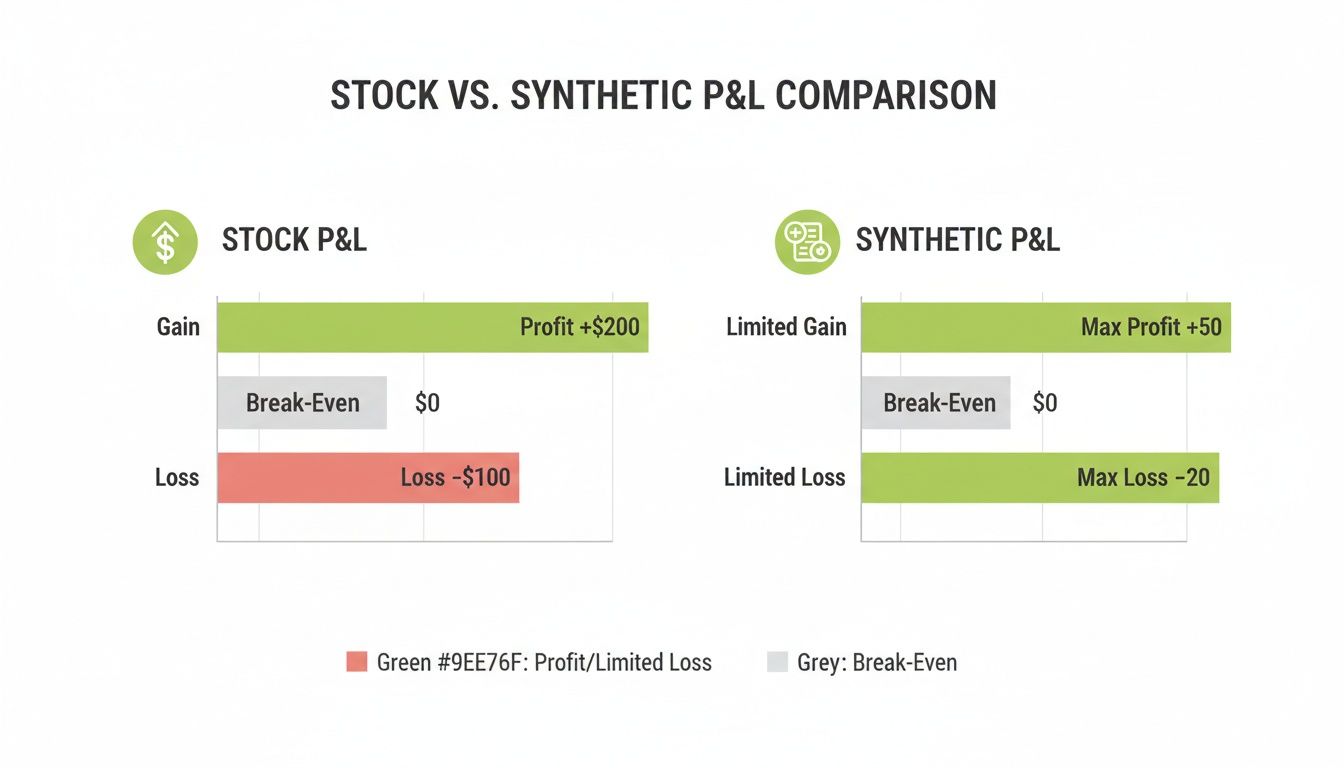
As you can see, the financial outcome is identical. But the mechanics behind them—options versus direct ownership—introduce some major strategic trade-offs.
Capital Efficiency and Margin Requirements
The biggest draw for a synthetic position is its incredible capital efficiency. Buying 100 shares of a $200 stock will set you back a cool $20,000 in cash. But setting up the synthetic version? It often requires little to no cash upfront, especially if the premium you collect from the short put covers the cost of the long call.
This frees up a huge chunk of capital you can use for other trades or just keep on the sidelines. But there’s a catch, and its name is margin.
Because that short put carries an obligation to buy 100 shares at the strike price, your broker is going to require you to keep a certain amount of capital in your account as collateral. This margin requirement is still way less than the cost of buying the stock, but it's something you absolutely have to manage.
Dividends and Ownership Rights
This one's straightforward but a dealbreaker for some. When you own shares, you're a part-owner of the company. That means you get paid any dividends and have a say through voting rights.
A synthetic long stock position, built from a long call and short put, does not confer any of the rights of a shareholder. You will not receive dividends, and you cannot vote at shareholder meetings.
If you're an income investor relying on those quarterly dividend checks, this is a massive downside. Plus, when a stock pays a dividend, its price is expected to drop by the dividend amount, which can hurt the value of your long call. It's a key detail to remember when trading options on dividend-paying stocks.
Assignment Risk and Expiration Dates
Owning stock is simple—you can hold it forever if you want. Options, on the other hand, have a ticking clock. They come with expiration dates, adding a whole new layer of management. You always need to know when your long call and short put contracts expire.
The short put also introduces assignment risk. At any time, the person who bought the put from you can exercise their right, forcing you to buy 100 shares at the strike price. Sure, this just converts your position into the stock you were mimicking, but it can happen without warning and requires you to have the capital ready to go.
To really appreciate the unique trade-offs of a synthetic position, it helps to understand how to invest in real stocks in the first place.
Ultimately, it comes down to what you're trying to achieve. Are you a long-term investor who values simplicity and dividends? Or are you an active trader looking to maximize capital efficiency and leverage the strategic power of options? Your answer will point you in the right direction.
When to Use the Synthetic Long Stock Strategy
Knowing that a long call and short put can mimic owning stock is one thing. Knowing exactly when to use this powerful combo is what separates serious traders from hobbyists. The synthetic long isn't just a clever financial maneuver—it's a flexible tool for solving real problems with capital, risk, and portfolio management.
This strategy really comes alive when buying the stock outright is either too expensive or doesn't fit the risk profile you’re looking for. It’s a way to act on a strong bullish hunch with far greater efficiency, turning a massive capital outlay into a nimble, manageable position.
Gaining Exposure to High-Priced Stocks
One of the best reasons to go synthetic is to get exposure to expensive, high-growth stocks without tying up a ton of cash. Let's say you're bullish on a company like NVIDIA or another tech giant that trades for hundreds of dollars a share.
Buying just 100 shares could easily lock up $50,000 or more. For many traders, that's way too much concentration in a single stock.
Instead of deploying all that capital, you can build a synthetic long. This lets you capture the exact same upside if the stock takes off, but the capital you have at risk is often just a fraction of the cost of the shares themselves. This efficiency is a game-changer. It allows you to:
- Ride the growth of market leaders without over-allocating your funds.
- Free up cash for other trades, which helps with diversification.
- Get leveraged-style returns on the margin capital required for the position.
It’s an especially smart move when you believe in a fundamentally strong but pricey company that's just had a bit of a pullback.
Managing an Existing Short Put Position
Another great use case is when you already have half of the position in place. Imagine you sold a cash-secured put on a stock you'd be happy to own, aiming to pocket the premium. But then, the stock starts rallying—hard.
Your short put is making money, but your profit is capped at the premium you collected. You’re stuck watching the stock soar without you, missing out on all that upside. This is the perfect moment to "leg in" to a synthetic long.
By simply buying a long call with the same strike and expiration as your short put, you instantly transform your trade. It goes from a simple income play to a position with unlimited profit potential. You’ve just converted a capped-gain strategy into a full-blown bullish position that can ride the rally for as long as it lasts.
This strategic tweak—adding a long call to an existing short put—is a common way traders adapt on the fly. It lets you pivot from a neutral-to-bullish income strategy to an aggressively bullish one without having to close your original trade.
Defining Your Risk with Precision
Finally, the synthetic long offers a unique way to think about risk. While the downside is theoretically the same as owning the stock, the structure forces you to be more deliberate about your entry point and maximum loss. Understanding the underlying asset's conditions, including its market volatility, is key to figuring out the best time to put on this trade.
When you create the position, you're effectively setting your purchase price at the strike. If the stock drops, your loss is calculated from that strike price (minus any net credit you received). That clarity can be a huge psychological plus compared to buying shares in a falling market, where the urge to "average down" can lead to accidentally building a much larger—and riskier—position. The synthetic structure gives you a clear line in the sand right from the start.
Executing the Strategy with Confidence
Understanding the theory behind a long call and short put is one thing; putting it into practice with real money is another. Success comes down to data-driven execution, not guesswork. The right tools can transform this process from a shot in the dark into a clear, strategic exercise that fits your financial goals.
This is especially true when choosing the strike for the short put. That decision directly sets the premium you’ll collect and your odds of being assigned the stock. Relying on gut feelings here is just asking for trouble.
Using Probabilities to Select Your Short Put
The best way to nail down your short put strike is by looking at the numbers—specifically, the probability metrics. These stats give you a real edge, showing the statistical likelihood that the stock will end up below your strike when the contract expires.
For instance, you could sell a put with a 70% chance of expiring worthless (out-of-the-money). This is a pretty safe bet, but the premium you collect will be smaller. Or, you could aim for a bigger payout by selling a put with only a 40% probability of expiring worthless, but that comes with a much higher risk of assignment.
Data-driven tools help you find that perfect balance between income and risk. You can weigh the premium you want against the assignment risk you’re willing to take, moving beyond simple price charts to make smarter, probability-based choices.
If you want to get even deeper into the mechanics of this leg of the trade, check out our detailed guide on crafting a powerful sell put options strategy.
Setting Up Smart Alerts and Screeners
Once your trade is live, you can't just set it and forget it. But you don't have to be glued to your screen, either. Smart alerts can do the heavy lifting for you, sending a notification if the stock price starts moving against you. You could set an alert if the share price drops near your short put strike, giving you a heads-up to manage the position before it becomes a real problem.
A good dashboard, like the one below, lets you see all the key metrics for your open positions in one place.
This kind of consolidated view makes it easy to track assignment probabilities and total premium without having to jump between multiple tabs or apps.
Even better, you can use screeners to find the best opportunities right from the start. A good screener can sift through thousands of options contracts based on the rules you set, such as:
- Minimum Premium: Find trades that actually meet your income goals.
- Probability Thresholds: Filter for options that match your personal comfort zone for risk.
- Days to Expiration: Focus only on opportunities within your preferred timeframe.
By using these tools for both your long call and short put legs, you ensure every part of your synthetic strategy is built on a solid foundation of data, not just hope.
Common Questions About Synthetic Longs
As you start working with the long call and short put strategy, a few practical questions always come up. Getting clear on assignment, capital, and how time affects your position will help you trade with more confidence. Here are the answers to what traders usually ask.
What Happens if I Get Assigned on the Short Put?
If the stock price dips below your strike, you might get assigned on your short put. This isn't a disaster—it's actually part of the strategy's design.
Assignment just means you're now obligated to buy 100 shares of the stock at the strike price. Your synthetic position simply flips into actual stock ownership. Your long call is still active, but now you own the shares with a cost basis equal to the strike price (minus any net premium you collected). You wanted to own the stock, and now you do.
Is a Synthetic Long Position Better Than Buying Stock?
That depends entirely on what you’re trying to achieve. The synthetic long is dramatically more capital-efficient, which is its main draw for active traders. It frees up cash that would otherwise be locked into owning shares.
But it's a trade-off. You won't collect dividends, and you have to stay on top of the options' expiration dates.
- For long-term investors who want dividends and simplicity, just buying the stock is usually the better move.
- For traders focused on leverage and making their capital work harder, the synthetic position often comes out on top.
Think of a synthetic long as a tool for strategic exposure, not passive ownership. It shines when you want to maximize your capital's impact on a bullish idea, while direct stock ownership is built for a long-term, dividend-generating portfolio.
Can I Create This Position for a Net Credit?
Yes, it’s possible, though it's less common when using at-the-money strikes. You'd get a net credit if the premium you collect from selling the put is higher than the premium you pay for the call.
This scenario is more likely during periods of high implied volatility or if you use different strike prices—a setup known as a risk reversal. Just remember that collecting a credit changes your cost basis and the overall risk profile of the position.
Ready to stop guessing and start making data-driven options trades? Strike Price provides real-time probability metrics and smart alerts to help you find the best covered call and secured put opportunities. Turn your trading into a strategic, income-generating process.