
A Trader's Guide to Options Extrinsic Value
If a stock moves past your strike, the option can be assigned — meaning you'll have to sell (in a call) or buy (in a put). Knowing the assignment probability ahead of time is key to managing risk.
Posted by
 John Clarke
Related reading
A Step-by-Step Covered Calls Example for Consistent Income
Unlock consistent income with our step-by-step covered calls example. This guide breaks down the strategy, risks, and outcomes to help you trade confidently.
Long Call and Short Put The Ultimate Synthetic Stock Guide
Unlock the power of the long call and short put strategy. This guide explains how synthetic long stock works, its benefits, risks, and how to execute it.
What is a Call Spread? A Clear Guide to Bull and Bear Spreads
What is a call spread? Discover how bull and bear spreads limit risk and sharpen your options trading strategy.
Options extrinsic value is the part of an option's price that isn't tied to its immediate, tangible worth. Think of it as the premium you pay for the possibility of a future profit, driven by factors like time and market jitters.
In short, it’s the difference between an option's market price (what you pay) and its intrinsic (or real) value.
Decoding an Option's True Potential

Imagine buying a ticket to the Super Bowl months in advance. The ticket has a face value—that’s its intrinsic worth. But you might pay a little extra, a premium, for the chance your favorite team makes it to the final, which would make that ticket way more valuable. That extra bit you paid? That’s the extrinsic value.
In the world of options, this value isn't just a guess; it's a calculated premium that boils down to two key things:
- Time Until Expiration: More time means more opportunity for the stock price to make a big move in your favor.
- Implied Volatility (IV): This is the market's forecast of how much a stock's price might swing. More uncertainty means a higher extrinsic value.
This premium, built on hope and uncertainty, is why an option's total price is often higher than its immediate, calculable value. To see how this stacks up against an option's real, in-the-money worth, check out our deep dive on the core differences between intrinsic vs extrinsic option value.
For a quick reference, here’s a simple table breaking down the two core components of an option's premium.
Intrinsic vs Extrinsic Value At a Glance
| Component | Definition | What It Represents | Example (Stock at $100) |
|---|---|---|---|
| Intrinsic Value | The amount an option is currently in-the-money. | The option's real, tangible worth if exercised now. | A $95 call has $5 of intrinsic value. A $105 call has $0. |
| Extrinsic Value | The portion of the premium above its intrinsic value. | The "time and volatility" premium traders pay for potential. | A $95 call trading for $7 has $2 of extrinsic value. |
This table makes it clear: intrinsic value is about what is, while extrinsic value is about what could be.
The Role of Time and Market Sentiment
That extrinsic part of an option's premium is always in flux. For at-the-money options with over 60 days left, it's not unusual for extrinsic value to make up 80-90% of the entire premium.
But as expiration looms, this value melts away fast. Historical data shows that in the final few weeks, extrinsic value might only account for 20-30% of the premium as time decay kicks into high gear. This is a big reason why roughly 70% of options expire worthless.
An easy way to think about it: Extrinsic value is the speculative part of an option's price. It's the amount you pay for the potential of the option to become profitable, not for any profit it currently holds.
Calculating Extrinsic Value
The formula to pinpoint this value is beautifully simple. It strips away the tangible worth to show you the pure premium attached to time and volatility.
Extrinsic Value = Option Premium – Intrinsic Value
Let’s run a quick example. Say a stock is trading at $52. A call option with a $50 strike price is selling for a premium of $3.50.
- First, the intrinsic value is $2.00 (the $52 stock price minus the $50 strike price).
- So, the extrinsic value is $1.50 (the $3.50 premium minus the $2.00 intrinsic value).
That $1.50 is what traders are willing to pay for the chance the stock climbs even higher before the option expires. For those of us selling options, this decaying premium is exactly where we make our money.
The Two Main Drivers of Extrinsic Value
An option's extrinsic value doesn't just materialize out of thin air. It’s a premium driven by two powerful market forces: time to expiration and implied volatility.
Getting a handle on these is crucial. They dictate the size of the premium you can collect as a seller or the headwind you face as a buyer. Think of them as the key ingredients in a recipe—the amount of each you add directly changes the final result.
Let’s break down how each one works.
Time: The Opportunity Window
Time is the most straightforward component of extrinsic value. The more time an option has until it expires, the higher its extrinsic value will be, all else being equal.
This makes perfect sense. A longer timeframe gives the underlying stock a wider window of opportunity to make a big move. If you buy a lottery ticket for a drawing six months from now, it feels like it holds more potential than one for a drawing in five minutes. More time just equals more chances for things to happen.
This "time premium" is best visualized as a melting ice cube.
An option starts its life with a full block of extrinsic value. With each passing day, a little bit melts away. As expiration gets closer, that melting speeds up until, at the final moment, the cube is gone. All that’s left is any intrinsic value the option might have.
This melting effect, known as theta decay, is exactly what options sellers count on to generate income.
Implied Volatility: The Market’s Anxiety Meter
If time is the opportunity window, implied volatility (IV) is the market's forecast for how wild the weather will be during that window. It’s not a guarantee, but it reflects the market’s collective guess about how much a stock’s price will swing in the future.
High IV acts like fuel on the fire for extrinsic value. When the market expects big moves—think earnings reports, product launches, or Fed announcements—uncertainty spikes. This "anxiety" inflates the premium on options because the potential for a huge price swing is much higher. Traders are willing to pay up for the chance to catch that move.
To see how these two forces play off each other, let's look at a quick example. Imagine stock XYZ is trading at $100, and we’re looking at two at-the-money call options with a $100 strike price.
- Option A: Expires in 10 days with low IV. Its extrinsic value might be $1.20.
- Option B: Expires in 60 days with high IV (right before an earnings report). Its extrinsic value could be $5.50.
Both options have zero intrinsic value, but Option B is over four times more expensive. That massive difference comes purely from the extra time on the clock and the market’s heightened expectation of volatility. As an option seller, spotting these differences is how you find the best opportunities to collect premium.
Understanding Theta and Time Decay
If extrinsic value is the "hope" premium baked into an option, then Theta is the quiet, relentless force that eats away at the "time" part of that value. Think of it as a countdown timer on every option's life, constantly ticking down.
For option buyers, Theta is a tough headwind, making their positions worth a little less every single day. But for option sellers? Theta is their best friend—a reliable tailwind that helps push trades toward profitability. When you sell an option, you're letting this natural erosion of time work for you. That daily decay is exactly what income strategies are built to capture.
The chart below shows how time and volatility both play a role in an option's extrinsic value.
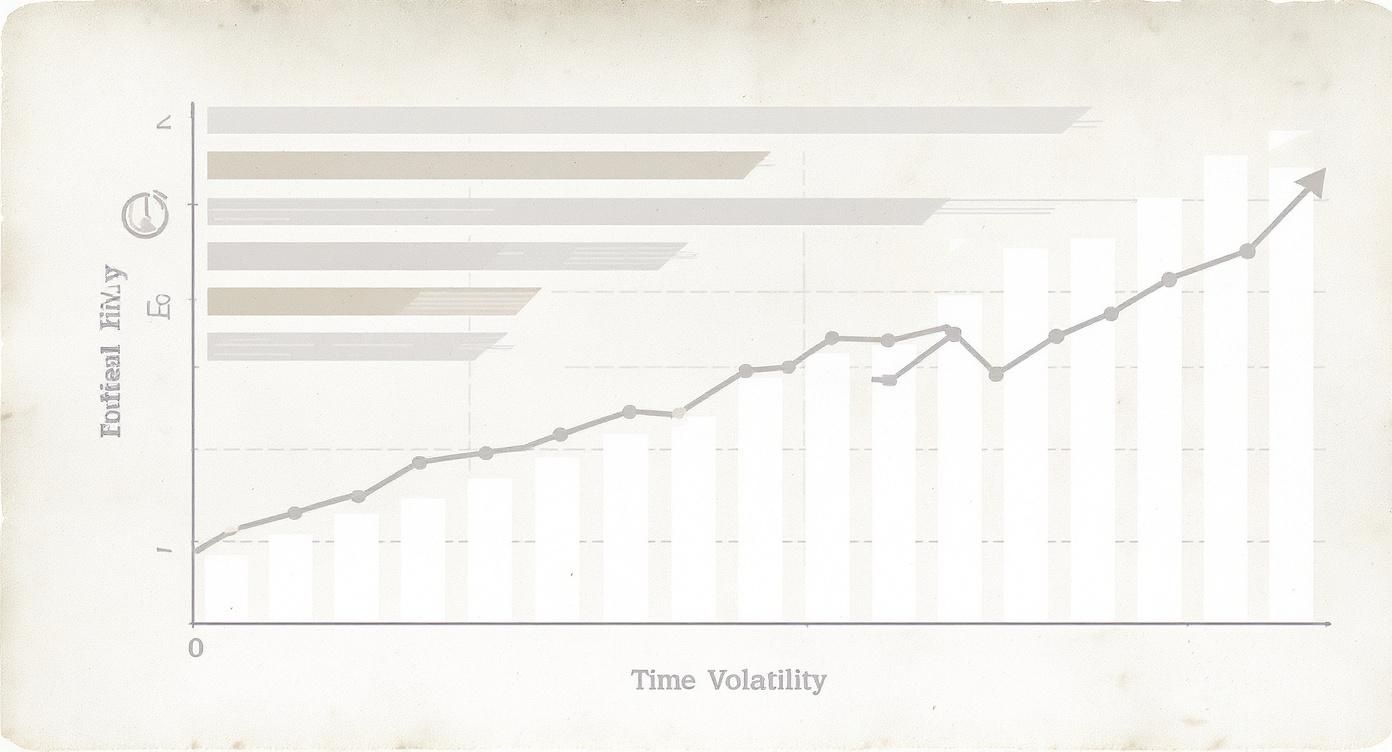
While volatility can make extrinsic value jump up and down, time decay applies constant downward pressure as an option gets closer to its expiration date.
The Acceleration of Time Decay
Here’s one of the most important things to understand about Theta: its effect isn't linear. Time decay doesn't just chip away a fixed amount of value each day. It speeds up, like a ball rolling down a hill.
At the top of the hill, when an option has plenty of time left, the ball moves slowly. An option with 90 days or more until expiration loses very little value day-to-day. But as it nears the bottom—the expiration date—the ball picks up serious speed. The decay gets far more aggressive, hitting its peak in the final 30-45 days of an option's life.
This non-linear decay is the secret sauce for premium-selling strategies. The goal isn't just to collect any premium; it's to collect it when it's decaying at the fastest possible rate. This maximizes your return in a shorter amount of time.
This is why you don’t see many experienced sellers writing options months and months out. The daily decay is just too slow to be worth it.
Why the 30-45 Day Window Is Key
The dramatic speed-up of time decay in the last month or so of a contract's life creates a strategic sweet spot for sellers. This is the period where you can collect a decent premium that will then evaporate at an accelerated pace.
- Options with 30-45 DTE (Days to Expiration): This is often called the ideal window. It offers a great balance between receiving a worthwhile premium and benefiting from that rapidly increasing Theta.
- Options with Under 21 DTE: The decay is incredibly fast here, which sounds great. The catch is that the premium you collect is usually smaller, and your position is much more sensitive to any sudden price swings, which adds risk.
By targeting that specific 30-45 day window, sellers position themselves to capture the most aggressive phase of extrinsic value erosion. For a deeper dive into how this all works, check out our complete guide on time decay in options. Getting a handle on this dynamic is fundamental to consistently generating income from selling covered calls and cash-secured puts.
How Strike Price Affects Extrinsic Value
While time and volatility pump up an option's extrinsic value, the strike price is what determines where that value is most concentrated. Not all strike prices are created equal—their relationship to the current stock price plays a huge role in how much "hope premium" is baked into an option's price.
Think of it like betting on a close football game. The most excitement, and therefore the highest betting odds, centers around the teams that are neck and neck. That’s the tipping point where the outcome is most uncertain. Options work the same way. The strike price closest to the current stock price holds the most uncertainty about whether it will finish in the money or out of the money.
This peak uncertainty translates directly into peak extrinsic value.
The At-the-Money Sweet Spot
At-the-money (ATM) options—those with strike prices right around the current stock price—consistently carry the most extrinsic value. This is the battleground where the bulls and bears are most evenly matched.
An ATM option has roughly a 50/50 shot of expiring worthless or finishing in-the-money. Traders are willing to pay the highest premium for this toss-up because the potential for the stock to swing in either direction is at its maximum. This is precisely why sellers looking to capture premium often gravitate toward ATM or near-the-money strikes.
As an option moves away from this central point, the outcome becomes more predictable, and the extrinsic value starts to shrink. To really get this, it helps to understand the different states an option can be in. You can learn more about how strike price placement works in our guide explaining what moneyness is in options trading.
How Value Fades from the Middle
As an option’s strike moves away from the at-the-money point, its extrinsic value systematically drops off. This happens whether it moves deeper in-the-money (ITM) or further out-of-the-money (OTM).
- Deep In-the-Money (ITM) Options: For these options, the outcome is almost a foregone conclusion. Their premium is nearly all tangible, intrinsic value. There’s very little "hope" or uncertainty left to pay for, so the extrinsic value is minimal.
- Far Out-of-the-Money (OTM) Options: These are the long shots. While their premium is 100% extrinsic value, the actual dollar amount is tiny. The probability of these options ever becoming profitable is so low that traders are only willing to pay a pittance for that slim chance.
In essence, extrinsic value is the market's price for uncertainty. The more uncertain the outcome (ATM), the higher the price. The more certain the outcome (deep ITM or far OTM), the lower the price.
Visualizing Extrinsic Value Across Strikes
To make this concept crystal clear, let’s look at how extrinsic value changes for a stock trading at exactly $100. The table below lays out some sample premiums for both calls and puts at different strike prices, breaking down how much of the price is real (intrinsic) versus speculative (extrinsic).
Extrinsic Value Across Different Strike Prices (Stock Price $100)
| Strike Price | Option Type | Moneyness | Sample Premium | Intrinsic Value | Extrinsic Value |
|---|---|---|---|---|---|
| $90 | Call | ITM | $11.10 | $10.00 | $1.10 |
| $95 | Call | ITM | $6.80 | $5.00 | $1.80 |
| $100 | Call | ATM | $3.50 | $0.00 | $3.50 |
| $105 | Call | OTM | $1.50 | $0.00 | $1.50 |
| $110 | Call | OTM | $0.45 | $0.00 | $0.45 |
| $90 | Put | OTM | $0.35 | $0.00 | $0.35 |
| $95 | Put | OTM | $1.30 | $0.00 | $1.30 |
| $100 | Put | ATM | $3.40 | $0.00 | $3.40 |
| $105 | Put | ITM | $6.70 | $5.00 | $1.70 |
| $110 | Put | ITM | $11.05 | $10.00 | $1.05 |
Notice how the extrinsic value peaks right at the $100 strike for both calls and puts, then tapers off as you move away in either direction. Understanding this distribution is a game-changer for sellers who want to maximize the premium they collect for the risk they're taking on.
Putting Extrinsic Value to Work: Trading Strategies
Knowing the theory is one thing, but making it work for your portfolio is another. This is where we shift from understanding extrinsic value to actively capturing it.
When you sell an option, you're putting yourself in a position to collect that premium as it naturally melts away. It’s less about making a huge bet on a stock's direction and more about systematically generating income from the predictable passage of time.
Let's walk through the two foundational strategies for doing just that: selling covered calls and cash-secured puts. These are the bread and butter for most income-focused options traders.

Selling Covered Calls to Generate Income
A covered call is a go-to strategy for investors who already own at least 100 shares of a stock and want to generate extra cash flow from it.
You’re essentially selling someone the right to buy your shares at a specific price (the strike price) by a certain date. For selling them that right, you get paid a premium upfront. This entire premium is pure extrinsic value.
Think of it like renting out your stock. You get paid for it, and as long as the stock price doesn't shoot past the strike you sold, you keep both your shares and the cash.
Covered Call Example
Let’s make this real.
- Your Position: You own 100 shares of Company XYZ, currently trading at $48 per share.
- The Trade: You sell one call option with a $50 strike price that expires in 40 days. For this, you immediately collect a $1.80 per share premium, pocketing $180.
- The Premium Breakdown: Since the $50 strike is higher than the current $48 stock price, this option is out-of-the-money. Its entire $1.80 premium is options extrinsic value.
What Could Happen?
- Stock Stays Below $50: If XYZ closes below $50 on expiration day, the option expires worthless. The buyer won't use it. You keep the full $180 and your 100 shares. This is the perfect outcome for an income strategy.
- Stock Rises Above $50: If XYZ closes above $50, your shares will be "called away" from you at the agreed-upon price of $50 each. You still keep the $180 premium, plus you've locked in a profit from your stock's appreciation from $48 to $50.
Selling Cash-Secured Puts to Buy Stocks
A cash-secured put is a fantastic strategy for when you want to buy a stock, but you think you can get it for a little cheaper than its current market price.
You sell someone the right to sell you their shares at a specific strike price. In exchange, you get paid a premium. The "secured" part just means you have enough cash set aside in your account to buy the 100 shares if you have to.
It's often called "getting paid to wait." Either the stock stays up and you just keep the premium, or it drops and you get to buy the stock you wanted at a discount.
Cash-Secured Put Example
Let's say you're eyeing ABC Corp, which is trading at $112.
- Your Goal: You'd like to own 100 shares of ABC, but you’d love to pay $110 instead.
- The Trade: You sell one put option with a $110 strike price that expires in 35 days. You instantly collect $2.50 per share, for a total of $250. You also need to have $11,000 in cash ready to go.
- The Premium Breakdown: That $2.50 premium is all options extrinsic value, and it's yours to keep no matter the outcome.
What Could Happen?
- Stock Stays Above $110: If ABC is trading above $110 at expiration, the put expires worthless. You keep the $250 and your $11,000 is freed up for the next trade. You can simply repeat the process.
- Stock Drops Below $110: If ABC falls below $110, you are now obligated to buy 100 shares at your strike price of $110. But here's the good part: your effective purchase price is actually $107.50 per share ($110 strike price - $2.50 premium). You just bought the stock you wanted at a nice discount.
Key Takeaway: Both covered calls and cash-secured puts are built to profit from the decay of extrinsic value. Your maximum gain on either trade is the premium you collect when you sell the option.
Common Mistakes to Avoid
When getting started, traders often fall into a few traps that can hurt their results. A big one is picking an expiration date too far into the future. Sure, those longer-dated options have juicy premiums, but they also expose you to more risk and their time decay is painfully slow at first.
On the flip side, selling weekly options often doesn't provide enough premium to be worth the risk and hassle. The sweet spot for many traders is the 30-45 day window, which offers a great balance of solid premium and accelerating time decay.
Another common slip-up is failing to manage a trade when the stock moves against you. Hesitating to roll a position can lead to getting assigned when you didn't want to be.
Using Trading Tools to Your Advantage
Knowing the theory behind extrinsic value is one thing. Turning that knowledge into a profitable, repeatable strategy? That requires the right tools. Modern trading platforms are no longer just simple order-takers; they're analytical powerhouses that help you find, vet, and execute trades based on the specific extrinsic value criteria you’ve just learned about.
Instead of hunting through endless option chains, you can let screeners and scanners do the heavy lifting. These tools can sift through thousands of contracts in seconds, pinpointing the ones that match your exact needs. This brings a data-driven approach to your trading, taking a lot of the guesswork and emotion out of the equation.
When you use technology to analyze options' extrinsic value, you stop being a passive market participant and become an active strategist. The whole point is to consistently spot high-probability trades that line up with your income goals and what you’re comfortable risking.
This shift means you can go way beyond just looking at a premium and start asking smarter questions. Which option offers the best bang for your buck? How fast is its value really set to decay? Good tools give you the answers.
Pinpointing Ideal Entry Points
The best platforms let you build custom scans based on the metrics that drive extrinsic value. This is how you turn theory into a practical workflow for finding solid trade candidates.
Here are a few ways you can put these tools to work right away:
- Scan for High Premium: Set up a scan to find options with a high annualized return on your collateral (sometimes called "Return on Risk"). This instantly surfaces contracts offering the most attractive extrinsic value for the capital you have to put up.
- Filter by Probability: Use metrics like delta to cut through the noise. For instance, you could scan for puts with a delta between .20 and .30, which roughly translates to a 70-80% chance of expiring worthless.
- Set Extrinsic Value Alerts: Create alerts that ping you when an option’s extrinsic value hits a certain dollar amount or when its implied volatility (IV) rank is nice and high. This makes sure you don’t miss a chance to sell premium when it’s inflated.
Modeling Trades and Managing Risk
Finding a trade is just the start. Advanced tools, like those inside the Strike Price platform, let you visualize and model what could happen before you ever risk a dime. You can see how time decay is projected to eat away at the premium day by day, or how a sudden volatility spike might impact your P&L.
For example, using a feature like Target Mode, you can plug in your desired weekly or monthly income goal. The system will then generate a list of covered call or cash-secured put opportunities that match your safety preferences and have a high probability of getting you to that target. This kind of analysis is what separates hopeful trading from building a consistent, long-term income strategy centered on capturing options' extrinsic value.
Common Questions About Extrinsic Value
As traders start digging into options premium, the same few questions always seem to pop up. Getting these concepts straight is the key to building the confidence you need to trade effectively. Let's tackle some of the most common sticking points.
Can an Option Have Zero Extrinsic Value?
Yes, but only for a fleeting moment—right at expiration. When that final bell rings, all the "hope" and "potential" vanish. An option's price collapses to its pure, tangible intrinsic value, and not a penny more.
An out-of-the-money option has zero intrinsic value, so at expiration, its extrinsic value also hits zero. That’s when it expires completely worthless. But up until that very last second, almost every option carries at least a tiny bit of extrinsic value, even if it's just a few cents. It’s the market’s price for that slim, last-minute chance of a miracle price swing.
Why Would Anyone Buy High Extrinsic Value?
While sellers love watching it decay, buyers are paying for one thing: potential. When you buy a call or a put, you're not just buying a contract; you're buying the possibility of a huge, profitable move in the stock. High extrinsic value is simply the market's price tag for that possibility.
Traders willingly pay up for options with high extrinsic value when they have a strong conviction that the stock is going to move—and move big. They believe the stock will blow past the strike price by enough to cover the entire premium they paid, and then some. In short, they're paying for leverage and a shot at an outsized return.
An option buyer pays for time, hoping for a big price move. An option seller gets paid for taking on the risk of that move, hoping time passes uneventfully.
Is Extrinsic Value the Same for Puts and Calls?
Usually, yes. For the same strike price and expiration date, the extrinsic value for puts and calls will be very similar, but they're rarely identical down to the last penny.
A few things can cause these minor differences:
- Interest Rates: The prevailing interest rates have a small but measurable effect on the models that price options.
- Dividends: An upcoming dividend payment can make calls a little cheaper and puts a little more expensive.
- Volatility Skew: This is a big one. Traders are often willing to pay a little extra for puts as a form of "portfolio insurance" to protect against downside moves. This higher demand for puts, especially in uncertain markets, is known as volatility skew.
For most practical purposes, though, you can expect the at-the-money options to have the highest extrinsic value for both puts and calls.
What Is the Best Time Frame to Sell Options?
Most seasoned premium sellers live in the 30 to 45 day window before expiration. This is widely considered the strategic sweet spot for capturing extrinsic value.
Why? Because it offers the best of both worlds. It’s the point where time decay (Theta) really starts to accelerate, meaning the value of the option erodes faster each day. Yet, there’s still enough premium on the table to make the trade worth your while and justify the risk you’re taking on.
Sell an option with too much time left, and you expose yourself to months of potential market chaos. Sell with too little time, and the premium you collect is often too small to be worth the effort. The 30-45 day window hits that perfect balance.
Ready to stop guessing and start making data-driven decisions? Strike Price provides the real-time probability metrics and smart alerts you need to consistently capture extrinsic value. Find your next high-probability trade and optimize your income strategy by visiting https://strikeprice.app.