
A Trader's Guide to the Iron Condor Options Strategy
If a stock moves past your strike, the option can be assigned — meaning you'll have to sell (in a call) or buy (in a put). Knowing the assignment probability ahead of time is key to managing risk.
Posted by
 John Clarke
Related reading
A Step-by-Step Covered Calls Example for Consistent Income
Unlock consistent income with our step-by-step covered calls example. This guide breaks down the strategy, risks, and outcomes to help you trade confidently.
Long Call and Short Put The Ultimate Synthetic Stock Guide
Unlock the power of the long call and short put strategy. This guide explains how synthetic long stock works, its benefits, risks, and how to execute it.
What is a Call Spread? A Clear Guide to Bull and Bear Spreads
What is a call spread? Discover how bull and bear spreads limit risk and sharpen your options trading strategy.
The iron condor is a fantastic, risk-defined way for traders to make money when they expect a stock or ETF to stay put, trading within a predictable range. It's built by selling two vertical credit spreads—one above the current price and one below—which lets you collect a premium right from the start.
What Exactly Is an Iron Condor?

Imagine you're setting up boundaries on a football field. Your bet is that the ball (the stock price) will stay between the 20-yard lines until the clock runs out (the options expire). If it does, you win. That prize is the premium you collected when you placed the trade.
This strategy is built with four different option contracts, often called "legs," that all work together. It creates a high-probability trade where you don't care if the stock goes up or down. You're simply betting on it staying relatively stable.
The Four Legs of the Trade
At its core, an iron condor is just two credit spreads sold at the same time: a bearish call spread above the stock’s current price, and a bullish put spread below it.
Here’s how the pieces fit together:
- The Bull Put Spread (Your Lower Boundary): You sell a put option below the current stock price and then buy another put even further down the chain. This brings in a credit and neatly defines your risk on the downside.
- The Bear Call Spread (Your Upper Boundary): You sell a call option above the current stock price and buy another call even higher up. This generates another credit and puts a hard cap on your risk if the stock rallies.
When you combine these two spreads, you create a very specific "profit zone." The total premium you collect from selling both spreads is your maximum possible profit, and you know this number the second you enter the trade.
The goal of an iron condor is simple: you want the stock price to stay between your two short strike prices until expiration. If that happens, all four options expire worthless, and you get to keep every penny of the premium you collected.
Why Do Traders Love This Strategy?
The biggest draw of the iron condor is that its risk is completely defined. Unlike selling naked options where a bad move can lead to catastrophic losses, the iron condor has a fixed maximum loss. It's calculated as the width of your spreads minus the credit you received. You know your best- and worst-case scenarios before you ever hit the "confirm trade" button.
This strategy also profits from time decay, or what traders call theta. Every single day that goes by, the value of the options you sold tends to shrink, which is exactly what you want. It's often said that with an iron condor, you get paid for the passage of time.
The ideal scenario is for the stock to do almost nothing, letting time do all the heavy lifting for you. This makes the iron condor a go-to strategy for traders looking to generate consistent income in markets that are just chopping sideways without making any big, dramatic moves.
Iron Condor At a Glance
To get a quick handle on the strategy, here's a simple breakdown of its key characteristics.
| Characteristic | Description |
|---|---|
| Strategy Type | Credit Spread, Non-Directional |
| Market Outlook | Neutral / Low Volatility |
| Profit Source | Time decay (theta) and the stock staying in a range |
| Max Profit | The net credit received when opening the position |
| Max Loss | The width of the strikes minus the net credit received |
| Risk Profile | Defined risk, limited reward |
This table shows why traders are drawn to the iron condor: it offers a clear, defined risk-reward profile for generating income when you expect the market to be quiet.
Finding the Right Market for an Iron Condor

The iron condor isn't a strategy you can just throw at any stock. It’s a specialized tool that thrives under very specific conditions. Think of it like a fair-weather sailboat: it glides beautifully across calm, predictable seas but gets tossed around in a volatile storm. Your first job is to become a market meteorologist and find the right weather for your trade.
This strategy's sweet spot is a market that’s going nowhere fast—what traders call consolidating or range-bound. You're looking for a stock or ETF that seems stuck, bouncing between invisible walls of support and resistance. In these environments, you don't have to predict which way it will go; you just need it to stay put.
Identifying Range-Bound Behavior
Spotting a consolidating stock often starts with a simple look at its chart. Your success with an iron condor hinges on solid market analysis, and good charting tools, like those in a TradingView demo web application, are indispensable. When you pull up a price chart, you’re hunting for signs of boredom and indecision.
What does that look like?
- Flat Moving Averages: Key moving averages, like the 50-day or 200-day, are leveling out instead of pointing sharply up or down.
- Clear Support and Resistance: The price keeps bouncing off a floor (support) and hitting a ceiling (resistance).
- Decreasing Volume: Trading volume often dries up as the stock settles into its range, showing a lack of conviction from either buyers or sellers.
These are all clues that the stock has found a temporary equilibrium, making it a prime candidate for an iron condor options strategy.
The Role of Implied Volatility
Beyond the price chart, implied volatility (IV) is your most important weather gauge. IV is the market’s best guess about how much a stock's price will swing in the future. For an iron condor, you generally want low to moderate implied volatility. While high IV means fatter premiums, it also signals a greater risk of a huge price move that could blow up your trade.
A great metric for this is IV Rank (IVR). It puts the current IV in context by comparing it to its range over the last year. An IVR below 50% often signals a calmer environment, which is just what you're looking for.
By selling options, you're taking the other side of the volatility bet. Your goal is to sell premium when it's reasonably priced, not when the market is in a full-blown panic.
This isn't just theory; it's backed by data. A deep dive into 32 years of SPX and VIX data confirms that an iron condor's success is deeply tied to volatility. The strategy works best in periods of consolidation, particularly right after a volatility spike starts to calm down. That’s because a drop in IV after you open your trade shrinks the option's https://strikeprice.app/blog/extrinsic-option-value—exactly what you want as a premium seller.
How to Build an Iron Condor Step by Step
Alright, let's move from theory to the real world. This is where the rubber meets the road. Building an iron condor isn't nearly as complex as its name suggests; it's just a logical, repeatable process. Once you get the hang of the components, you can put these trades together with real confidence.
Think of it like assembling IKEA furniture. You've got four distinct parts—the option legs—that need to be put together in the right order. Get it right, and you have a sturdy, reliable structure. This guide will walk you through every step, from picking the right stock to choosing your strikes like a pro.
Step 1: Select a Suitable Stock or ETF
The foundation of any good iron condor is the underlying stock or ETF you choose. As we've covered, you're hunting for assets that are stuck in a predictable, sideways grind. You want boring.
Highly liquid names like SPY, QQQ, or IWM are popular for a reason. Their options markets are deep, which means it’s easy to get your trades filled at fair prices without a lot of drama.
Stay away from volatile meme stocks or any company with an earnings announcement just around the corner. The goal here is to find a stock that’s likely to do very little, not one that’s getting ready for a massive price swing.
Step 2: Choose the Right Expiration Date
With your stock picked out, the next decision is the expiration date. This is a huge one, as it directly impacts both how much you can make and how much you can lose.
Most traders find that the sweet spot for an iron condor options strategy is somewhere between 30 to 45 days until expiration (DTE). This timeframe hits a nice balance between two critical factors:
- Premium Collection: There’s enough time value left in the options to collect a worthwhile credit when you open the trade.
- Time Decay (Theta): You’re in the zone where time decay really starts to kick into high gear, which is exactly what you want. Theta is your best friend in this strategy.
If you go with less than 21 days to expiration, your position can become hypersensitive to small price moves (this is called gamma risk). On the flip side, if you go too far out, the trade can take forever to become profitable.
Step 3: Select Your Four Strike Prices
This is the most important part of the setup. Your four strike prices are what define your profit range, your maximum possible gain, and your absolute maximum loss. It's a game of trade-offs—you're balancing the desire for a bigger premium against the need for a higher probability of success.
The entire structure is really just two separate credit spreads bolted together. If you need a refresher, you can dive deeper in our guide explaining what an options spread is.
A simple and incredibly effective way to pick your strikes is by using the option Greek delta. Think of delta as a rough shortcut for the probability of an option finishing in the money. For example, a put option with a 0.15 delta has an approximate 15% chance of expiring in-the-money... which means it has an 85% chance of expiring worthless.
A great rule of thumb is to sell the short put and short call options around the 0.15 to 0.20 delta level. This setup usually gives you a high probability—often in the 80-85% range—that the stock price will stay between your short strikes until expiration.
Once you’ve locked in your short strikes, you simply buy the long strikes further out of the money to define your risk. The distance between your short and long strikes—known as the "wings"—is what sets your maximum loss. Wider wings mean more risk and a bigger premium, while narrower wings mean less risk and a smaller premium.
Anatomy of a Real Iron Condor Trade
Theory is great, but seeing an iron condor in the wild is where it all clicks. Let's walk through a real-world example from start to finish using a popular, highly liquid ETF: the SPDR S&P 500 ETF (SPY).
This will bridge the gap between abstract rules and putting a trade on. We'll see how finding the right setup, picking strikes with probabilities, and nailing down the numbers all come together.
Setting the Scene: The SPY Trade Setup
First, we need the right environment. Let's say SPY is trading at $510 and has been stuck in a sideways grind for a few weeks. Implied Volatility (IV) Rank is hanging out at a moderate 35% — not dirt cheap, but not sky-high either. It's just enough to make the premiums worthwhile.
This kind of calm, range-bound action is the green light we're looking for.
With those conditions met, we'll set up an iron condor with 45 days to expiration (DTE). That gives time decay (theta) plenty of runway to work its magic for us, without the heart-pounding gamma risk you get with shorter-dated options.
Choosing the Strikes with Delta
Now for the most important part: selecting our four strikes. We're going to use delta as our guide to build a high-probability trade. The game plan is to sell the short options right around the 0.16 delta level. This gives us a statistical edge, with a roughly 84% probability that each short strike will expire worthless.
Here are the four legs of our trade:
- Sell the $480 Put: This is our short put, with a delta near 0.16. We collect cash for selling this.
- Buy the $470 Put: This is our long put, which acts as our insurance and defines our risk on the downside.
- Sell the $540 Call: This is our short call, also around the 0.16 delta. We collect more premium here.
- Buy the $550 Call: Our long call caps our risk if SPY decides to rip higher unexpectedly.
This visual shows the simple, three-step process for setting up an iron condor options strategy.
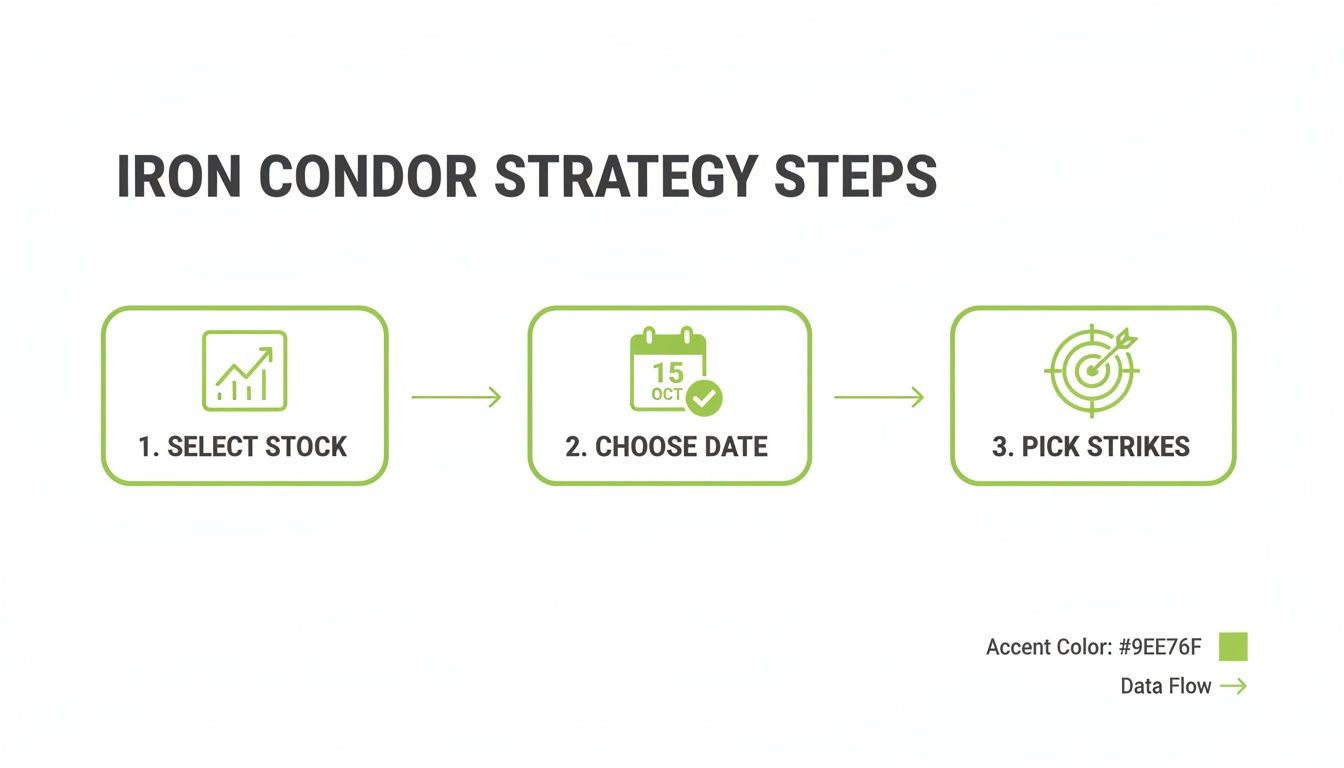
This process—picking the stock, choosing an expiration, and setting the strikes—is the foundation of every single condor trade.
Calculating the Trade’s Vitals
With our strikes locked in, we can figure out the exact risk and reward. Let's assume the premiums for these options give us a total net credit of $2.50 per share, which is $250 for one contract.
Here's a quick table to break down the numbers for our hypothetical SPY trade.
| Metric | Value / Calculation |
|---|---|
| Current SPY Price | $510 |
| Put Spread | Sell $480 Put / Buy $470 Put |
| Call Spread | Sell $540 Call / Buy $550 Call |
| Spread Width | $10 (for both put and call spreads) |
| Net Credit Received | $2.50 (or $250 per contract) |
| Maximum Profit | $250 (The net credit) |
| Maximum Loss | $750 (($10 Width - $2.50 Credit) x 100) |
| Downside Breakeven | $477.50 ($480 Short Put - $2.50 Credit) |
| Upside Breakeven | $542.50 ($540 Short Call + $2.50 Credit) |
| Profit Range at Expiration | $477.50 to $542.50 |
This table lays out everything we need to know before we even place the trade. There are no surprises here.
Our Maximum Profit is the $250 credit we took in upfront. That's our best-case scenario, and we achieve it if SPY closes anywhere between our short strikes of $480 and $540 when the options expire.
Our Maximum Loss is also clearly defined from the get-go. It's the $10 width of our spreads minus the $2.50 credit we received, which comes out to $7.50 per share, or $750 per contract.
Finally, the breakeven points tell us exactly where we start losing money. As long as SPY stays between $477.50 and $542.50, this trade will be profitable at expiration.
From here, we'd simply watch the trade over the next few weeks. Every day that SPY stays within our profit range, time decay quietly erodes the value of the options we sold, pulling us closer to our maximum profit.
Managing and Adjusting Your Iron Condor

Putting on an iron condor is only half the battle. The real skill—and where consistent traders separate themselves from the crowd—is in managing the trade once it's live. This is absolutely not a "set-and-forget" strategy.
Successful traders have a clear playbook for every trade before they even enter. That means knowing exactly when you'll take profits, when you'll cut losses, and what you'll do if the stock starts moving against you. This discipline is what protects your capital and keeps you in the game.
Taking Profits Early
One of the most powerful rules in the iron condor playbook is to take profits early. It's tempting to hold out for that 100% premium, but letting a trade run all the way to expiration is a rookie mistake that dramatically increases your risk. As the clock ticks down, gamma risk spikes, making your position hyper-sensitive to even small moves in the stock.
A widely accepted best practice is to set a profit target of 50% of the maximum potential profit. If you collected a $250 credit to open the trade, you’d put in an order to close the whole thing for a $125 debit.
This simple rule gets you out of the trade early, freeing up your capital and drastically reducing the chance of a winning trade turning into a loser. Locking in a solid gain and moving on is almost always the smartest play.
Why does this work so well? You capture the bulk of the profit in a fraction of the time. This lets you redeploy your money into new, high-probability trades, which speeds up your income generation and keeps your equity curve moving smoothly upward.
When the Trade Goes Against You
No matter how carefully you pick your strikes, the market is going to test your position sooner or later. The key is to have a plan. Panic is not a strategy, but a pre-defined adjustment plan is.
The most common problem is the stock price creeping up toward your short call or down toward your short put. Your first warning bell should ring when the delta of that short option doubles. For example, if you opened a short put with a 0.15 delta and it rises to 0.30, that's a clear signal that the probability of getting breached has shot up. You can learn more about how delta and other metrics work by reviewing our guide on the option trading Greeks.
This is your cue to act, not to hope.
Common Adjustment Techniques
When one side of your condor is feeling the heat, a classic adjustment is to "roll" the untested side closer to the current stock price. This move allows you to collect more premium, which in turn widens your breakeven point on the side being challenged.
Here’s how it works:
- Identify the Untested Side: If the stock is dropping and testing your put spread, the call spread is your untested (or "safe") side.
- Close the Untested Spread: You’ll buy back your original call spread.
- Sell a New Spread: Immediately, you'll sell a new call spread at lower strike prices—closer to the current stock price—for a credit.
That extra credit you just collected improves your entire position. It gives the stock more room to move against you before the trade turns into a loss. The goal of an adjustment isn't necessarily to turn a losing trade into a big winner, but to manage it back to a small profit or, at the very least, a scratch.
This kind of active management is a hallmark of successful strategies. For instance, a detailed performance analysis on VolatilityTradingStrategies.com of one iron condor system showed it delivered a 26% return in 2022—a year the S&P 500 fell 19%. This was achieved by layering trades and using disciplined, proactive management.
Finally, your exit plan for a loss is just as critical. A solid rule of thumb is to close the trade if the loss hits 2x the original credit you received. This prevents a small, manageable loss from spiraling into a max-loss catastrophe.
Common Questions About Iron Condors
Once you get the hang of the iron condor, a few common questions always seem to pop up. Let's tackle them head-on so you can trade with more confidence.
What Is a Good Win Rate for an Iron Condor?
Most traders shoot for a probability of profit (POP) between 80% and 85%. You typically find this sweet spot by selling your short strikes around the .15 delta. While that high win rate looks great on paper, it's only half the story.
You have to remember that a high win rate means nothing if your few losses are big enough to wipe out all your wins. That’s why disciplined risk management is non-negotiable. A classic rule of thumb is to close the trade if your loss hits twice the credit you received. It's about making sure one bad trade doesn't sink the ship.
History shows these high-probability setups often work. A major 13-year backtest of a weekly iron condor strategy found a win rate of 80.79%. But here's the catch: the study also showed a gut-wrenching drawdown of over -50%. It’s a stark reminder that even the safest-looking strategies have teeth. You can dig into the numbers yourself in the full analysis of the weekly options strategy.
Is an Iron Condor a Bullish or Bearish Strategy?
Neither. An iron condor is a neutral strategy, and that's its biggest advantage. You aren't betting on the stock rocketing up or tanking—you're betting on it doing a whole lot of nothing.
Your ideal scenario is for the stock to stay stuck in a range, letting time decay (theta) do its work. It's the perfect play for a market that's just chopping sideways or taking a breather.
How Much Capital Do I Need to Trade Iron Condors?
The capital you need is simply the maximum potential loss on the trade. Your broker will hold this amount as collateral for every contract you open.
The math is simple:
- Max Loss = (Width of the Spreads - Net Credit Received) x 100
So, if you open a $5-wide iron condor and collect a $1.50 credit, your max loss is $350 per contract. That’s calculated as (($5 - $1.50) x 100). This is the exact amount of capital you'll need to have in your account to place the trade, making it a great defined-risk strategy for accounts of all sizes.
Key Takeaway: The best part about an iron condor is you know your absolute worst-case scenario from the second you enter the trade. No surprises, no margin calls—just a fixed risk you can plan around.
When Should I Not Use an Iron Condor?
Knowing when to sit on your hands is just as important as knowing when to pull the trigger. Steer clear of iron condors in these situations:
- Crazy Volatile Markets: Yes, high implied volatility (IV) means you get paid more premium. But it also means the stock is much more likely to make a huge move and blow right past your strikes.
- A Stock on a Mission: If a stock is in a strong, clear uptrend or downtrend, an iron condor is like trying to stop a freight train. A directional strategy makes way more sense.
- Right Before Big News: Never, ever put on an iron condor right before an earnings report, an FDA announcement, or a Fed meeting. The volatility is a pure gamble, and you’re better off waiting until the dust settles.
Ready to put these ideas to work? Strike Price gives you real-time probability data for every strike, so you can build smarter, data-driven iron condors. Ditch the guesswork and start trading with an edge. https://strikeprice.app