
A Trader's Guide to the Put Credit Spread Strategy
If a stock moves past your strike, the option can be assigned — meaning you'll have to sell (in a call) or buy (in a put). Knowing the assignment probability ahead of time is key to managing risk.
Posted by
 John Clarke
Related reading
A Step-by-Step Covered Calls Example for Consistent Income
Unlock consistent income with our step-by-step covered calls example. This guide breaks down the strategy, risks, and outcomes to help you trade confidently.
Long Call and Short Put The Ultimate Synthetic Stock Guide
Unlock the power of the long call and short put strategy. This guide explains how synthetic long stock works, its benefits, risks, and how to execute it.
What is a Call Spread? A Clear Guide to Bull and Bear Spreads
What is a call spread? Discover how bull and bear spreads limit risk and sharpen your options trading strategy.
A put credit spread is one of the most popular ways options traders generate consistent income. The strategy is straightforward: you sell a higher-priced put option and buy a lower-priced one at the same time. The goal is simple—collect a cash premium upfront and hope the stock stays above your short put’s strike price by expiration. If it does, you pocket the entire premium.
What Is a Put Credit Spread and How Does It Work?

Think of a put credit spread as selling insurance on a stock. You get paid a premium today by someone who wants to protect themselves from a price drop. In exchange, you agree to buy their shares at a specific price (the strike price) if the stock falls below that level. The strategy gets its name because you receive a net credit in your account the moment you open the trade.
It’s a bullish to neutral strategy, meaning you can profit if the stock price goes up, stays flat, or even dips a little. The only thing that matters is that the stock remains above a specific price for you to make money. Since you're both selling and buying an option, it's a type of vertical spread. To get a better handle on the mechanics, check out our guide that explains in detail what an option spread is and how the different types are built.
To give you a quick overview, here are the essential characteristics of a put credit spread.
Put Credit Spread At a Glance
| Characteristic | Description |
|---|---|
| Strategy Type | Credit Spread |
| Market Outlook | Bullish to Neutral |
| Profit Potential | Capped at the net premium received |
| Risk | Defined and capped at the difference between the strikes minus the premium. |
| Ideal Environment | Stable or slowly rising stock prices; falling implied volatility. |
This table captures the essence of the strategy—a defined-risk approach to earning income when you expect a stock to hold its ground or climb.
Breaking Down the Two Components
Every put credit spread is made of two pieces working together—two put options with the same expiration date but different strike prices. Grasping what each one does is the key to understanding the whole strategy.
The Short Put Option: This is the engine of the trade. You sell a put option, which creates an obligation to buy the stock at that strike price if it drops below it by expiration. This is where you generate your income.
The Long Put Option: This is your safety net. You simultaneously buy a put option with a lower strike price than the one you sold. This long put caps your potential loss if the trade goes haywire.
A put credit spread is a defined-risk strategy. By buying that lower-strike put for protection, you know your exact maximum loss the moment you enter the trade. This prevents the kind of catastrophic losses you could face selling naked options.
The Core Logic of the Trade
The premium you collect from selling the higher-strike put will always be more than what you pay for the lower-strike put. That difference is the net credit that hits your account, and it also happens to be your maximum potential profit.
Your primary goal is for the stock price to close above the strike price of your short put when the options expire. If that happens, both options expire worthless. The person who bought your put won't exercise it, and your long put (which is even further out of the money) is also worthless. You have no more obligations, and the cash you collected upfront is yours to keep, free and clear.
This simple, high-probability outcome is what makes the put credit spread a cornerstone strategy for so many income-focused options traders.
Calculating Your Profit, Loss, and Breakeven Point
Before you ever click "confirm" on a trade, you need to know exactly what you stand to make, what you could lose, and where your line in the sand is. The math for a put credit spread is refreshingly simple, and getting these three numbers down will give you a crystal-clear picture of the risk and reward on the table.
Every single put credit spread has a hard ceiling on its profit, a firm floor on its loss, and a precise breakeven price. Knowing these lets you decide if the potential reward is actually worth the risk you're taking.
Calculating Your Maximum Profit
This is the easiest one. Your maximum possible profit is simply the net credit you receive the moment you open the trade. That cash hits your account right away.
Maximum Profit = Net Credit Received
Let's say you sell a put option and collect a $1.80 premium, while buying another put for $0.80. Your net credit is $1.00 per share. Since option contracts control 100 shares, your max profit for this trade is $100. You pocket that full amount as long as the stock closes at or above your short put's strike price when the contract expires.
Calculating Your Maximum Loss
Your maximum loss is also locked in from the very beginning. This is the beauty of a spread—your risk is capped, so a nasty market drop won't wipe you out.
The formula is just the distance between your two strike prices, minus the credit you already pocketed.
- Maximum Loss = (Width of Spreads) – Net Credit Received
Let's stick with our example. Imagine you sold the $100 strike put and bought the $95 strike put. The width of that spread is $5 ($100 - $95). Since you collected a $1.00 credit, your maximum loss is $4.00 per share, or $400 per contract ($5.00 width - $1.00 credit). This only happens if the stock price collapses below your long put's strike ($95) by expiration.
Calculating Your Breakeven Point
The breakeven price is the exact stock price where you don't make or lose a dime at expiration. For a put credit spread, this point is always below the strike price of the put you sold.
This gives you a bit of a cushion. The stock can fall, and you can still walk away with a profit.
- Breakeven Price = Short Put Strike Price – Net Credit Received
Using our ongoing example, your short strike is $100 and you got a $1.00 credit. Your breakeven is $99 ($100 - $1.00). If the stock closes at exactly $99 on expiration day, you're flat. Any price above that, and you're in the green.
Seeing this visually can make it all click. The payoff diagram below shows you exactly what a bull put spread's risk profile looks like.
The chart clearly lays out your flat, capped profit zone (your credit) and your flat, capped loss zone (your defined risk), with the breakeven price as the slope connecting them. If you want to dive deeper into the mechanics, our guide on how to calculate option profit breaks it down with more examples.
Let’s pull it all together with a real-world example.
Example Trade: XYZ Stock
- Current XYZ Price: $155
- Trade Setup:
- Sell one $150 put for a $2.50 premium
- Buy one $145 put for a $1.20 premium
- Calculations:
- Net Credit (Max Profit): $2.50 - $1.20 = $1.30 per share ($130 total)
- Spread Width: $150 - $145 = $5.00
- Maximum Loss: $5.00 width - $1.30 credit = $3.70 per share ($370 total)
- Breakeven Price: $150 strike - $1.30 credit = $148.70
In this trade, you make the full $130 profit as long as XYZ stays above $150. You only start to lose money if it dips below $148.70, and your loss is absolutely capped at $370, even if the stock goes to zero.
How to Select and Execute Your Put Credit Spread
Moving from theory to action is where the rubber meets the road in trading. Building a repeatable, data-driven process for finding and placing a high-probability put credit spread is what separates a lucky trade from a long-term strategy. This all comes down to picking the right stock, finding an optimal expiration date, and strategically choosing your strike prices.
The stock you choose matters—a lot. While this strategy works on individual stocks, many seasoned traders stick to major index ETFs like SPY, QQQ, or IWM. Why? These funds are incredibly liquid, which means you get tighter bid-ask spreads and better prices when you place your trade. More importantly, they aren't as vulnerable to the wild, overnight swings that can come from a single bad earnings report or unexpected news, which can wreck an otherwise solid trade.
Beyond just the mechanics, the most successful traders integrate put credit spreads into their larger portfolio. They're just one tool in a bigger toolbox used to diversify and formulate good investment strategies.
Choosing Your Expiration Date
The expiration date you select is a direct trade-off between profit and risk. Sure, selling options that are super close to expiration might look tempting because of the rapid time decay (theta), but it leaves you zero room for error. Even a small move against you can cause a ton of stress and force you into a tough spot.
On the flip side, selling options too far out in time ties up your capital for ages, and the rate of time decay is painfully slow.
The sweet spot for most traders is somewhere between 35 and 45 days to expiration (DTE). This window gives you a great balance of juicy premium and accelerating time decay without the heart-pounding volatility of the final couple of weeks.
This timeframe gives the trade enough breathing room to work out and allows you to make adjustments if the stock starts moving against your position.
Selecting the Right Strike Prices
This is arguably the most critical decision you'll make when setting up your spread. Your strike prices dictate your probability of winning, how much cash you collect upfront, and your absolute maximum risk. The whole game is finding a balance that you're comfortable with.
A powerful shortcut for this is the option Greek known as Delta.
- Delta as a Probability Gauge: Think of Delta as a rough, back-of-the-napkin estimate of an option expiring in-the-money. A put option with a 0.20 Delta, for instance, has about a 20% chance of finishing in-the-money. That also means it has an 80% chance of expiring worthless—which is exactly what you want.
A popular approach is to sell a put with a low Delta (giving you a high probability of success) and then buy a protective put with an even lower Delta. For example, a trader might sell a 0.20 Delta put and buy a 0.13 Delta put. This creates a high-probability trade designed to just sit back and collect premium as time ticks by.
The trade-off is simple: the lower the Delta (the further away from the current stock price you go), the less premium you'll collect. Your job is to find that sweet spot that pays you a respectable amount for the risk you're willing to take.
Placing the Trade with Your Broker
Once you've got your stock, expiration, and strikes picked out, it's time to pull the trigger. Thankfully, most modern brokerage platforms make this incredibly easy. You can typically enter a "vertical spread" or "put spread" as a single, all-in-one order. This ensures both legs of your trade—the put you sell and the put you buy—are executed at the exact same time for one net price.
Pro Tip: Always use a Limit Order, never a Market Order. This lets you name your price and tell the market the minimum credit you’re willing to accept. Before you submit, glance at the bid-ask spread. A wide spread is a sign of low liquidity and could mean you get a terrible entry price. Aim for the mid-price or even a little better to make sure you get a fair fill.
This graphic breaks down the financial flow of a put credit spread, showing you exactly where you make money, lose money, and break even.
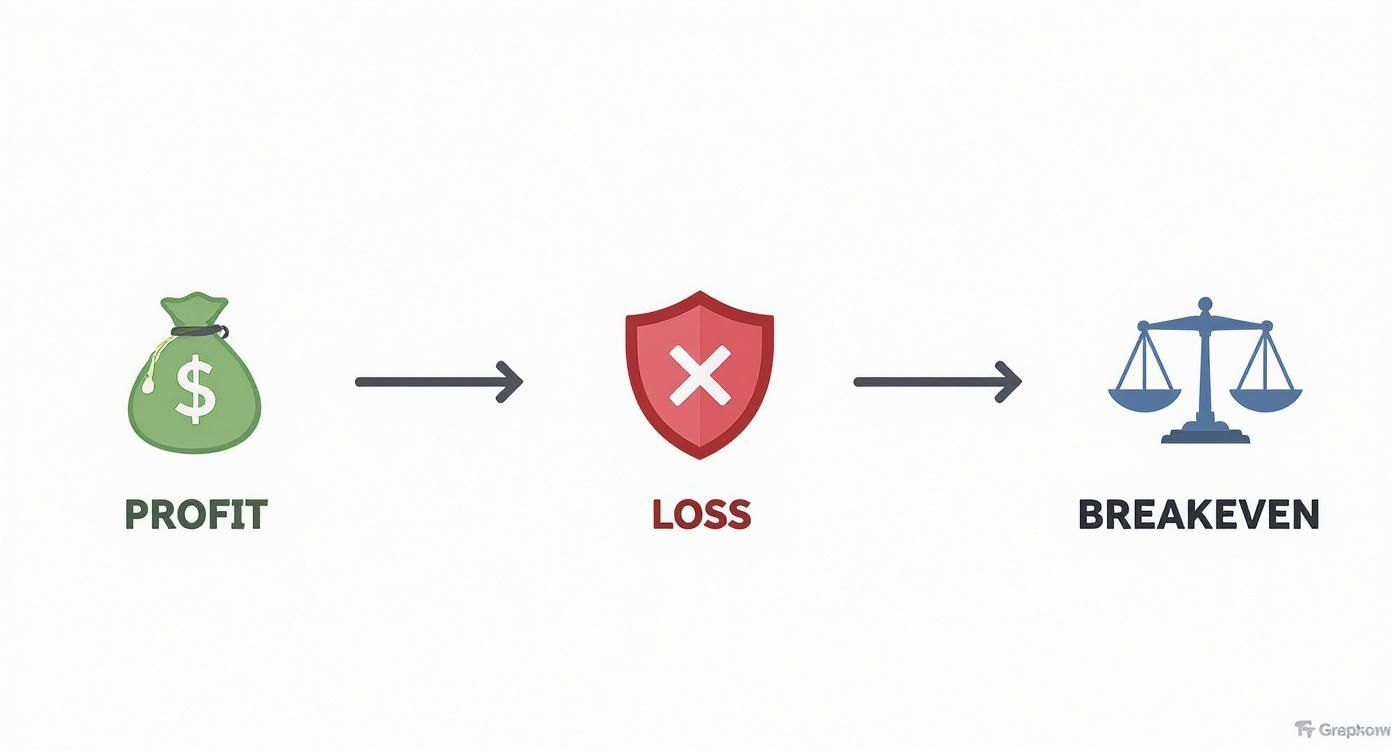
As you can see, your profit is capped at the credit you received, your loss is strictly defined by the width of your strikes, and your breakeven is the line in the sand where the trade flips from a winner to a loser.
Managing Your Trade with Clear Exit Rules

Putting on a well-researched put credit spread is just the beginning. The real secret to staying profitable in the long run comes down to disciplined trade management.
This means having a clear, non-negotiable set of exit rules before you even click the "trade" button. Doing this removes emotion from the equation, turning your decision-making from a reactive panic into a calm, strategic process. A great entry can easily sour into a big loss without a solid exit plan that covers two scenarios: when to take profits and when to cut your losses.
The Profit-Taking Plan
Sure, your maximum profit is the credit you collected upfront, but waiting until the very last day to squeeze out every penny is usually a bad move. As an option gets closer to expiration, the risk-reward gets skewed against you. You end up risking a lot of capital just to capture the tiny bit of premium left.
That's why so many experienced traders live by a firm profit target.
A common and incredibly effective rule is to close the trade once you've captured 50% of the maximum potential profit. This lets you lock in a solid gain, reduces your time exposed to the market, and frees up your capital for the next high-probability setup.
For instance, if you collected a $1.00 credit (that's $100 per contract), your target is to buy back the spread for $0.50 or less. That locks in a $50 profit. Some traders might push for 75% of max profit, but the core idea is the same: take your winnings off the table early and move on.
And this isn't just a hunch; it's backed by data. Backtesting bull put spreads shows that traders who took profits at 50% saw a major boost in their performance. You can dig into the numbers yourself in these detailed backtesting studies on optionsamurai.com.
The Loss-Management Plan
Hey, even the best-looking trades can turn against you. A disciplined trader knows exactly when to get out of a losing position before it snowballs. Letting a small paper cut turn into a maximum loss is one of the fastest ways to drain your account.
A simple rule of thumb is to bail on a trade if the loss hits a set multiple of the credit you received.
- The 2x Rule: A popular guideline is to close the position if the loss hits 2x your initial credit.
- Example: If you collected a $1.00 credit, you'd exit if the cost to close the spread hits $3.00. This caps your loss at $2.00 ($200 per contract) and prevents it from ever reaching the maximum possible loss.
This kind of rule-based stop-loss helps you live to trade another day by protecting your most important asset: your capital.
Considering Defensive Adjustments
Sometimes, a trade that's moving against you doesn't have to be an immediate loss. If you still have plenty of time until expiration (think more than 21 days), you could consider a defensive move called "rolling."
This is where you close your current spread and immediately open a new one with a later expiration date. Often, you can roll to the same strike prices and collect another small credit, effectively buying yourself more time to be right. It's an advanced technique, but it can be a powerful tool for salvaging a challenged trade.
Navigating Margin Requirements and Common Mistakes
Understanding the nuts and bolts of a put credit spread—like margin and common screw-ups—is what separates traders who make consistent money from those who don't. These details are just as important as picking the right strikes. Get them wrong, and you're setting yourself up for preventable losses and surprise account issues.
First, let's talk about margin. When you sell a put credit spread, your broker just needs to know you can cover the trade if it goes completely sideways. They don't use some complex formula; they simply set aside cash in your account equal to your maximum possible loss.
It's that simple. If your spread has a maximum risk of $400, your broker will hold $400 of your buying power as collateral until the trade is closed. This is one of the best things about a defined-risk strategy—you know exactly how much of your capital is on the line. For a deeper dive, you can learn more about how different options margin requirements work and how brokers calculate them.
Steering Clear of Common Pitfalls
Knowing the math is only half the battle. The other half is actively avoiding the rookie mistakes that trap so many traders. If you can sidestep these, you'll dramatically improve your odds of long-term success with this strategy.
Here are the biggest blunders to watch out for:
Selling Strikes Too Close to the Money: The premium is always juicier when you sell options closer to the stock's current price. It's tempting, but it leaves you zero room for error if the stock has a bad day. This is the classic "picking up pennies in front of a steamroller"—taking on way too much risk for a tiny reward.
Ignoring Implied Volatility (IV): A put credit spread is a short-volatility trade. That means you want IV to drop after you get in. Selling spreads when IV is already scraping the bottom of the barrel gives you tiny premiums and exposes you to a world of hurt if volatility suddenly spikes (which it often does when prices fall).
The best time to sell a put credit spread is when implied volatility is high. The fear in the market inflates the premium you collect, giving you a wider breakeven point and a much better risk-reward setup.
More Mistakes to Avoid
Beyond strike selection and volatility, a few other bad habits can sabotage your trading. These are less about the technicals and more about discipline.
Trading Without an Exit Plan: We touched on this earlier, but it’s so critical it’s worth repeating. Entering a trade without knowing your profit target and your "get me out" stop-loss point is like setting sail without a destination or a life raft.
Risking Too Much on One Trade: Position sizing is everything. A good rule of thumb is to never risk more than 1-3% of your total account value on a single trade. This discipline ensures that one bad trade—and they will happen—doesn’t wipe out weeks of hard-earned gains.
By getting a handle on margin and consciously avoiding these common errors, you build a much stronger foundation for trading put credit spreads safely and effectively.
Real-World Examples of Put Credit Spreads
Theory is one thing, but seeing how a strategy plays out in the wild is where the lessons really stick. Let's walk through two detailed scenarios—one that goes off without a hitch and another that gets a little dicey—to see the put credit spread in action.
These examples will connect the dots between picking your strikes, collecting the premium, and managing the trade when things get interesting. We’ll use the SPDR S&P 500 ETF Trust (SPY) for our examples since it’s incredibly liquid and a favorite playground for this strategy.
Example 1: The "Best Case" SPY Trade
Let's say SPY is trading at $450 a share. Your outlook is neutral to slightly bullish, so you decide to open a put credit spread to bring in some income.
You look out about 45 days to expiration and use Delta to help find some high-probability strikes.
- Sell to Open: The $430 strike put (with a 0.20 Delta) for a $2.50 premium.
- Buy to Open: The $425 strike put (with a 0.15 Delta) for a $1.70 cost.
This sets up a $5-wide spread. Here’s how the numbers stack up:
- Net Credit (Max Profit): $2.50 - $1.70 = $0.80 per share, which is $80 per contract.
- Maximum Loss: ($430 - $425) - $0.80 = $4.20 per share, or $420 per contract.
- Breakeven Price: $430 - $0.80 = $429.20.
Over the next three weeks, SPY does exactly what you hoped it would—it drifts up to $455. Time decay and the price move work their magic, and the value of your spread collapses. You see that you can buy it back for just $0.40.
Following your plan to take profits at 50% of the maximum gain, you close the position.
You pocket a $40 profit ($80 initial credit - $40 to close) with weeks to spare. This frees up your capital for the next trade. This is the textbook lifecycle of a winning put credit spread.
Example 2: Managing a Trade Under Pressure
Now for the other side of the coin. You enter the exact same SPY $430/$425 put credit spread and collect the same $80 credit. This time, however, the market has other plans.
About a week into the trade, some rough economic news hits, and SPY tumbles down to $432. Your spread is now being tested. Its value has ballooned to $2.40, putting you at an unrealized loss of $160 ($2.40 value - $0.80 credit).
Panic is not a strategy. You still have over 30 days until expiration—plenty of time for things to turn around. Instead of bailing for a loss, you decide to wait it out.
Over the next week, the market finds its footing and SPY slowly grinds back up to $438.
That price rebound, combined with another week of time decay, starts eating away at the spread's value. It’s now trading for just $0.70. You decide to close the position and take a small $10 profit, happy to have weathered the storm without taking a loss.
These examples show just how resilient a put credit spread can be. Historical data backs this up, with the strategy showing strong performance through all kinds of market weather. Backtesting on SPY, for instance, has demonstrated that this approach can deliver high win rates and solid returns over time. Check out this comprehensive SPY put credit spread backtest to see the numbers for yourself.
Put Credit Spread FAQ
Even after you've got the basics down, a few common questions always seem to pop up. Let's tackle some of the most frequent ones I hear from traders just starting with this strategy.
When’s the Best Time to Use a Put Credit Spread?
The sweet spot for a put credit spread is when you have a neutral to bullish outlook on a stock or ETF. You don’t need the stock to shoot for the moon; you just need it to stay above your short strike. This makes it a great fit for stocks that are stable, stuck in a range, or slowly grinding higher.
Another key ingredient is implied volatility (IV). You want to sell spreads when IV is relatively high. Why? High IV pumps up option premiums, which means you get paid more upfront for taking on the same amount of risk. That extra credit gives you a bigger cushion if the trade moves against you.
Can I Get Assigned Early?
Yes, it's possible, but it's extremely rare on the short put you sold. Early assignment almost exclusively happens on American-style options, and even then, only if your short put is deep in-the-money with barely any time value left.
But here’s the good news: the long put in your spread is your safety net. If you do get assigned (meaning you’re forced to buy 100 shares), your broker can typically use your long put to manage the position and cap your loss.
Honestly, this is something most traders never have to worry about. If you're managing your trades correctly—closing for a profit at 50% of the max gain or cutting losses at a set point—you'll almost never hold the position long enough for early assignment to become a real threat.
Why Not Just Sell a Naked Put Instead?
Selling a naked put accomplishes the same goal—profiting from a stock that doesn't crash. But the put credit spread has one massive advantage: defined risk.
When you sell a naked put, your potential loss is technically unlimited if the stock plummets to zero. That's a scary thought.
A put credit spread, on the other hand, completely caps your maximum loss from the moment you enter the trade. That long put you bought acts as a floor, preventing any further losses no matter how far the stock falls. This protection requires way less margin and provides a ton more peace of mind, making it a much better strategy for most traders.
Ready to trade options with more confidence? Strike Price gives you the real-time probability data you need to find high-probability setups and manage risk effectively. Stop guessing and start making data-driven decisions. Explore Strike Price today and see how our tools can improve your trading.