
What Is Option Vega and How It Shapes Your Trades
If a stock moves past your strike, the option can be assigned — meaning you'll have to sell (in a call) or buy (in a put). Knowing the assignment probability ahead of time is key to managing risk.
Posted by
 John Clarke
Related reading
Out of Money Call Options A Guide to Consistent Income
Learn how to use out of money call options to generate consistent income. This guide covers key strategies, risk management, and real-world examples.
How Options Are Priced A Practical Guide for Investors
Understand how options are priced with this clear guide. Learn about intrinsic value, implied volatility, and pricing models to improve your investing strategy.
Greek Options Explained for Income Traders
Unlock your options trading potential. This guide on greek options explained shows you how to use Delta, Gamma, and Theta to generate consistent income.
Of all the "Greeks" you'll hear about in options trading, vega is one of the most powerful, yet often misunderstood, forces that directly impacts the premium you collect.
In simple terms, vega tells you exactly how much an option's price will change for every 1% shift in the underlying stock's implied volatility. Mastering this concept is a game-changer for option sellers.
Understanding Vega and Volatility
Think of vega like the sail on a boat. A bigger sail (high vega) catches more wind (volatility), causing the boat’s speed (option price) to change more dramatically. A smaller sail (low vega) is far less affected by that same gust of wind.
In trading, vega quantifies this sensitivity in dollars and cents.
If a call option has a vega of 0.15, its price will increase by $0.15 for every 1% rise in implied volatility. Conversely, its price will drop by $0.15 for every 1% fall in volatility—assuming everything else stays the same.
Why Vega Matters to Sellers
For anyone selling covered calls and secured puts, understanding vega is non-negotiable. When you sell an option, you are "short vega," which is a fancy way of saying you generally profit when implied volatility decreases after you've opened your position.
This "volatility crush" is a key source of profit for premium sellers.
High volatility isn't just a risk; it's a measurable opportunity. It directly leads to juicier option premiums, giving you more income for the positions you sell. Vega helps you answer the crucial questions:
- How much extra premium am I getting for this volatility? Vega puts a hard number on the risk premium you're collecting.
- How will my position's value change if the market calms down? It predicts how much your short option's value will decay if volatility drops.
- Is this a good time to sell? Elevated vega often signals an ideal environment for selling premium.
To help these concepts stick, here is a quick summary table.
Vega at a Glance Key Concepts
| Concept | Simple Explanation | What It Means for Sellers |
|---|---|---|
| Vega | The change in an option's price for every 1% change in implied volatility. | Your sensitivity to market fear or calm. |
| Implied Volatility (IV) | The market's expectation of future price swings. | High IV means higher premiums to collect. |
| Short Vega | Your position as an option seller. You profit when IV goes down. | You want volatility to drop after you sell. |
| Volatility Crush | A rapid decrease in IV, often after an event like earnings. | A major source of profit for your short options. |
By getting a handle on vega, you can turn market uncertainty from a vague threat into a calculated part of your income strategy.
It transforms your approach from just guessing to making data-driven decisions based on risk and reward. For a more comprehensive understanding of the financial landscape in which options trading operates, consider exploring deeper into topics within the subject of finance.
How Vega Connects Volatility and Time
To get a real feel for option vega, you have to look at the two powerful forces that fuel it: implied volatility and time. Vega doesn't create volatility; it just measures the financial impact of its ebbs and flows on your option's price. The relationship is pretty direct and intuitive.
When implied volatility (IV) climbs, it’s a signal that the market is bracing for bigger price swings ahead. This uncertainty is a premium booster, making options more valuable. As a result, the option's vega also goes up, reflecting a greater sensitivity to each subsequent 1% change in that now-higher IV.
Think of it like this: a calm, low-IV stock might have an option premium that barely moves. But a volatile, high-IV stock has a premium that's way more responsive to market mood swings. To really dig into this, a comprehensive guide to market volatility can give you a deeper perspective.
The Critical Role of Time
Time until expiration is the other crucial piece of the vega puzzle. The more time an option has left, the more opportunities there are for the underlying stock to make a big move. That longer window of uncertainty is a key part of the overall valuation of options.
This is exactly why longer-dated options always have a higher vega than their short-term cousins. An option expiring in 90 days has a lot more runway for volatility to influence its outcome than one expiring in just 7 days. Because of this, the 90-day option is much more sensitive to shifts in IV.
Key Takeaway: An option with more time until expiration has a higher vega because there is a longer period for volatility to potentially push the option into a profitable position. As expiration gets closer, vega decays rapidly.
The difference can be huge. For instance, data from the Options Industry Council highlights this relationship well. Imagine a 12-month call option with a vega of 0.15. A simple 2% jump in IV could boost its value by $0.30. In contrast, a front-month option might need a volatility spike 2.5 times larger just to see the same dollar impact, simply because its premium and vega are smaller from the start.
Understanding this dance between time and volatility is fundamental for any option seller. It’s why selling premium on longer-dated options can be so tempting during high-IV periods—the vega is higher, so the premium you collect is more substantial. But it also cuts both ways, exposing the risk: a spike in volatility will hit that same position much harder.
Seeing Vega's Impact on Real Trades
Theory is one thing, but watching vega add or subtract real dollars from your account is where it all clicks. Let's move past the definitions and walk through two scenarios every option seller will face sooner or later.
These examples use realistic numbers to show exactly how a shift in implied volatility can impact an option's price. You'll see how vega can become either a powerful tailwind pushing profits your way or a frustrating headwind working against you.
Scenario 1: The Vega Crush
Imagine Company XYZ is about to drop its quarterly earnings report. The market is holding its breath, and that uncertainty has pushed the implied volatility (IV) for XYZ options sky-high to 75%. Seeing this, you decide it's a perfect time to sell a cash-secured put.
- The Trade: You sell one at-the-money put option on XYZ with a $100 strike, expiring in 30 days.
- The Premium: Thanks to that juicy IV, you collect a fat premium of $6.00 per share, or $600 for the contract.
- The Vega: This specific option has a vega of 0.12.
The next day, XYZ releases its earnings. The news is... fine. Not great, not terrible. The stock price barely budges, closing right around $100. But with the earnings uncertainty gone, the air comes out of the IV balloon. It plummets from 75% down to 45%—a massive 30% drop.
Here’s what that vega crush does to your position:
Vega Impact: 30% IV Drop × 0.12 Vega = $3.60 Decrease in Premium
Even though the stock went nowhere, the option's value collapsed by $3.60 per share overnight, purely because volatility vanished. The premium is now worth just $2.40 ($6.00 - $3.60). You can buy back the contract for only $240, locking in a quick $360 profit.
This is a classic "short vega" win. You bet that volatility would fall, and it paid off handsomely.
Scenario 2: The Vega Spike
Now for the flip side. You've sold a covered call on a stable, blue-chip stock, ABC, which is trading at $150. The market is calm, and IV is sitting at a low 20%.
- The Trade: You sell one out-of-the-money call option with a $155 strike, expiring in 45 days.
- The Premium: You collect a modest premium of $2.50, or $250 per contract.
- The Vega: This option has a vega of 0.15.
A week later, unexpected bad news hits the entire sector. While ABC's stock only dips a little to $149, panic ripples through the market. Suddenly, IV for ABC options spikes from 20% to 35%—a 15% jump.
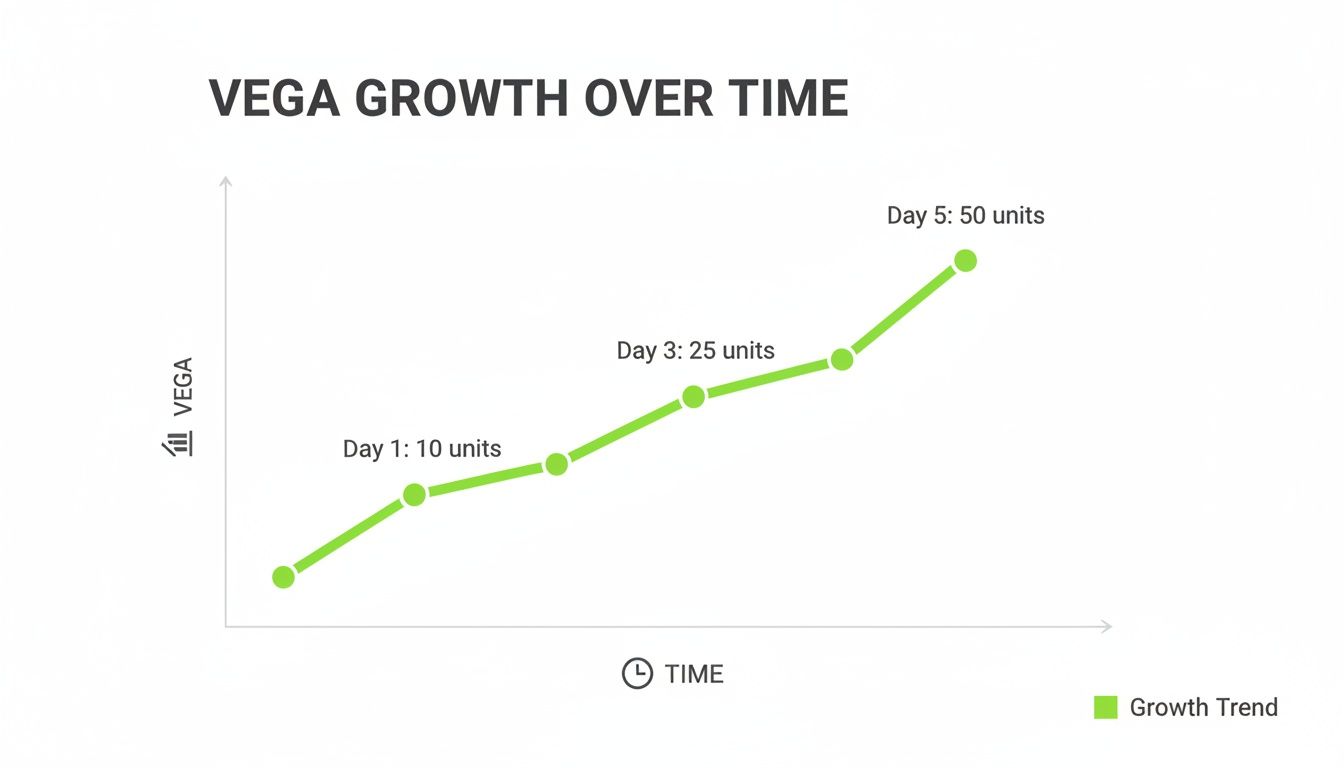
This chart helps visualize why this matters so much. An option's vega naturally grows the more time it has until expiration, making longer-dated options like this one much more sensitive to volatility swings.
Let's calculate the damage from this vega spike:
- Vega Impact: 15% IV Rise × 0.15 Vega = $2.25 Increase in Premium
Ouch. The option you sold for $2.50 is now trading for $4.75 ($2.50 + $2.25). Even though the stock actually moved in a favorable direction for your covered call, the trade is now showing a significant unrealized loss of $225. This is the pain of being short vega when volatility decides to wake up.
Why Vega Is a Seller's Secret Weapon
For traders focused on generating income from covered calls and secured puts, vega isn’t just some obscure Greek letter—it's your secret weapon. When you sell an option, you become "short vega," which is a fancy way of saying you stand to profit when implied volatility (IV) drops after you've opened your trade.
This simple fact completely reframes how you look at the market. Instead of seeing high volatility as a sign of chaos, sellers see it as an opportunity. A solid grasp of vega is what lets you turn that fear and uncertainty into a premium-harvesting advantage.
Capitalizing on Volatility Decay
The strategy here is beautifully simple: sell high, buy low. But we're not talking about the stock's price—we're talking about its volatility. You find moments when the market is anxious and option premiums are fat with fear, sell a contract, and then wait for things to calm down.
As that uncertainty fades, the option's premium shrinks due to the drop in IV. Traders often call this a "vega crush." This decay works directly in your favor, letting you buy back the option for much less than you sold it for. Often, the stock doesn't even need to move an inch for you to profit. You can see the full mechanics in our guide to the short call options strategy.
A Seller's Mindset: You aren't just selling a contract on a stock; you are selling insurance against big price swings. When the perceived risk of those swings is high, the insurance premium you collect is naturally much higher.
High Vega vs. Low Vega Opportunities
The real power of vega becomes obvious when you compare different types of stocks. A high-flying, volatile name will always offer much richer premiums than a stable, slow-moving blue chip—and vega is the reason why.
Let's look at a real-world example. In the options world, vega tells you how much an option's price will change for every 1% move in implied volatility. A recent analysis showed a volatile stock like TSLA had a daily standard deviation of 4.04%, which works out to a massive 64.13% annualized volatility. Compare that to a steady blue-chip like JNJ, with a daily standard deviation of just 1.04%, or 16.50% annualized. You can dig into the numbers yourself in this in-depth analysis of vega's market impact.
That huge gap in volatility explains why selling a TSLA option can bring in so much more cash than a similar option on JNJ. The higher vega baked into TSLA's options means sellers get paid far more for taking on that perceived risk.
Ultimately, vega is the tool that lets you measure this risk-reward trade-off. It helps you pick the stocks and expiration dates that offer the most attractive premium for the amount of volatility you're willing to handle, turning market noise into a reliable source of income.
How to Manage Vega Risk in Your Portfolio
As an option seller, watching volatility fall feels like a win. But what about when it moves the other way? An unexpected spike in implied volatility can turn a profitable trade into a painful loss, even if the stock price is moving in your favor.
That’s vega risk in action.
The idea isn't to get rid of vega entirely—that would mean giving up the juicy premiums that come with high-IV environments. Instead, the goal is to actively manage its impact on your portfolio, turning it from an unknown variable into a calculated part of your strategy.
Smart management starts with awareness and a few solid rules. With a few practical habits, you can protect your capital and keep control of your positions.
Practical Steps to Control Vega Exposure
Getting a handle on your vega exposure really comes down to being deliberate about what you trade and when. Instead of getting caught off guard by market panic, you can proactively set yourself up to ride out the volatility storms.
Here are three straightforward strategies to manage vega:
Avoid Binary Events: One of the easiest traps to fall into is selling options right before a big, known catalyst like an earnings report or an FDA decision. The premiums are tempting, sure, but the risk of a massive volatility explosion (or collapse) makes it a coin flip. It’s often much smarter to just wait until the news is out.
Diversify Your Positions: Piling all your cash into a single, high-volatility stock is asking for trouble. If that one stock’s vega blows up, your entire portfolio takes a hit. Spread your trades across different stocks and sectors with different volatility profiles. This helps dilute the impact any single position can have.
Prioritize Proper Sizing: Never over-leverage your account, especially with high-IV stocks. Just because an option offers a huge premium doesn’t mean you should throw a big chunk of your portfolio at it. Keep your position sizes reasonable so that a vega spike on one trade doesn’t sink your entire strategy.
Key Insight: Good risk management means you control the trade; the trade doesn't control you. By managing your position size and sidestepping obvious volatility traps, you keep the odds stacked in your favor.
Of course, vega is just one piece of the options puzzle. To see how it interacts with the other key metrics, check out our complete guide to understanding option greeks and see how they all work together.
Ultimately, mastering vega risk is about being selective, disciplined, and always knowing exactly how much exposure you’re carrying.
Putting Your Vega Knowledge into Action
Connecting the theory to what happens in your trading account is where a real strategy is born. Getting your head around option vega is the first big step. The next is turning that knowledge into a repeatable process for generating income.
That’s exactly where a tool like Strike Price comes in, translating all that complex data into simple, actionable steps.
Instead of just chasing the highest premiums you can find, you can start using real-time probability metrics to weigh the reward of a high-vega option against its true risk of assignment. This data-driven approach pulls emotion and guesswork out of the equation, helping you build a strategy that feels consistent and confident.
Finding High-Reward Opportunities
Let’s be honest, manually hunting for good trades is a grind. Smart alerts are a game-changer for sellers, notifying you the moment an opportunity pops up that fits your exact criteria for both premium and safety.
Vega measures an option’s sensitivity to a 1% change in implied volatility, and it’s a crucial piece of the puzzle. For income sellers, it’s the reason a secured put on a volatile ETF might pay out 2-3x more than one on a stable blue-chip stock. An option with a vega of 0.40 could jump $40 in value (per contract) if IV expands by 10% — that’s its power in a nutshell.
Strike Price’s alerts are designed to pinpoint these premium sweet spots, turning raw market data into a clear edge. You can find more insights on how options data shapes modern trading at firstratedata.com.
The Goal: Systematically find trades where the premium you collect is more than enough to compensate you for the vega risk you're taking on. It’s all about finding that perfect balance between high income and a high probability of success.
By using tools built for this job, you graduate from basic option selling. You start building a portfolio based on calculated risk and reward, designed to meet your specific financial goals.
Building a Data-Driven Strategy
A successful income strategy isn't about hitting home runs; it's about consistently hitting singles and doubles. Features like 'Target Mode' in Strike Price help you do just that.
You can filter for trades that line up perfectly with your income targets and personal comfort level with vega risk. This makes building a steady, reliable system easier than ever. You set the rules, and the platform brings the opportunities that fit.
Common Questions About Vega
Let's clear up a few common points of confusion about vega. Think of this as a quick debrief to lock in what you've learned.
What’s the Difference Between Vega and Implied Volatility?
This is a big one. Implied volatility (IV) is the market's best guess on how much a stock might swing in the future. You can think of it as the overall "volatility level" for that stock.
Vega, on the other hand, is the tool that measures the financial impact of a change in that level. It tells you, in plain dollars and cents, how much an option's premium will change for every 1% move in IV.
So, IV is the forecast. Vega is the price tag on that forecast.
Is High Vega Good or Bad for an Option Seller?
For sellers, high vega is a classic double-edged sword.
- The Good: High vega lets you collect a much fatter premium when you sell an option. The market is pricing in more uncertainty, and you get paid for taking on that risk.
- The Bad: It also makes your position way more sensitive to a spike in volatility. If IV suddenly jumps, the option's price will shoot up, creating an unrealized loss on your short position.
Do All Options Have Positive Vega?
No, and this is a critical distinction for sellers. Only long options—the calls and puts you buy—have positive vega. When you buy an option, you want volatility to rise because it increases the value of your contract.
As an option seller, your position has negative vega. This means you profit when implied volatility drops, which is why sellers are often called "short volatility."
Key Takeaway: A short option's value decays as volatility falls. This "vega crush" is exactly what a seller wants to see and is a major source of profit for covered call and secured put writers.
Ready to stop guessing and start using vega to your advantage? Strike Price gives you the real-time data and alerts you need to sell options with confidence. See how our members are building smarter portfolios with data-driven decisions. Explore our tools at https://strikeprice.app.