
What Is A Strike Price And How Does It Drive Profit?
If a stock moves past your strike, the option can be assigned — meaning you'll have to sell (in a call) or buy (in a put). Knowing the assignment probability ahead of time is key to managing risk.
Posted by
 John Clarke
Related reading
Out of Money Call Options A Guide to Consistent Income
Learn how to use out of money call options to generate consistent income. This guide covers key strategies, risk management, and real-world examples.
How Options Are Priced A Practical Guide for Investors
Understand how options are priced with this clear guide. Learn about intrinsic value, implied volatility, and pricing models to improve your investing strategy.
Greek Options Explained for Income Traders
Unlock your options trading potential. This guide on greek options explained shows you how to use Delta, Gamma, and Theta to generate consistent income.
When you get into options trading, you’ll hear the term strike price constantly. So, what is it?
Simply put, the strike price is the fixed price where you agree to either buy a stock (with a call option) or sell a stock (with a put option). It’s the official price tag on your contract, and it doesn’t change, no matter how much the stock’s market price bounces around before your option expires. This single number is the bedrock of every options trade you’ll make.
The Foundation of Every Options Trade

Think of it like a special coupon. Imagine you get a coupon that lets you buy a hot stock for exactly $50 a share, anytime in the next 30 days. Even if that stock shoots up to $60 on the open market, your coupon locks in that $50 price. That $50 is your strike price—it's the line in the sand that determines whether your trade makes money.
This predetermined price is what you’ll use to calculate every potential profit or loss. It’s also what gives an option its intrinsic value—its real, tangible worth. For example, if you have a call option with a $100 strike on a stock currently trading at $120, your option has $20 per share of intrinsic value right there. But if that same stock was trading at $80, your option would have zero intrinsic value.
Getting a solid grip on these fundamentals is key. You can dive deeper into the mechanics in our complete guide on how options trading works.
Why This Single Number Matters So Much
The strike price isn't just some random number; it’s the central pillar of the entire options contract. It’s the core of the agreement between the buyer and the seller, and it shapes everything about the trade’s outcome.
Here’s a quick rundown of what the strike price sets in motion:
- Your Breakeven Point: It’s the starting point for figuring out where the stock needs to go for your trade to turn a profit.
- Profit and Loss Potential: The gap between the strike price and the stock’s market price is what drives your potential gains or losses.
- The Option's Status: It tells you if your option is in-the-money (profitable to exercise), at-the-money (strike price = market price), or out-of-the-money (not profitable to exercise).
The strike price is the reference point for calculating all the option "Greeks"—like delta, gamma, and theta—which are just fancy terms for measuring how an option's price reacts to market changes.
At the end of the day, that fixed price is what gives an option its power. It lets a trader control a block of shares at a specific price without having to own them outright. Whether you’re dealing with calls or puts, the strike price you choose is a direct reflection of your bet on where the stock is headed, making it one of the most critical decisions in your strategy.
Understanding An Option's Real Versus Potential Value
Every option's price, known as its premium, isn't just one number. It’s actually made of two distinct parts that tell a story about where the option is today and where it might go tomorrow.
Think of it like buying a ticket to a big game. Part of the ticket price is for the seat itself—its tangible, real value. The rest is the "convenience fee" you pay for the chance to see an incredible, game-winning play. In options, we call these intrinsic value and extrinsic value. The strike price is the bedrock that the first, more concrete part of this equation is built on.
The Real Value an Option Holds Today
Intrinsic value is the straightforward, no-fluff part of an option's premium. It’s the actual cash value you’d have if you exercised the option right this second. It's what the option is worth in the here and now. If an option has intrinsic value, it's already in a profitable position.
Figuring it out is just simple math, and it all revolves around that strike price.
- For a Call Option: Intrinsic value is how much the current stock price is above the strike price.
- For a Put Option: Intrinsic value is how much the current stock price is below the strike price.
If an option isn't in a profitable spot—like a call option where the stock is trading below the strike—its intrinsic value is simply zero. It can never be a negative number.
Example of Intrinsic Value
Let's say you have a call option for XYZ stock with a $50 strike price. If XYZ is currently trading at $55 per share, your option has $5 of intrinsic value ($55 stock price - $50 strike price). That's real, measurable profit on the table.
The Potential Value Based on Hope and Time
While intrinsic value is all about the "now," extrinsic value is about the "maybe." This is the speculative part of the premium—the extra juice traders are willing to pay for the chance the option will become even more profitable before it expires. This is the "hope" premium, and it’s what makes options so dynamic.
A few key factors pump up this value:
- Time Until Expiration: More time equals more opportunity for the stock price to make a big move in your favor. As the clock ticks down, this time value evaporates—a process traders call "theta decay."
- Implied Volatility: If the market thinks the stock is about to go on a wild ride, extrinsic value gets a serious boost. High volatility means a better shot at the option becoming deeply profitable.
At its core, extrinsic value is whatever is left of the premium after you subtract the intrinsic value. To get a much deeper look into this speculative side of the premium, check out our complete trader's guide to extrinsic option value. Just remember, while potential is exciting, the strike price is always the fixed benchmark everything is measured against.
ITM, OTM, And ATM Options Explained
Once you understand an option's premium is a mix of real and potential value, the next step is knowing its status right now. This is where the terms In-the-Money (ITM), Out-of-the-Money (OTM), and At-the-Money (ATM) come into play.
Think of them as simple labels that tell you, at a glance, how an option’s strike price stacks up against the current market price of the stock. It's like checking the score in the middle of a game.
The Three States Of An Option
An option's state isn't set in stone; it can flip from one to another as the underlying stock price moves. Understanding these classifications is fundamental to knowing what you're actually trading.
- In-the-Money (ITM): This is the profitable zone. An ITM option has intrinsic value, meaning you could exercise it for an immediate paper profit (before factoring in the premium you paid). For a call, this happens when the stock price is above the strike. For a put, it's when the stock price is below the strike.
- Out-of-the-Money (OTM): This option currently has zero intrinsic value. Its entire premium is made of extrinsic value—basically, the hope that time and volatility will push it into the money. A call is OTM when the stock price is below the strike, and a put is OTM when the stock price is above the strike.
- At-the-Money (ATM): This is neutral territory. An ATM option's strike price is either identical or extremely close to the current stock price. These options are hyper-sensitive to stock price movements and often carry the most extrinsic value.
This infographic breaks down how an option's total price, or premium, is built from these two core value components.
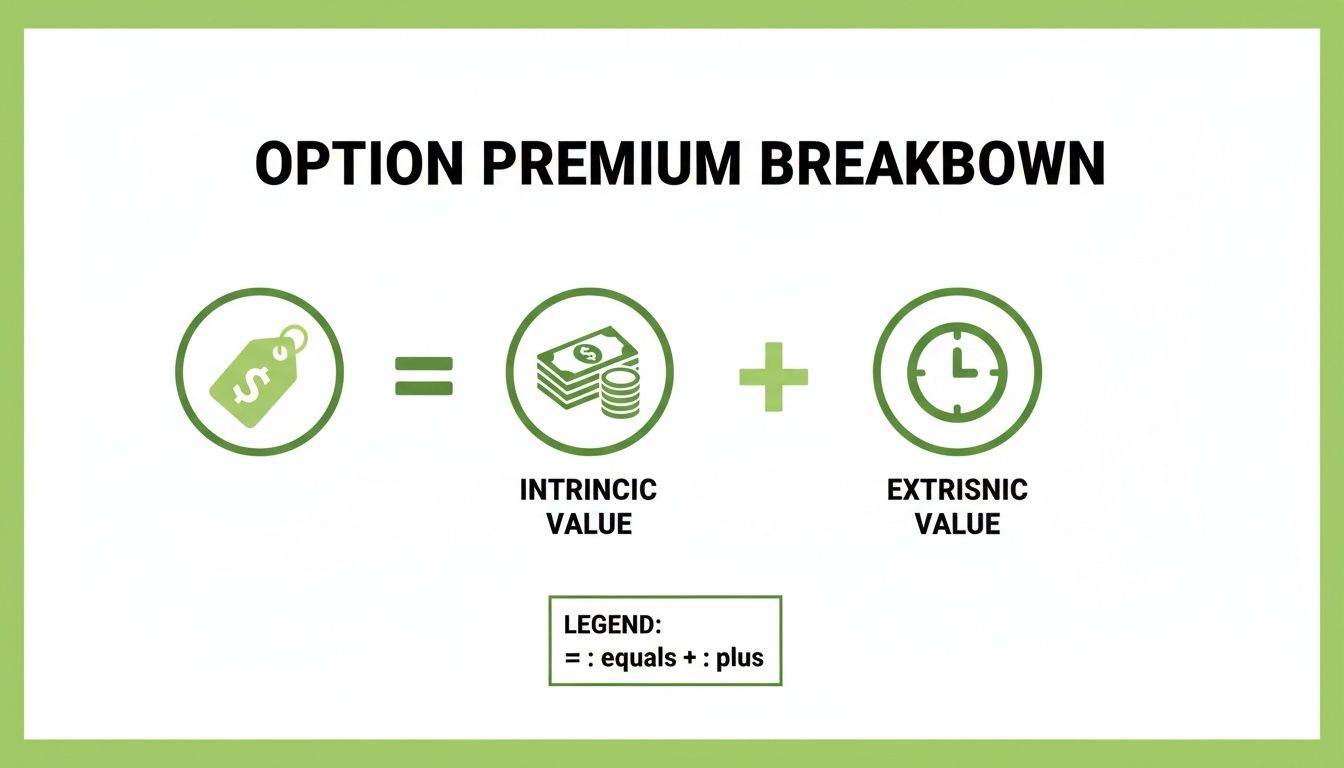
As the image shows, the premium you pay or collect is just a combination of its tangible intrinsic value and its more speculative, time-based extrinsic value.
A Practical Example With XYZ Stock
Let's make this crystal clear with a real scenario. Imagine XYZ stock is trading at exactly $50 per share. How would we classify different strike prices for calls and puts?
An option's "moneyness" is just a quick snapshot of its current health. An ITM option is healthy with real value, while an OTM option is surviving on potential alone.
To see this in action, check out the table below. It gives you a visual breakdown of how each strike price's status changes depending on whether it's a call or a put.
ITM, OTM, and ATM Status For XYZ Stock At $50
| Strike Price | Call Option Status | Put Option Status |
|---|---|---|
| $45 | In-the-Money (ITM) | Out-of-the-Money (OTM) |
| $50 | At-the-Money (ATM) | At-the-Money (ATM) |
| $55 | Out-of-the-Money (OTM) | In-the-Money (ITM) |
As you can see, the relationship is a mirror image. A strike that is ITM for a call is automatically OTM for a put, and vice-versa. This makes perfect sense, since calls profit when the stock rises above the strike, while puts profit when it falls below.
The probability of an option finishing ITM is a key metric traders rely on. This concept is closely tied to another Greek, and you can learn more about how these probabilities are measured by reading up on delta in option trading, which is often used as a rough proxy for this exact likelihood.
How To Choose The Right Strike Price
Alright, let's get into the heart of the matter. Picking a strike price isn't like throwing a dart at a board; it's where all the theory turns into an actual trading strategy. Your choice here says everything about your goal. Are you playing for consistent, smaller wins with less stress, or are you aiming for a bigger payday and comfortable with the risk that comes with it?
This single decision is the most important part of income strategies like covered calls and cash-secured puts. It sets the entire risk-reward tone for your trade the second you place it.
Balancing Safety and Income
Think of choosing your strike price like turning a knob. You can dial it up for more potential income, or dial it down for a better chance of keeping your premium without any drama. There’s no right or wrong setting—it's all about what you're comfortable with.
The relationship is pretty simple:
- Higher Potential Income: Picking a strike price closer to the current stock price (At-the-Money) will get you a much fatter premium. The catch? It also dramatically increases the odds of assignment—meaning your shares get called away or you’re forced to buy the stock.
- Higher Probability of Success: Selecting a strike price way out from the current stock price (Out-of-the-Money) means a smaller premium. But, your odds of assignment are much lower, making it a safer bet for just pocketing the cash.
There’s no magic "best" strike price. The right one is the one that fits your game plan and what you’re trying to accomplish with the trade.
Your strike price choice is a strategic trade-off. You're constantly weighing the premium you collect against the probability that the stock actually hits that price. The goal is to find that sweet spot that lines up with your financial goals and how much risk you’re willing to stomach.
Using Probability To Guide Your Decision
Instead of just going with a gut feeling or trying to predict where the market is headed, smart traders lean on data. The best tool in the box for this is probability. Forget asking, "Will the stock hit this price?" The better question is, "What are the odds the stock will hit this price?"
This data-first approach turns a wild guess into a calculated plan. Most trading platforms have a metric called Delta, which is a fantastic shortcut for estimating the probability of an option expiring In-the-Money (ITM).
For example, a call option with a Delta of 0.30 has roughly a 30% chance of finishing ITM. For an income seller, that’s great news—it also means there's a 70% chance it will expire worthless, letting you keep 100% of the premium.
A Framework for Selecting Strikes
Let's walk through how you might approach this based on your personal risk tolerance. This isn't financial advice, just a mental model to help you think strategically.
1. The Conservative Approach (Playing it Safe)
- Goal: Generate steady, reliable income with the lowest possible chance of assignment.
- Strategy: Sell options far Out-of-the-Money (OTM).
- Probability Target: Look for strike prices with a low Delta, typically between 0.10 and 0.20. This translates to an 80% to 90% probability that the option expires worthless.
- The Payoff: You'll collect smaller premiums, but you'll win a lot more often. It’s a game of compounding small gains with less anxiety.
2. The Balanced Approach (The Middle Ground)
- Goal: Earn a decent premium while keeping the odds of success comfortably in your favor.
- Strategy: Sell options that are moderately OTM.
- Probability Target: Aim for strikes with a Delta around 0.30. This gives you about a 70% chance of keeping the full premium.
- The Payoff: This is a popular spot for a reason. It's a solid mix of income and safety, offering a respectable return without taking on wild risks.
3. The Aggressive Approach (Going for Max Income)
- Goal: Squeeze out the highest possible premium, accepting a much bigger risk of assignment.
- Strategy: Sell options At-the-Money (ATM) or just a little OTM.
- Probability Target: Pick strike prices with a Delta closer to 0.40 or 0.50. Your chance of success is now basically a coin flip—around 50% to 60%.
- The Payoff: You get a huge premium right out of the gate. Traders often use this when they're perfectly fine with their shares being called away (for covered calls) or happy to buy the stock at that price (for cash-secured puts).
By building your decisions around these probability benchmarks, you create a repeatable, disciplined process. It takes emotion out of the driver's seat and grounds your strategy in real numbers—and that's the key to long-term success in options trading.
Putting It All Together With Real Trade Examples
Theory is one thing, but seeing how a strike price plays out in a real trade is where it all clicks. Let's walk through two of the most common income strategies—the covered call and the cash-secured put—to make these concepts crystal clear. We’ll look at a couple of different strike price choices for each one to show you exactly how that single decision shapes the entire trade.
These examples will show you how your choice of strike sets the rules of the game from the very beginning.
Example 1: The Covered Call
Let's say you own 100 shares of a fictional company, "TechCorp" (TC), and the stock is currently trading at $100 per share. You like the company for the long haul but want to squeeze some extra income from your shares right now. The plan is to sell a covered call that expires in 30 days.
Your choice of strike price here is everything. It dictates how much premium you collect upfront and the odds that your shares will be "called away" (sold at the strike price).
Scenario A: The Conservative OTM Strike
You decide to sell a call option with a $110 strike price. Because this is safely out-of-the-money, the premium is going to be smaller. Let's say you collect $1.50 per share, which works out to $150 for the contract (since one contract covers 100 shares).
- Your Goal: Collect a small but very safe premium. You're betting the stock won't rally past $110 in the next month.
- Maximum Profit: Your total potential gain is $1,150. That's the $150 premium plus a possible $1,000 in capital gains if the stock hits $110 and your shares get sold.
- Break-Even Point: You’ve effectively lowered your cost basis on the shares to $98.50 ($100 purchase price - $1.50 premium). You only start losing money if the stock drops below that price.
Scenario B: The Aggressive ATM Strike
Now, what if you sell a call with a $100 strike price, right where the stock is trading now? The premium is much juicier because the risk of assignment is way higher. You collect $5.00 per share, for a total of $500.
- Your Goal: Maximize your immediate income. You're totally fine with selling your shares at $100 because that huge premium makes it worth your while.
- Maximum Profit: Your gain is capped at that $500 premium. Since the strike is at your purchase price, there are no capital gains to be had, but you get a much bigger check upfront.
- Break-Even Point: Your break-even is now much lower at $95 ($100 purchase price - $5.00 premium), giving you a bigger cushion on the downside.
The Takeaway: The strike price is your trade-off dial. The conservative $110 strike offers less cash now but keeps the door open for your stock to appreciate. The aggressive $100 strike banks a big, immediate payout but puts a hard ceiling on your upside.
Example 2: The Cash-Secured Put
Alright, let's flip the script. This time, you want to buy 100 shares of TechCorp (TC), but you feel the current $100 price tag is a little steep. You decide to sell a cash-secured put to either generate income while you wait or snag the stock at a discount. To do this, you set aside $9,500 in cash to secure the trade, just in case you have to buy the shares.
Your strike price here determines the price you might have to pay for the stock and how much you get paid for being patient.
Scenario A: The Conservative OTM Strike
You choose to sell a put option with a $90 strike price. The stock would have to drop a full 10% to get there, so the premium is modest. Let's say you collect $1.00 per share, for a clean $100.
- Your Goal: You only want to buy the stock if it takes a serious dive. If not, you're happy to just pocket the premium.
- Effective Purchase Price: If the stock drops below $90 and you get assigned the shares, your real cost basis will be $89 per share ($90 strike price - $1.00 premium).
- The Outcome: If TC stays above $90, the option expires worthless and you just keep the $100. You earned a 1.1% return on your secured cash ($100 / $9,000) in 30 days without ever touching the stock. Not bad.
Scenario B: The Aggressive ATM Strike
This time, you sell a put with a $100 strike price. Because the option is at-the-money, the premium is far more attractive. You collect $5.50 per share, for a total of $550.
- Your Goal: You're more than willing to buy the stock at its current price and want to get paid the highest premium possible for that commitment.
- Effective Purchase Price: If you are assigned, your cost basis drops to $94.50 per share ($100 strike price - $5.50 premium)—a sweet discount from today's market price.
- The Outcome: If TC stays above $100, you simply keep the $550 premium. That's a 5.5% return on your secured cash in just one month.
These real-world examples prove the strike price isn't just a random number. It's the main tool you have to define your strategy, manage risk, and make sure every single trade aligns with your financial goals.
Using Data To Trade With Confidence
The biggest challenge for any income trader is wrestling with uncertainty. How do you really know the risk of a stock blowing past your strike price? Instead of just going with your gut, today's tools can turn that guesswork into a calculated, data-driven decision.
Platforms like Strike Price give you clear, real-time probability metrics for every single strike price available. Imagine seeing the exact, data-backed likelihood of assignment before you even think about placing a trade. This completely changes the game from just hoping for a good outcome to actively planning for one.
From Guesswork to a Methodical Strategy
Using real data turns selling options from a nerve-wracking gamble into a repeatable system for building income. When you can see the numbers behind the risk, you can make choices that fit your personal comfort level perfectly.
This lets you find that sweet spot between safety and income on every single trade. It's not just about picking a strike price anymore; it's about picking a probability that matches your goals.
Here’s how a data-first approach helps you trade smarter:
- Real-Time Probability Metrics: Instantly see the statistical odds of any strike price ending up in-the-money by expiration.
- Smart Alerts: Get a heads-up on high-reward opportunities or when a position's risk suddenly changes, so you can act fast.
- Portfolio Dashboards: See all your positions in one place, making it easier to manage your overall strategy and see how you’re doing.
When you ground your decisions in probability, you stop being a reactive trader and become a proactive strategist. You can set your own rules—like only selling options with a 75% or greater chance of expiring worthless—and build a system you can count on.
Making Informed Decisions with Confidence
Ultimately, this data-driven method is all about building confidence. When you know the statistical odds of your trade, you can enter a position with a clear head, fully understanding the potential outcomes. It replaces emotional, seat-of-your-pants decisions with a calm, logical framework for generating income.
To explore more advanced ways of analyzing the market, you can also look into how AI can be leveraged for financial analysis. By combining powerful tools and smarter analytical methods, you give yourself the insights needed to trade with the kind of conviction that only comes from solid data.
Frequently Asked Questions
Once you've got the basics down, a few common questions always pop up. Let's tackle them head-on.
How Does Time Decay Affect Strike Price Selection?
Time decay, or theta, is an option seller's best friend. Think of it as the daily rent you collect for taking on the contract. It’s the rate at which an option's extrinsic value melts away as the expiration date gets closer.
Options that are At-the-Money (ATM) have the most extrinsic value packed into them, so they experience the fastest time decay. Selling ATM strikes can generate the most income, but it's a bit like standing closer to the fire—you get more heat, but also a higher risk of getting burned (assigned).
On the flip side, selling Far-Out-of-the-Money (OTM) options brings in a smaller premium. However, you have a much higher probability of keeping that premium, since theta has less value to eat away and the stock has further to travel.
What Happens When My Option Is Assigned?
Assignment isn't something to be afraid of. It’s just the other side of the contract playing out exactly as planned based on the strike price you chose.
- Covered Call Assignment: You sold a call, and the stock price closed above your strike at expiration. Your 100 shares are automatically sold at that strike price. You get to keep the premium you collected from selling the call, plus all the cash from the stock sale.
- Cash-Secured Put Assignment: You sold a put, and the stock price finished below your strike. You're now obligated to buy 100 shares of the stock at that strike price. The premium you collected helps lower your effective cost basis, since it's money you were paid upfront.
Can I Change My Strike Price After a Trade Is Placed?
Nope, you can't edit an existing options contract. But you can do the next best thing: "roll" the position.
Rolling simply means closing out your current option and immediately opening a new one on the same stock, but with a different strike price and a later expiration date. Traders do this all the time to dodge an assignment they don't want or to adjust their outlook if the market starts moving in an unexpected direction.
While getting a handle on strike prices is key to trading options, it's just as important to recognize the risks and the possibility of investment losses. For guidance on recovery, you can look into resources covering options investment loss recovery options.
Ready to stop guessing and start trading with data-driven confidence? Strike Price gives you the real-time probability metrics you need to make smarter decisions on every single trade. Find your perfect balance of safety and income.