
How to Trade Stock Options for Steady Weekly Income
If a stock moves past your strike, the option can be assigned — meaning you'll have to sell (in a call) or buy (in a put). Knowing the assignment probability ahead of time is key to managing risk.
Posted by
 John Clarke
Related reading
Out of Money Call Options A Guide to Consistent Income
Learn how to use out of money call options to generate consistent income. This guide covers key strategies, risk management, and real-world examples.
How Options Are Priced A Practical Guide for Investors
Understand how options are priced with this clear guide. Learn about intrinsic value, implied volatility, and pricing models to improve your investing strategy.
Greek Options Explained for Income Traders
Unlock your options trading potential. This guide on greek options explained shows you how to use Delta, Gamma, and Theta to generate consistent income.
To really succeed with stock options, the first thing you have to do is completely reframe your goal. Forget the high-stakes gambles. We're here to talk about building a consistent, reliable income stream.
The key is to be the seller of options contracts—like covered calls and cash-secured puts—not the buyer. This simple switch allows you to collect upfront cash payments, called premiums. It’s a move that transforms options from a lottery ticket into a powerful tool for generating steady cash flow from your portfolio.
Shifting From Speculator to Income Earner

You've probably heard the wild stories of traders making—or losing—a fortune overnight. That world definitely exists, but it’s not the path to dependable income.
Our focus is entirely different. We treat options trading like a business where you are the seller. Think of yourself as a landlord collecting rent, not a house flipper chasing one massive payday.
This guide will show you how to trade options by becoming "the house," putting the mathematical odds firmly in your favor.
The Mindset of an Options Seller
The core of this strategy is a powerful mindset shift. You're no longer trying to predict exactly where a stock is headed. Instead, you're using simple data to determine where it probably won't go.
That distinction is everything.
By selling options, you get paid right now for taking on a specific, calculated risk over a set period. Success comes from leaning into a few key principles:
- You get paid upfront. The second you sell an option, the premium hits your account. That's your income, and it’s yours to keep, no matter what happens next.
- Time is your best friend. Every single day that passes, the value of the option you sold shrinks. This is called time decay (or theta), and it works directly in your favor as a seller.
- Probability is your guide. No more guessing. You'll learn how to use straightforward probability metrics to find trades that have a high likelihood of expiring worthless, which lets you pocket the entire premium.
By focusing on selling premium instead of buying for speculative gains, you move from gambling on market direction to operating a probability-based business. Your goal isn't to hit a home run; it's to consistently get on base.
This approach is especially great for beginners because it’s built on defined rules and solid risk management, not gut feelings or risky bets.
Let's break down the two fundamentally different approaches to see exactly why selling is the smarter way to generate income.
Options Trading Speculation vs Income Generation
| Strategy Focus | Buying Options (Speculation) | Selling Options (Income Generation) |
|---|---|---|
| Primary Goal | Huge, rapid gains from predicting major price moves. | Consistent, reliable income from collecting premiums. |
| How You Profit | The stock must move significantly in your predicted direction before expiration. | The stock simply needs to not move too far against you. Time decay works in your favor. |
| Probability of Success | Low. Most options expire worthless, making this a tough game to win consistently. | High. You can structure trades to have a 70%, 80%, or even 90% chance of success. |
| Role of Time | Time is your enemy. Every day that passes erodes the value of your option. | Time is your friend. Time decay is a primary source of your profit. |
| Analogy | Buying a lottery ticket. High risk, high reward, low probability. | Being the insurance company. You collect premiums for taking on calculated risks. |
As the table makes clear, buying options is a bet on the future, while selling them is a business built on the present. By selling, you start every trade with an immediate profit (the premium) and let time and probability do the heavy lifting for you.
Your Core Strategies: Covered Calls and Cash-Secured Puts

Alright, this is where the theory stops and your income engine really starts humming. We’re diving into the two strategies that will become the bedrock of your weekly cash flow: covered calls and cash-secured puts.
These aren't complex, lottery-ticket bets. Think of them as smart, repeatable financial moves—two sides of the same coin. One lets you generate income from stocks you already own, and the other pays you to potentially buy stocks you want at a discount. Getting these two down is everything.
Covered Calls: Your Stock Portfolio’s Rental Service
The covered call is probably the simplest and most popular income strategy out there. If you own at least 100 shares of a stock, you can start selling them today. The idea is dead simple: you’re essentially "renting out" your shares for a fee.
You do this by selling a call option against your stock. This contract gives the buyer the right (but not the obligation) to purchase your 100 shares at a set price—the strike price—on or before a specific date, known as the expiration date.
Just for agreeing to this, you get paid an upfront, non-refundable cash payment called the premium. That money is yours to keep, no matter what happens next. It's instant income, deposited right into your brokerage account.
Let's walk through a real-world scenario.
- You own 100 shares of Company XYZ, which is currently trading at $45 per share.
- You decide to sell one call option contract with a $50 strike price that expires in 30 days.
- For making this trade, you immediately collect a premium of, say, $1.00 per share. That’s $100 cash in your pocket ($1.00 x 100 shares).
Now, you just wait. If XYZ stays below $50 by the expiration date, the option expires worthless. You keep the $100 premium and your 100 shares, and you're free to do it all over again. That's the perfect outcome for pure income generation. For a deeper dive, check out our guide on the covered call strategy for income.
Cash-Secured Puts: Get Paid to Buy the Stocks You Want
Now, let's flip the script. What if you want to buy a stock, but you think the current price is just a little too steep? This is where the cash-secured put becomes your best friend. It’s like setting a limit order to buy a stock you like, but you actually get paid while you wait for your price.
Here, you sell a put option. This gives the buyer the right to sell you 100 shares of a stock at your chosen strike price by the expiration date. In return for taking on this obligation, you collect a premium.
To make it "cash-secured," you need to have enough cash in your account to buy those 100 shares if you get assigned. This isn't just a suggestion; it's a critical risk management rule.
Key Takeaway: A cash-secured put is a bullish strategy. You use it to either buy a stock for cheaper than it's trading today or to just generate income if the stock price stays above your target entry point.
Imagine this situation:
- You want to own 100 shares of Company ABC, currently trading at $98, but you'd feel much better buying it at $95.
- You sell one put option with a $95 strike price that expires in two weeks. To secure the trade, you set aside $9,500 ($95 x 100 shares) as collateral.
- The moment you place the trade, you collect a premium of $1.50 per share, pocketing $150.
If ABC’s price stays above $95, the option expires worthless. You keep the $150 and your $9,500 is freed up. You literally made money for being willing to buy a stock at your price. If it drops below $95, you’ll be assigned the shares at $95, but your actual cost basis is lower because you get to keep that $150 premium.
Setting Up Your Trading Operation
Once you’ve got the strategies down, it's time to build your command center. Success in options trading isn't just about picking winners; it's about creating a disciplined, repeatable process right from the start. That means choosing the right tools and—just as important—getting your head in the game.
Your brokerage account is ground zero. Don’t just sign up for the first one you see. You need a broker that’s options-friendly, which really means they offer low (or zero) commissions per contract. Since you'll be trading often to generate income, even a small fee like $0.65 per contract adds up fast and will absolutely chew through your profits over time.
Beyond cost, look at the platform itself. Can you easily find the data you need, like an option's Delta or its Implied Volatility? A clean, intuitive platform makes a world of difference when you're trying to execute and manage trades without pulling your hair out.
Getting the Right Account Access
When you open your brokerage account, you’ll have to apply for options trading approval. This is completely standard. Brokers just need to make sure you have a basic understanding of the risks involved.
For the strategies we’re focused on—selling covered calls and cash-secured puts—you typically only need the first couple of approval levels.
- Level 1 Approval: This usually allows you to sell covered calls. It’s perfect if you already own shares of stock and want to put them to work generating income.
- Level 2 Approval: This typically adds the ability to sell cash-secured puts, which is essential for rounding out your income-focused toolkit.
The application will ask about your investing experience, income, and net worth. Be honest. Most traders who stick to these conservative strategies will have no problem getting the access they need.
Defining Your Plan and Mindset
The tech setup is the easy part. It’s the mental game that separates traders who last from those who don't. Before you even think about placing a trade, you have to define your rules of engagement. This is your personal trading plan—a set of non-negotiable guidelines that will save you from making emotional decisions later.
First, get clear on your income goals. Are you trying to make an extra $200 a week or $1,000 a month? A specific target helps you filter out bad trades and stops you from chasing unrealistic premiums.
Next, you have to be brutally honest about your risk tolerance. For every covered call, ask yourself this simple question: “Am I truly okay with my 100 shares being sold at this strike price?” If the answer is no, it's the wrong strike. Period. For cash-secured puts, it’s: “Am I genuinely happy to buy 100 shares of this company at this price if it drops?”
Your trading plan is your constitution. It dictates what you will and won't do, protecting you from your own worst instincts in moments of market panic or greed. Write it down and treat it like law.
A simple trading journal or dashboard is a game-changer for staying disciplined. At a minimum, track the entry date, underlying stock, strike price, expiration, and the premium you collected. Also, jot down why you entered the trade. This simple habit creates accountability and gives you invaluable data to refine your approach over time, helping you learn how to trade options more effectively.
Placing Your First Trade with a Data-Driven Edge
Alright, your account is funded and you've got a game plan. Now it's time to put your money to work. This is the moment you shift from theory to action and place your first trade.
A solid options income strategy comes down to three key decisions—all of which should be guided by data, not gut feelings.
For every single trade, you'll need to choose a stock, an expiration date, and a strike price. Getting this process right is the secret to generating consistent weekly income. Let's walk through it, step-by-step.
This simple workflow is the foundation of a repeatable, low-stress trading operation.
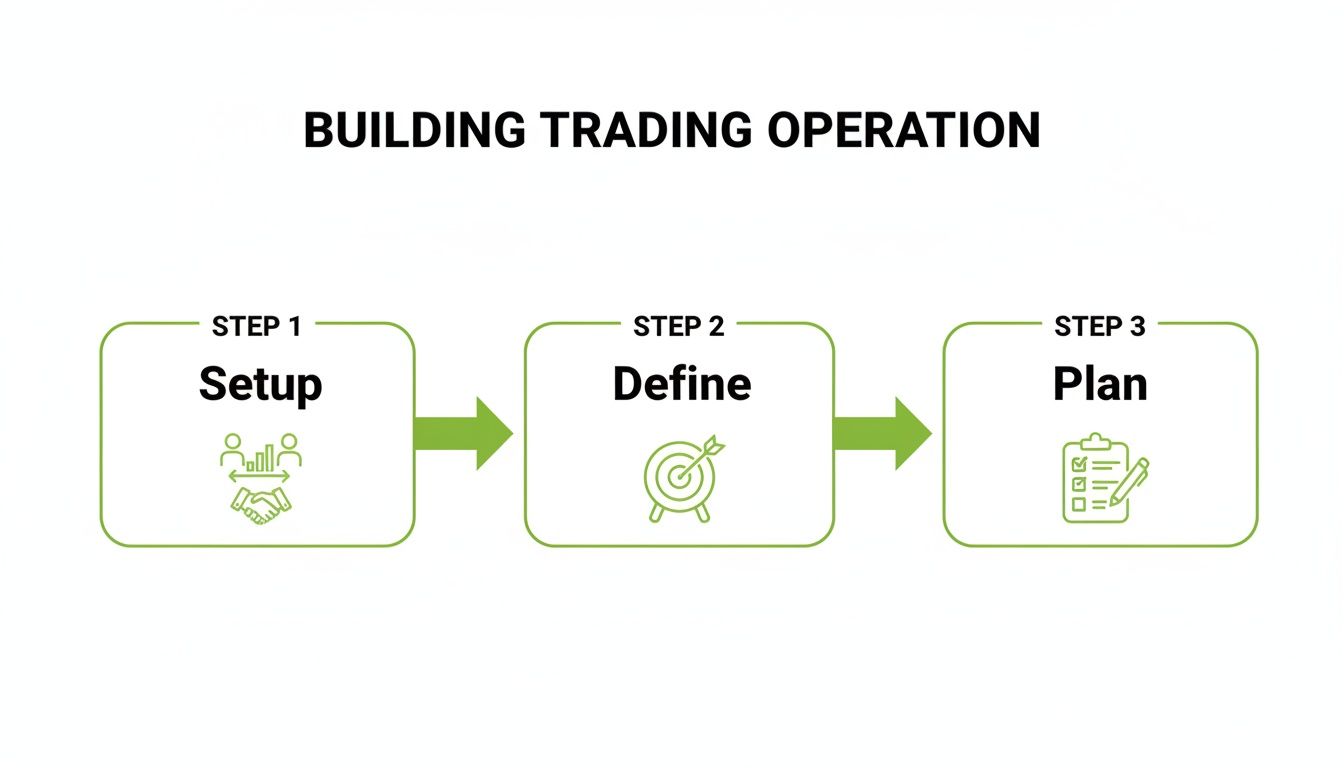
It’s all about a structured approach: get your tools set up, know your criteria cold, and plan every move before you click "trade."
Choosing Your Underlying Stock
First things first: you need to pick the right stock. Not all stocks are good candidates for selling options. What we're looking for is stability and, most importantly, high liquidity.
A liquid options market is one with tons of buyers and sellers, which creates a tight bid-ask spread. Think of this as the tiny gap between what someone is willing to pay (the bid) and what someone is willing to sell for (the ask).
When that gap is just a penny or two, you can get in and out of trades at a fair price without getting ripped off. This is why stocks like SPY, QQQ, AAPL, and MSFT are staples for options sellers—their markets are always buzzing with activity.
This isn't just a niche strategy, either. Single-stock options are a massive part of the derivatives market, accounting for 66% of the 16.44 billion contracts traded in 2024—a 19.4% jump from last year. And since the U.S. markets make up a 61% global share, this is where the best opportunities are.
Selecting an Expiration Date
Once you have your stock, the next question is when. How long do you want this trade to be open? This is your expiration date.
As an income seller, you want to hit the sweet spot—collecting a decent premium without locking up your cash or shares for too long.
Options lose value faster as they get closer to expiration. This time decay, called theta decay, works in your favor as a seller. It's why many traders focus on weekly options, typically looking 7 to 45 days into the future. This range usually offers a great balance of premium income and the ability to compound your returns frequently.
Using Delta to Pick a Strike Price
This is where the magic happens. Your strike price is the most important decision you'll make, and using data gives you a serious edge. This is the price where you agree to either sell your shares (for a covered call) or buy shares (for a cash-secured put).
Instead of guessing, we use a simple metric called Delta.
Delta is one of the options "Greeks," which are just risk measurements. It has a technical definition, but for our purposes, you can think of it as a quick and dirty proxy for probability.
Pro Tip: An option's Delta gives you a rough estimate of the probability it will expire in-the-money (ITM). A call option with a 0.20 Delta has roughly a 20% chance of expiring ITM. That means there's an 80% chance it expires worthless—exactly what you want as a seller.
Your goal is for the option to expire worthless so you can keep the full premium. That means you want to sell options with a low Delta. A conservative starting point is to sell options with a Delta between 0.15 and 0.30. This translates to a 70% to 85% probability of the trade being profitable. Understanding this is everything, and our article on the probability of profit in options trading goes much deeper.
Let's put this into practice with a covered call example.
- Stock: You own 100 shares of Microsoft (MSFT).
- Expiration: You pick a date 30 days from now.
- Strike Selection: You pull up the option chain and find a call strike with a 0.25 Delta. That’s your target. You're selling the contract that has a high probability of expiring worthless, letting you keep both the premium and your shares.
When you're ready to place the trade, always use a Limit Order, not a Market Order. This lets you set the minimum price you're willing to accept for the option. It protects you from getting a bad price if the market moves suddenly.
Once your order is filled, the cash premium hits your account instantly. Just like that, your first data-driven trade is live.
How to Manage Your Open Trades Before They Expire
Putting the trade on is only half the job. The real craft of trading options for consistent income comes down to what you do after the trade is live. This isn't a "set it and forget it" game; it's about staying engaged and making smart, proactive decisions before expiration day arrives.
Once you’ve sold a contract, your job is to monitor it as it heads toward one of three outcomes. Having a clear plan for each scenario is what separates disciplined traders from gamblers. This is how you lock in your wins, cut your losses, and protect your capital.
The Best Case Scenario: Expiring Worthless
The perfect outcome for any option you sell is for it to simply expire worthless. This means the stock price never crossed your strike, so the contract never got assigned.
When this happens, you do absolutely nothing. The contract vanishes after the market closes on expiration day, and you keep 100% of the premium you collected. Your obligation is gone. If it was a covered call, your shares are free again. For a cash-secured put, your collateral is released. It's the cleanest win you can get.
This outcome is the entire point of a probability-driven income strategy. You sold an option that had a high chance of expiring out-of-the-money, and the math worked in your favor. Now you're free to sell a new option for the next week or month and repeat the cycle.
Closing a Position Early to Lock in Profits
Waiting until the final bell on expiration day isn't always the sharpest move. Markets can turn on a dime, and a profitable trade can quickly become a problem. A core tactic of professional traders is closing a position early after capturing most of the potential profit.
Why bother? Because the final week of an option's life is often when the biggest, most unpredictable price swings happen. That’s where the risk is.
A common guideline I stick to is the "50% profit in 50% of the time" rule.
- Example: You sell an option with 30 days to go and pocket a $200 premium.
- Just 15 days later, time decay and a favorable stock move have eroded the option's value to $100.
- You can now buy back that same contract for $100, instantly closing your position and banking a $100 profit.
You just made half the potential profit in half the time, and more importantly, you've removed 100% of the risk. Your capital (or shares) is now free to deploy on a new trade, rather than waiting two more weeks for the last few dollars to decay away.
By closing a trade early, you are choosing a guaranteed profit now over a slightly larger, uncertain profit later. This is a hallmark of disciplined, risk-averse trading.
The Art of Rolling Your Position
So what happens when a trade goes against you? You don’t have to just sit there and take the loss or get assigned. This is where you learn to "roll" the trade. Rolling is just a slick way of saying you’re closing your current option and immediately opening a new one on the same stock.
It’s a powerful adjustment tool used for two main reasons:
- To Avoid Assignment: If the stock is threatening your strike price near expiration, you can roll the option "out" to a later expiration date. You can often also roll "up" (for calls) or "down" (for puts) to a safer strike. You're basically buying yourself more time for the trade to work out.
- To Continue Generating Income: When a trade works out perfectly and expires worthless, you can simply roll it to the next expiration cycle to keep the income train moving on a stock you like.
When you roll to defend a trade, you can often do it for a net credit. This means the premium from the new option is more than the cost to close the old one, putting more cash in your account while improving your position. It’s a flexible tactic that keeps you in the driver's seat.
To make these decisions easier, I use a simple mental framework. This quick-reference table breaks down what to do and when.
Trade Management Decision Matrix
| Scenario | Your Action | Why You Do It |
|---|---|---|
| Option is profitable early (e.g., 50% profit in 50% of the time) | Close the Trade | To lock in a guaranteed profit and eliminate all remaining risk. Frees up capital for new opportunities. |
| Option is expiring worthless | Hold to Expiration (Do Nothing) | To capture 100% of the premium collected. This is the ideal, hands-off outcome. |
| Stock is moving against you (challenging your strike) | Roll the Trade (Out, and Up/Down) | To avoid assignment and give the trade more time to become profitable, often for an additional credit. |
| Stock is moving against you quickly (and you've lost conviction) | Close for a Small Loss | To cut your losses and prevent a small problem from becoming a big one. Protects your capital. |
This matrix isn't rigid, but it provides a solid foundation for making clear, unemotional decisions about your open trades. Having a plan beforehand is what separates consistent income from hopeful gambling.
Using Smart Tools to Streamline Your Income Strategy
Once you’ve got the hang of how to trade stock options, your focus will naturally shift from learning the basics to being more efficient and consistent. Let’s be honest, manually scanning for good trades, crunching probabilities, and babysitting your open positions can feel like a full-time job. This is exactly where smart tools come into play, automating the grind so you can focus on the strategy.
Modern platforms are built to do the heavy lifting for you. Instead of scrolling through endless option chains, you can just plug in your own rules—like a specific weekly income goal or a risk level you’re not willing to cross—and let the software hunt down trades that fit your plan perfectly.
Imagine getting a real-time alert on your phone for a high-probability covered call on a stock you already own. It perfectly matches your goals for both safety and income. That’s the kind of power you unlock when you move from a manual process to an optimized one.
From Manual Searches to Automated Alerts
The real game-changer here is turning your trading plan into a proactive system. You can set up rules, like only selling options with less than a 20% chance of assignment, and get a ping the second a qualifying opportunity pops up.
This applies just as much to managing risk. A good tool will keep an eye on your open positions and warn you if a stock’s price movement pushes the probability of assignment above your comfort zone. This gives you a heads-up to decide whether to close or roll the trade before it turns into a problem.
This shift is all about making smarter, faster decisions. It’s the difference between reacting to the market and having a system that helps you anticipate it, whether you’re at your desk or checking in on your phone.
The options market is more active than ever, which is great news for income-focused traders. In 2025, the U.S. options market saw a record-breaking 15.2 billion contracts traded, a 26% jump from 2024. All that liquidity—averaging 61 million contracts a day—means tighter spreads and better prices when you sell premium. This is a huge advantage for platforms that use real-time probability data to pinpoint the best trades. You can read more about the state of the options industry on cboe.com.
Key Features to Look For
Not all tools are created equal, though. For an income seller, some features are non-negotiable if you want to build a strategy that lasts. We break this down in more detail in our guide to the best options trading software.
When you’re kicking the tires on different platforms, make sure these functions are front and center:
- Probability-Based Scanners: You need tools that let you filter for trades based on their actual statistical odds of expiring worthless. Think: "Show me all covered calls with a <25% chance of assignment."
- Customizable Alerts: These are your eyes and ears. You want real-time pings for new trades that fit your rules and for any rising risk in your current positions.
- Consolidated Dashboard: A clean, single view to track all your open contracts, premiums collected, and performance is a must. It gets you out of messy spreadsheets for good.
Using the right tools helps you run your income strategy with precision, saving you hours of manual research and letting you execute your plan with confidence.
Got Questions? Let's Talk Practicalities
Even with the best plan, jumping into options trading for the first time brings up a ton of practical "what if" questions. It's totally normal. Getting these cleared up is what gives you the confidence to actually place a trade.
Here are the most common questions that pop up when people are starting out.
How Much Cash Do I Actually Need to Start?
This is the big one, and the honest answer is: it really depends on the stocks you want to trade. There's no single magic number.
For a cash-secured put, the math is straightforward. You need enough cash in your account to buy 100 shares at the strike price you choose. If you sell a put on a $20 stock with a $15 strike, you'll need $1,500 ($15 strike x 100 shares) sitting there as collateral.
For a covered call, you have to own the stock first—specifically, 100 shares of it. So your starting capital is whatever it costs to buy those shares. That could be a few hundred dollars for a cheaper stock or tens of thousands for something like Amazon or Google.
What Happens If My Option Gets Assigned? Is That Bad?
First off, getting assigned is not a failure. It's not a penalty or a mistake. It's one of the two planned outcomes for every trade you make.
Think of it as the contract simply playing out exactly as designed.
- Covered Call Assignment: You sell your 100 shares at the strike price you agreed to. Simple as that.
- Cash-Secured Put Assignment: You buy 100 shares at the strike price you agreed to. You just bought a stock you wanted at a discount.
And in both cases, you keep 100% of the premium you were paid upfront. Assignment is just the fulfillment of your end of the deal.
Assignment is a core part of the income cycle. It's not something to fear. Getting your puts assigned means you now own shares you can immediately start selling covered calls on. It's how the wheel turns.
Can I Lose More Than the Premium I Collect?
Yes, but it's crucial to understand where the risk comes from. The risk isn't in the option contract itself—it's tied to the underlying stock you're dealing with.
With a covered call, your risk is that the stock absolutely moons, soaring way past your strike price. You'll make a profit, but you'll miss out on those extra gains. It's an opportunity cost.
With a cash-secured put, the real risk is that you're forced to buy a stock that then continues to tank. Suddenly, you own 100 shares of a falling company.
This is exactly why the golden rule is to only sell options on high-quality companies you'd be perfectly happy to own for the long haul anyway. If you follow that one rule, you dramatically reduce your risk.
Ready to stop guessing and start making data-driven trades? Strike Price gives you the real-time probability metrics you need to find high-probability trades, manage risk, and build a consistent income stream. Start your free trial at strikeprice.app.