
How Can I Learn to Trade Options A Realistic Path to Success
If a stock moves past your strike, the option can be assigned — meaning you'll have to sell (in a call) or buy (in a put). Knowing the assignment probability ahead of time is key to managing risk.
Posted by
 John Clarke
Related reading
Out of Money Call Options A Guide to Consistent Income
Learn how to use out of money call options to generate consistent income. This guide covers key strategies, risk management, and real-world examples.
How Options Are Priced A Practical Guide for Investors
Understand how options are priced with this clear guide. Learn about intrinsic value, implied volatility, and pricing models to improve your investing strategy.
Greek Options Explained for Income Traders
Unlock your options trading potential. This guide on greek options explained shows you how to use Delta, Gamma, and Theta to generate consistent income.
Learning how to trade options isn't about chasing quick profits; it's a journey of disciplined education and consistent practice. Think of it as a structured process: you first master the core concepts, then focus on conservative income strategies like covered calls and cash-secured puts. Along the way, you'll learn to manage risk by thinking in probabilities and get plenty of practice in before putting real money on the line.
This methodical approach is what turns options trading from a high-stakes gamble into a repeatable, rules-based business.
Your Realistic Path to Trading Options
The allure of options often comes from stories of massive, overnight gains. But the reality for consistent, long-term success is far less dramatic—and infinitely more sustainable. It all starts with a fundamental mindset shift. You're not trying to predict the market; you're the owner of a small business that sells insurance. Your "product" is the options contract, and the premium you collect is your revenue.
This guide provides a practical blueprint for building that business. We'll be using a crawl-walk-run methodology designed to build your skills and confidence systematically. You won't get bogged down with dozens of complex strategies. Instead, you’ll master two foundational techniques perfect for generating steady income.
Adopting a Business Owner Mindset
The biggest hurdle for new traders is almost always psychological. Gamblers chase those lottery-ticket wins, often buying cheap, far out-of-the-money options that have a tiny probability of success. A business owner, on the other hand, operates on probabilities and careful risk management.
Your goal is to "sell policies" (options contracts) that are statistically likely to expire worthless, letting you keep the premium. This approach immediately puts the odds in your favor.
The core of this method is simple: Don't guess where the market is going. Instead, identify where it is unlikely to go and structure your trades around that. This is the bedrock of high-probability income trading.
This strategic shift is more important than ever. The options market has seen explosive growth, with volume averaging a record 59 million daily contracts—a 22% increase from the previous year. With so much activity, a disciplined, educated approach is what will set you apart. You can learn more about these options trading statistics and what they mean for traders.
The Four Core Pillars of Learning Options Trading
To navigate this landscape successfully, your education should stand on four core pillars. Each one builds on the last, creating a stable framework for your entire trading journey. Think of them as the non-negotiable building blocks for success.
| Pillar | What It Means | Why It's Critical |
|---|---|---|
| Foundation First | Mastering core concepts like calls, puts, and the Greeks. | You can't execute a strategy if you don't understand its moving parts. |
| Strategy Focus | Specializing in high-probability income strategies. | This prevents analysis paralysis and helps you build deep expertise in repeatable methods. |
| Risk Management | Thinking in probabilities and protecting your capital. | It ensures you can survive the inevitable losing trades and stay in the game for the long haul. |
| Practical Application | Moving from paper trading to small, live trades. | This is where you bridge the crucial gap between theory and real-world execution. |
By committing to this structured path, you move beyond just asking "how can I learn to trade options?" and start building the skills to actually do it—safely and effectively.
Laying the Groundwork: Core Options Concepts
Trying to trade options without knowing the lingo is like showing up to a poker game without knowing what a full house is. You're going to lose your shirt. Before you even think about placing a trade, you have to get the basics down. This isn't about memorizing crazy formulas, but about internalizing a few key ideas that drive every single trade.
An options contract is just an agreement. It gives the buyer the right (but not the requirement) to buy or sell a stock at a set price by a certain date. The seller, on the other hand, has the obligation to make good on that deal if the buyer decides to go through with it. Think of it like a very specific, time-sensitive rain check for a stock.
Of course, options don't exist in a vacuum. They're tied to the stocks themselves. If you're completely new to the markets, it’s a good idea to get a handle on the fundamentals first. A good primer on how to start investing in the stock market for beginners will give you the context you need to understand why and how these contracts are valuable.
Calls and Puts: The Two Sides of the Coin
Everything in the options world boils down to two types of contracts: calls and puts. Figuring out what they do is your first real step.
Call Options: A call gives its owner the right to buy a stock at a certain price. Someone buying a call is bullish; they think the stock is going way up. As an income seller, you'd sell a call when you're neutral or even a little bearish, betting the stock will stay below a certain price.
Put Options: A put gives its owner the right to sell a stock at a certain price. A put buyer is bearish, betting the stock is going to tank. We, as income sellers, would sell a put when we're neutral to bullish, believing the stock will stay above a certain price.
Since our goal is to generate income, we will almost always be the seller of these contracts. In exchange for taking on the obligation, we collect a payment—the premium—right away. That's our paycheck.
The Anatomy of an Options Contract
Every single options contract, whether it's for Apple or some small-cap stock, is built from the same parts. Get these down, and you'll be able to read an option chain like a pro.
| Term | What It Really Is | A Simple Way to Think About It |
|---|---|---|
| Strike Price | The locked-in price where you agree to buy or sell the stock. | The price printed on your rain check. |
| Expiration Date | The day the contract dies and becomes worthless. | The "Expires On" date on that rain check. |
| Premium | The cash the buyer pays you (the seller) for the contract. | The fee someone pays you for the rain check. |
That premium is what this is all about for us. It's our revenue. The interesting part is that the premium is made of different kinds of value. For our strategies, we're laser-focused on extrinsic value. This is the portion of the premium that comes from time and volatility—it's pure profit potential that decays a little bit every single day, which is exactly what we want as sellers.
A Quick Intro to "The Greeks"
Don't let the name scare you. The "Greeks" are just a handful of metrics that tell you how a contract will behave. You don't need a math PhD, but you absolutely need to know these three to manage your risk.
Delta: This tells you how much an option's price will move for every $1 change in the stock price. But here's the real magic: Delta is an amazing shortcut for probability. A 30 Delta option has roughly a 30% chance of finishing "in-the-money" (meaning it has value at expiration).
Theta: This is the option seller's best friend. Theta measures how much value an option loses every single day just from the passage of time. As a seller, you want this decay working for you around the clock.
Vega: This measures how sensitive an option is to changes in volatility. Higher volatility pumps up option premiums (which is great when you're selling), but a sudden drop in volatility after you've sold a contract can shrink its value fast.
By focusing on Delta, you stop guessing where a stock is headed and start making trades based on where it probably won't go. Selling a 15 Delta call isn't a bet on the stock's direction; it's a calculated position with an approximate 85% probability of expiring worthless. That’s the difference between gambling and running a trading business.
Mastering Two Foundational Income Strategies
Forget trying to learn dozens of complex options strategies at once. The fastest path to consistent income is to master just two: the covered call and the cash-secured put. These are the workhorses of premium selling, designed for steady cash flow, not lottery-ticket wins.
By focusing on these two, you build a deep, practical understanding of how options really work. And the market is ripe with opportunity—single stock options volume has jumped 25% year-to-date, with ETF and index options up 18% and 17% respectively. This growth means more liquid, tradable opportunities for straightforward strategies like these. You can see the full breakdown by checking out the latest options industry trends on cboe.com.
Before you can execute these, you need to understand the basic building blocks: Calls, Puts, the Greeks, and the contract itself.
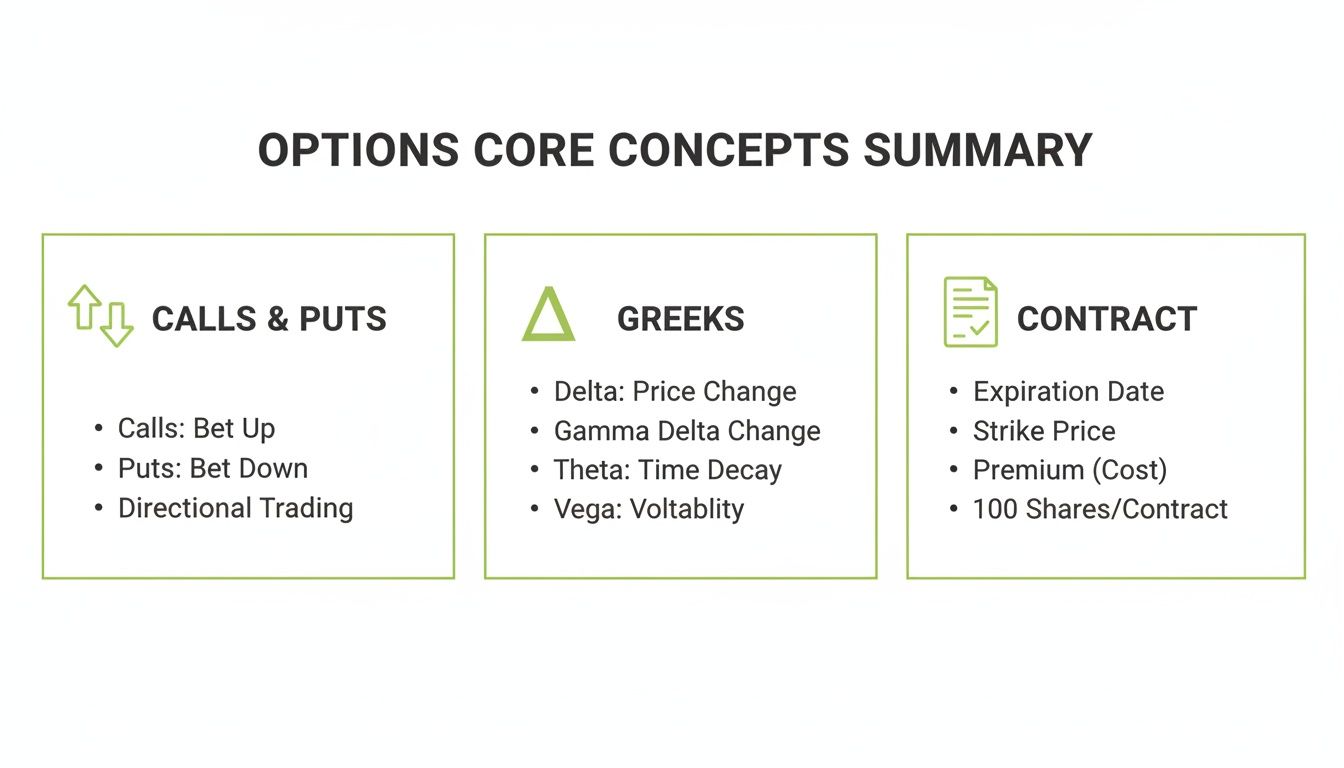
Get comfortable with these concepts first. They are the foundation for everything that follows.
Strategy One: The Covered Call
The covered call is easily the most popular place to start. Think of it as renting out stocks you already own. The "covered" part is the key—it means you hold at least 100 shares of the underlying stock, which makes this a defined-risk trade.
Here’s the simple version:
- You own 100 shares of a stock (or ETF).
- You sell one call option contract against those shares.
- You immediately collect cash (the premium) in your account.
Your goal is for the stock price to stay below the strike price you chose. If it does, the option expires worthless, you keep the entire premium, and you still have your shares. Then you can do it all over again next month. For a deeper dive, check out our guide on the covered call strategy for income.
A Real-World Covered Call Scenario
Let's say you own 100 shares of Apple (AAPL), currently trading around $190. You think the stock will probably hover around this price or creep up a bit over the next month, but you don't expect it to rocket past $200.
So, you sell one AAPL call option with a $200 strike price that expires in 30 days. For selling this contract, you might collect $2.50 per share in premium. That's $250 ($2.50 x 100 shares) deposited into your account right away.
At expiration, one of two things happens:
- Outcome A (AAPL is below $200): The option expires worthless. You keep the $250 free and clear and you still own your 100 shares of AAPL. You just made a quick 1.3% return on your stock position in a month.
- Outcome B (AAPL is above $200): Your shares get "called away." This means you have to sell your 100 shares at the agreed-upon $200 strike price. You still keep the $250 premium, plus you lock in a capital gain as the stock moved from $190 to $200.
Strategy Two: The Cash-Secured Put
The cash-secured put is the other side of the income coin. It’s a brilliant strategy because you either get paid to wait to buy a stock you already want, or you get to buy that stock at a discount.
"Cash-secured" simply means you have enough cash in your account to buy 100 shares of the stock at the strike price you choose. Your broker will set this cash aside as collateral.
Think of a cash-secured put as setting a limit order to buy a stock, but getting paid while you wait. If the order fills, you get the stock at your desired price. If it doesn't, you keep the payment for your patience.
A Practical Cash-Secured Put Example
Imagine Microsoft (MSFT) is trading at $425, but you think that's a little rich. You’d be a happy owner if you could get it for $410.
You decide to sell one MSFT put option with a $410 strike price that expires in 45 days. To do this, you must have $41,000 ($410 x 100) available in your account. For selling this contract, let's say you collect a $6.00 per share premium, which is $600 total.
Here’s how it can play out:
- Outcome A (MSFT is above $410): The option expires worthless. You keep the entire $600 premium, and your cash is unlocked. You just made a 1.46% return on your secured cash in 45 days without ever buying the stock.
- Outcome B (MSFT is below $410): You are "put" the shares. This means you're obligated to buy 100 shares of MSFT at $410 each. But your real cost basis is actually $404 per share ($410 strike - $6.00 premium), a nice discount from the $425 price when you started.
Covered Call vs Cash-Secured Put At a Glance
To make it even clearer, here’s a simple comparison of the two strategies. Both are designed to generate income, but they start from different positions and have different ideal outcomes.
| Feature | Covered Call | Cash-Secured Put |
|---|---|---|
| Your Goal | Generate income from stocks you already own. | Generate income while waiting to buy a stock you want. |
| What You Do | Sell a call option against 100 shares you own. | Sell a put option backed by cash to buy 100 shares. |
| Ideal Scenario | Stock price stays below the strike price. | Stock price stays above the strike price. |
| Risk | Capping your upside if the stock soars past your strike. | Being forced to buy a stock that is dropping in price. |
| Best For | Neutral to slightly bullish outlook on a stock you own. | Neutral to slightly bearish outlook on a stock you want to buy. |
Both strategies revolve around the same principle: selling time and probability to other traders for upfront cash.
By focusing your energy on just these two strategies, you’re not just learning theory from a book. You're building a practical, repeatable skill for pulling consistent income from the market.
How to Think in Probabilities and Manage Risk
If you take one thing away from this guide, let it be this: the single biggest leap you'll make as an options trader is a mental one. It's the moment you stop trying to predict where a stock is going and start managing probabilities.
That's it. That's the secret sauce. Successful traders aren't crystal-ball gazers. They’re more like casino owners—they put on trades where the mathematical edge is stacked in their favor, over and over again.
You have to shift your entire mindset. Stop asking, "Will this stock go up?" and start asking, "What's the probability this stock stays above price Y by Friday?" The answer to that second question is how you build a real, income-focused trading business.
This is especially critical now. Retail trading has exploded, making up about half of all short-dated options volume. But with that access comes a steep learning curve. A London Business School study found that from 2019 to 2021, retail traders collectively lost over $2 billion on options, mostly with short-term bets. You can read more on how retail investors are influencing options markets on devexperts.com.
Using Delta as Your Probability Gauge
The good news is that the key to thinking in probabilities is already hiding in plain sight on every option chain. It's called Delta.
While we touched on it earlier, Delta is much more than a Greek letter measuring price sensitivity. It’s your back-of-the-napkin calculator for the probability of an option expiring in-the-money.
- An option with a 30 Delta has roughly a 30% chance of finishing in-the-money.
- This also means it has a 70% chance of expiring worthless (out-of-the-money).
As an income seller, that 70% is where you live. When you sell a 30 Delta put, you aren’t making a heroic call that the stock is about to rocket higher. You’re simply taking a position where there’s a high statistical likelihood the stock just stays above your strike price. You're selling a low-probability event to someone else and getting paid for it.
This concept is the bedrock of high-probability trading. The entire game is to consistently find and structure trades where the odds of you keeping the premium are heavily in your favor—think 70% or higher.
This is how you quantify your risk before you ever put a dollar on the line. For a deeper dive, check out our complete guide on the probability of profit in options trading.
The Unbreakable Rule of Position Sizing
Even a trade with an 85% chance of success will fail the other 15% of the time. It’s not an "if," it's a "when." This is where the single most important rule in all of trading comes into play: position sizing.
No single trade should ever have the power to blow up your account. Ever.
Here's the cardinal rule: Never risk more than 1-2% of your total portfolio value on any single trade.
Got a $25,000 account? Your maximum potential loss on any one position should be between $250 and $500. This discipline turns a string of bad luck—which will absolutely happen—into a minor drawdown instead of a catastrophe. It's what keeps you in the game long enough for the law of large numbers to work for you.
Here's a look at how the Strike Price platform visualizes this data, making it easy to see the probabilities and premium for different strike prices at a glance.
This is what making informed, probability-driven decisions looks like in practice.
Always Have an Exit Plan
The final layer of risk management is knowing how you'll get out before you get in. "Hoping" is not a strategy. You need a clear, mechanical plan for when things go right and when they go wrong.
Know Your Profit Target: Most veteran premium sellers don’t wait for expiration day. A tried-and-true rule is to take profits and close the trade once you've captured 50% of the premium you collected. It gets risk off the table and frees up your capital for the next opportunity.
Set Your Stop-Loss: What if the trade moves against you? Define your "uncle point" ahead of time. A common method is to close the trade for a loss if the premium doubles. For example, if you sold an option for $1.00 (collecting $100), you'd exit the position if its price hits $2.00, taking a defined $100 loss.
When you combine probability-based trade selection with strict position sizing and a pre-defined exit plan, you're no longer gambling. You're running a methodical business.
From Paper Trading to Your First Live Trade
Theory is great, but it doesn't pay the bills. All the reading you've done on probabilities, strategies, and risk management is just trivia until you put it into practice. This is where the rubber meets the road—where you build the muscle memory to trade effectively, starting in a place where mistakes are free lessons, not financial losses.
Think of this as your flight simulator. It's a non-negotiable step for anyone serious about trading options for income. The goal isn't just to learn which buttons to click; it's about forging the mechanical skills and, more importantly, the psychological discipline you'll need when your own money is on the line.
Your Paper Trading Regimen
Your first mission is simple and measurable: execute 50 to 100 paper trades. Stick exclusively to the two core strategies—covered calls and cash-secured puts. This isn't the time to get fancy. It's about building deep, repeatable competence in your bread-and-butter plays.
Fire up the paper trading mode on your brokerage platform. Most have one. Fund your virtual account with a realistic amount—whatever you actually plan to start with. Then, and this is crucial, treat every single simulated trade as if it's real. The habits you form here, good or bad, will follow you directly into your live account.
Your paper trading account is your business incubator. You're testing your model to prove it's profitable before you go looking for funding from your real bank account. If you can't make money when the stakes are zero, you have no business trying when emotions are running high.
This structured practice is what separates the wannabes from the traders who actually make it. You’re learning the entire workflow: finding a setup, executing the trade, managing it, and closing it out.
The Power of a Trading Journal
As you paper trade, you need to keep a meticulous trading journal. This is, without a doubt, the most powerful tool for improvement you have. A journal turns a bunch of random clicks into a structured learning process, revealing the patterns—both good and bad—in your own decision-making.
For every single trade, you need to log:
- Ticker: The stock or ETF.
- Strategy: Covered Call or Cash-Secured Put.
- Entry: Date, and the premium you collected.
- The "Why": What was your reason for this trade? What was your thesis?
- Exit: Date, and the final profit or loss.
- The Debrief: What went right? What went wrong? What would you do differently next time?
After 50+ trades, you'll have a goldmine of data on your own performance. Are you letting winners run too long and turn into losers? Are you cutting losses based on your plan, or on fear? The journal holds the answers.
Graduating to Live Money
Only move to a live account after you've proven you can be consistently profitable on paper. And "consistent" doesn't mean winning 100% of the time. It means your trading plan has a positive expectancy—it makes more than it loses over a large number of trades.
When you’re ready to make the leap, do it slowly and deliberately.
- Start Tiny. Your first live trade should be for one, single contract on a cheap, liquid stock or ETF. The goal here isn't profit. The goal is to feel the psychological punch of having real money at risk. It’s different.
- Size Correctly. From day one, apply the 1-2% position sizing rule we talked about. No exceptions. This discipline is what will keep you in the game long enough to succeed.
- Stick to the Plan. Execute your live trades exactly as you did on paper. Use the same entry rules, the same profit targets, and the same stop-loss criteria. Don't let emotion creep in now.
This crawl-walk-run approach is the safest path forward. It builds confidence through small, repeatable wins and cements the discipline you need to run this like a business for the long haul.
Essential Tools and Resources for Your Journey
Succeeding as an options trader doesn't happen in a vacuum. You've got to arm yourself with the right knowledge and the right software—it can literally shave years off your learning curve. Think of it as building your personal trading toolkit.
First things first, get the foundational knowledge down. Classic books on selling options are timeless for a reason; they lay the strategic groundwork. Pair that with some of the better YouTube channels out there that show you how these concepts play out in the real world. A good trading community can also be a game-changer for asking questions and seeing how others navigate the market.
The Right Software Makes All the Difference
Once you have the basics, the right software becomes your most important asset. Your standard brokerage platform is fine for hitting the "buy" and "sell" buttons, but that's about it. Modern, specialized tools are built to help you find and manage high-probability trades. They're what separate guessing from making data-driven decisions.
For instance, instead of manually hunting for trades, a good platform can scan the market for setups that meet your exact criteria—like finding covered calls with an 85% probability of profit and a 1.5% return on collateral. It lets you see the risk and reward of a trade before you ever put a dollar on the line. This is a non-negotiable step in learning to trade options the right way. If you're looking for the best tools available today, check out this detailed comparison of the best options trading software.
The goal is to build a system that supports your strategy. Good tools don't trade for you; they provide the clarity and data you need to execute your plan with confidence and precision.
When you combine timeless trading knowledge with modern tech, you're setting yourself up to navigate the markets intelligently, not just reactively.
Got Questions About Trading Options?
As you get started, it's completely normal to have a bunch of questions. Getting straight, honest answers is the first step toward setting realistic expectations and sidestepping the classic mistakes that trip up new traders. Here are a few of the most common ones we hear.
How Much Money Do I Need to Start Trading Options?
This is the big one, and the real answer is: it depends on the strategy you're using.
To sell a cash-secured put, for instance, you need enough cash in your account to actually buy 100 shares of the stock if you get assigned. If a stock is trading at $50, that means you need $5,000 sitting there as collateral for just one contract.
For a covered call, you have to own at least 100 shares of the stock first. So, the capital required is simply the cost of those shares, which can vary wildly. A good starting point is to focus on less expensive stocks or ETFs to keep that initial investment manageable.
Is Options Trading Just a Form of Gambling?
It absolutely can be—if you treat it that way. Buying super cheap, far out-of-the-money options with a prayer of them hitting is pure gambling. The odds are monumentally stacked against you.
But selling options with a high probability of success? That's the complete opposite. It’s more like being the casino. You're using real statistics and probability to give yourself a mathematical edge on every single trade. When you pair that with disciplined risk management, it stops being a gamble and starts becoming a methodical, rules-based business.
The critical difference is your mindset. A gambler chases a prediction. A business owner manages probabilities.
How Long Does It Take to Really Learn This Stuff?
You can probably get a handle on the basics—what calls and puts are, how the main strategies work—in a few weeks of focused study. But becoming consistently profitable is a whole different ballgame.
Honestly, you should expect to spend at least three to six months just paper trading. This is where you prove your strategy actually works and, more importantly, build the discipline to follow your own rules.
Your personal timeline really comes down to how committed you are to the process:
- Study: Actually digging in and learning the core concepts, not just skimming.
- Practice: Consistently placing trades in a paper account to get your reps in.
- Review: Keeping a detailed trading journal to learn from what went right and what went wrong.
There are no shortcuts to building real, lasting competence.
Can I Actually Make a Consistent Income from Options?
Yes, it's a realistic goal, but only if you stick to a conservative, high-probability approach. Strategies like covered calls and cash-secured puts are tailor-made for generating income.
The key is to focus on hitting singles and doubles, not swinging for home runs. A 1-2% return on your capital each month is a very achievable target for a disciplined trader. It might not sound like much, but over time, those small, steady gains compound into something significant. It's all about consistency, not chasing huge one-off payouts.
Ready to stop guessing and start making data-driven trades? Strike Price gives you the real-time probability data and smart alerts you need to sell options with confidence. Turn your trading into a systematic, income-generating business today. Explore your options at Strike Price.