
Covered Call Strategy Explained A Practical Guide
If a stock moves past your strike, the option can be assigned — meaning you'll have to sell (in a call) or buy (in a put). Knowing the assignment probability ahead of time is key to managing risk.
Posted by
 John Clarke
Related reading
Out of Money Call Options A Guide to Consistent Income
Learn how to use out of money call options to generate consistent income. This guide covers key strategies, risk management, and real-world examples.
How Options Are Priced A Practical Guide for Investors
Understand how options are priced with this clear guide. Learn about intrinsic value, implied volatility, and pricing models to improve your investing strategy.
Greek Options Explained for Income Traders
Unlock your options trading potential. This guide on greek options explained shows you how to use Delta, Gamma, and Theta to generate consistent income.
The covered call strategy is a straightforward way for investors to get paid from stocks they already own. At its heart, you’re selling someone the right to buy your stock at a set price down the road. In return for that promise, you collect an instant cash payment.
It's easily one of the most popular options strategies out there for anyone looking to create a steady stream of cash flow from their portfolio.
How a Covered Call Turns Your Stocks Into an Income Source

Think of owning stock like owning a rental house. You bought it for its long-term potential and plan to hold onto it. A covered call is like renting out that house to a tenant. You get paid rent (cash) immediately, but you agree you won't suddenly sell the house out from under them while their lease is active, even if you get a massive offer.
That simple analogy gets you 90% of the way there. Your "house" is your stock, and the "rental lease" is the call option you sell. To make this work, you need to own at least 100 shares of a stock for every contract you want to sell. That ownership is what makes the call "covered"—it guarantees you have the shares to deliver if the buyer comes knocking.
The Core Components of the Trade
With your 100 shares in hand, you sell one call option contract. The moment you do, you generate an instant cash payment, known as the premium, that lands directly in your brokerage account. This premium is yours to keep, no matter what happens next. It's your compensation for taking on an obligation.
So, what’s the obligation? By selling that call, you’re agreeing to sell your 100 shares at a specific price if the stock hits that level before a certain date. Two key terms define this agreement:
- Strike Price: This is the locked-in price you agree to sell your shares at. It’s the "sale price" written into your rental agreement.
- Expiration Date: This is the deadline for the deal. If the stock price doesn't climb past the strike price by this date, the contract expires worthless, and your obligation vanishes.
Let's take a closer look at these moving parts and how they relate to our house rental analogy.
Covered Call Components at a Glance
| Component | Role in the Strategy | Analogy (Renting Your House) |
|---|---|---|
| 100 Shares of Stock | The underlying asset you own that "covers" the call you sell. | Your rental house. |
| Call Option Contract | The agreement you sell, giving someone the right to buy your shares. | The rental lease agreement. |
| Premium | The instant cash income you receive for selling the call option. | The rent payment you collect upfront. |
| Strike Price | The pre-agreed price at which you will sell your shares if assigned. | The locked-in sale price in the lease. |
| Expiration Date | The date the call option contract ends. | The end date of the rental lease. |
This table neatly summarizes the trade. You're using an asset you already own (your shares) to generate immediate income (the premium) by agreeing to a potential future sale at a set price (the strike).
A covered call is fundamentally an exchange. You give up some of the stock's potential upside in return for immediate, guaranteed income in the form of a premium.
This trade-off is the key to the whole strategy. If the stock skyrockets way past your strike price, you'll miss out on those extra gains because you're obligated to sell at the lower strike. But if the stock price stays flat, drifts down, or only rises a little, you simply collect the premium and keep your shares—free to do it all over again.
This is exactly how savvy investors use covered calls to create a consistent, repeatable income stream from their portfolio.
Calculating Your Potential Profit and Loss
Figuring out the math behind a covered call is a lot simpler than it sounds. When you sell a call option against your shares, you're really just setting a ceiling on your potential profit in exchange for cash in your pocket today.
Let's walk through a quick example.
Imagine you own 100 shares of XYZ stock that you bought for $50 a share (a $5,000 investment). You decide to sell one covered call contract with a $55 strike price that expires in 30 days. For making that deal, you get paid a premium of $2.00 per share right away, which comes out to $200 ($2.00 x 100 shares).
That $200 is yours to keep, no matter what happens next. It acts like a small rebate, effectively lowering your cost basis for this particular trade.
Breaking Down the Three Scenarios
When the expiration date arrives, only three things can happen. Your profit or loss depends entirely on where XYZ's stock price ends up relative to that $55 strike you sold.
- The Stock Finishes Below Your Strike Price (say, at $54): This is what you're usually hoping for. The call option you sold expires worthless, and your obligation to sell your shares vanishes. You simply keep your 100 shares of XYZ and the $200 premium.
- The Stock Finishes Above Your Strike Price (say, at $58): Now, your shares get automatically sold at the agreed-upon $55 strike price. Your total profit is the capital gain on the stock ($5 per share) plus the option premium you collected ($2 per share), for a grand total of $700. You've hit your maximum possible profit for this trade.
The heart of the covered call strategy is this simple trade-off: you agree to cap your upside potential in exchange for immediate, guaranteed income. Once the stock blows past your strike, your profit is locked in.
The Trade-Off: What You Give Up
That second scenario perfectly illustrates the strategy's main catch—the opportunity cost. Sure, you made a solid $700, but you missed out on any extra gains the stock made above $55.
This becomes really obvious during a screaming bull market. It's a constant tug-of-war between earning income now versus capturing bigger long-term growth. For example, an investor who just held the S&P 500 from March 2009 to December 2021 would have seen a return of nearly 700%. A covered call strategy on that same index? It returned closer to 200% over the same period, giving up massive gains for smaller, steadier premium payments.
Finally, let's figure out your breakeven point. Because you collected that $2.00 per share premium, your breakeven on the whole position is your original purchase price minus that premium: $50 - $2 = $48. As long as the stock stays above $48, you're in the green. The premium gives you a real, tangible buffer against small dips in the stock price. You can dive deeper into how these numbers work in our guide to calculating the probability of profit in options trading.
When to Use the Covered Call Strategy for Best Results
Timing is everything in trading, and covered calls are no exception. This isn't a strategy you can just set and forget in any market. It really shines under specific conditions—namely, when you don't expect a stock to make any huge, dramatic moves.
Think of it this way: the sweet spot for a covered call is a neutral or slightly bullish market. You want the stock to either drift sideways or climb gently, but not take off like a rocket.
When this happens, the stock price usually stays below the strike price you sold. The option contract expires worthless, you pocket the premium as pure profit, and you keep your shares. It's a fantastic way to create a steady income stream when the broader market feels a bit sleepy.
The Ideal Market Climate for Covered Calls
The whole point of a covered call is to generate income, not to chase massive capital gains. Because of that, the strategy works best when a stock is trading within a fairly predictable range. You're essentially making a bet on low to moderate volatility for the life of the option.
This is a powerful way to put your assets to work, especially during those long periods of market consolidation. Instead of just letting your shares sit there doing nothing, they're actively generating cash for you. The premium you collect acts like a dividend, boosting your portfolio's returns when big stock gains are hard to come by.
A covered call is a yield-enhancement tool designed for calm waters. It excels when stocks are moving sideways, turning market stagnation into a reliable source of income.
And while it’s perfect for neutral markets, that premium also gives you a small cushion if the stock dips a little. If the price drops, the cash you already received helps offset some of that unrealized loss, softening the blow.
The visual below breaks down the three main outcomes, showing you exactly where this strategy pays off the most.
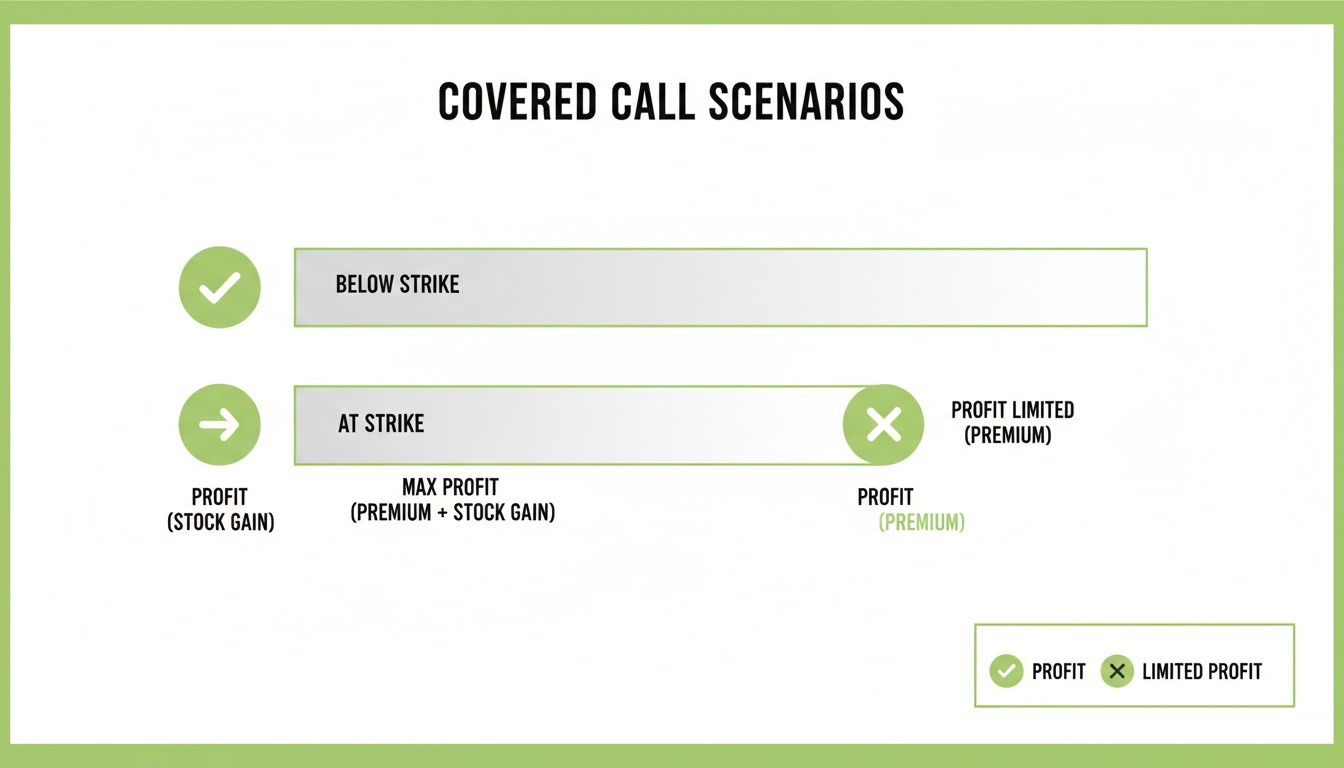
As you can see, the best-case scenarios happen when the stock finishes at or below the strike price. That’s when you get to keep both the premium and your shares, ready to do it all over again.
When to Avoid This Strategy
Knowing when not to use a covered call is just as important. If you're in a roaring bull market and your stock is ripping higher every day, this strategy will absolutely cap your gains and create a ton of opportunity cost. You’ll be forced to sell your shares at the lower strike price while the stock continues to climb without you.
On the flip side, it offers very limited protection in a steep market crash. The premium you collected is nice, but it won’t do much to offset a major nosedive in the stock's value. That said, historical data shows it can still help. During the big bear markets of 2000-2002 and 2008, covered call strategies lost far less than the S&P 500 because the options sold consistently expired worthless, providing a steady income buffer against the falling prices.
To help clarify, here’s a quick comparison of the market environments where covered calls tend to work best versus when you should probably stay away.
Optimal vs. Suboptimal Markets for Covered Calls
| Market Condition | Strategy Effectiveness | Reasoning |
|---|---|---|
| Neutral / Sideways | Excellent | The stock stays below the strike, letting you consistently keep the premium and your shares. |
| Slightly Bullish | Good | You collect premium, and the stock may appreciate slightly without breaching the strike price. |
| Slightly Bearish | Fair | The premium collected helps offset a small portion of the stock's decline. |
| Strongly Bullish | Poor | Your gains are capped, and you'll likely have to sell your shares, missing out on major upside. |
| Strongly Bearish | Poor | The premium provides very little protection against a significant drop in the stock's value. |
Ultimately, success with covered calls comes down to reading the market environment correctly.
For a deeper dive, be sure to check out our guide on finding the best stocks for covered calls.
How to Execute Your First Covered Call Trade
Alright, you get the theory behind why covered calls work. Now, let's bridge the gap between understanding the concept and actually placing a trade.
Putting on your first covered call is way more straightforward than it sounds. Once you get the hang of it, you'll develop a simple, repeatable process that builds confidence with every trade.
Of course, to do this, you’ll need a brokerage account that supports options trading. If you're just starting, looking into the best stock trading apps for beginners is a great first step to find a platform that feels intuitive. Once you're set up, it all starts with picking the right stock.
Step 1: Select the Right Underlying Stock
This is the bedrock of a good covered call. The strategy is built on stock you already own, so it should be a company you're happy to hold for the long haul.
There’s always a chance the stock price could fall, so you should only run this play on stable, quality companies you actually believe in. Never, ever pick a stock just because it offers a juicy premium. That's a classic rookie mistake.
Look for stocks with these traits:
- Price Stability: Try to avoid hyper-volatile stocks that swing wildly. They introduce a level of risk that can easily wipe out your premium income.
- Sufficient Liquidity: The stock and its options need to have high trading volume. This just means you can get in and out of your positions easily without any drama.
- Positive Long-Term Outlook: Ask yourself: "Would I be okay owning this stock even if the trade doesn't go my way?" If the answer is no, find another stock.
Step 2: Choose the Strike Price and Expiration Date
Okay, this is where the art and science of the trade really come into play. The choices you make here will directly dictate your income, your risk, and the odds of your shares getting sold.
First up, the expiration date. A great starting point for generating steady income is selling options that expire in 30 to 45 days. This timeframe usually hits the sweet spot, offering a solid premium for the amount of time your capital is tied up.
Next, you need to pick your strike price. This is the classic trade-off between risk and reward:
- Closer Strike Prices (near the current stock price) will pay you a much higher premium. The catch? There's a much higher chance your shares will get "called away" (sold).
- Farther Strike Prices (well above the current stock price) pay a smaller premium. But, the probability of your shares being sold is significantly lower.
A killer metric that helps with this decision is Delta. You can think of Delta as a rough cheat sheet for the probability of an option finishing in-the-money. For example, a .30 Delta suggests there’s about a 30% chance of your shares being assigned at expiration.
Your job is to find that sweet spot that matches your goals. If you want to maximize income and you're perfectly fine with selling your shares, a closer strike is your play. If your top priority is keeping your shares and just earning a little extra income, a farther, safer strike price is the way to go.
Step 3: Place the Sell to Open Order
Once you've locked in your stock, expiration, and strike price, it's time to execute. In your brokerage app, you'll pull up the option chain for your stock and find the exact contract you've chosen.
You're looking for an order type called "Sell to Open." This simply tells your broker you're creating a new short option position. You’ll enter how many contracts you want to sell—just remember that one contract represents 100 shares you own.
From there, you place the order. Once it's filled, the premium cash is dropped into your account instantly. And just like that, you've placed your first covered call.
Managing Your Position and Avoiding Common Mistakes

Putting on a covered call is just the first step. The real skill—and where you lock in consistent results—comes from managing the position as it unfolds. Once the trade is live, you're not just a bystander; you're an active manager, watching the calendar and weighing the possible outcomes.
No guide to covered calls would be complete without a game plan for what happens next. As your option’s expiration date gets closer, one of three things will happen, and your next move will depend entirely on what you wanted to achieve in the first place.
The Three Potential Outcomes at Expiration
Every covered call trade ends in one of three ways:
The Stock Stays Below the Strike Price: This is usually the best-case scenario. The option expires worthless, you pocket 100% of the premium, and you keep your shares. Now you're free to sell another call and repeat the process.
The Stock Rises Above the Strike Price: Your shares get automatically sold at the strike price. This is still a win. You’ve hit your maximum profit for the trade, which is the premium you collected plus any gains in the stock up to the strike.
The Stock Price Moves Sharply: If the stock shoots way up or drops significantly, you might need to step in before expiration. This is where active management comes in to either protect your capital or adjust your strategy on the fly.
Proactive management is the key to turning a good strategy into a great one. Don't just set it and forget it; be prepared to adjust your position based on new market information.
Sometimes, you really don't want to sell your shares, even if it means hitting your max profit. If the stock is climbing and you want to avoid having your shares called away, you can "roll" the position. To get into the nuts and bolts, you can read more about how to roll over options contracts and keep the trade alive. It’s a simple two-part move: buying back the call you sold and selling a new one with a later expiration date or a higher strike price.
Common Mistakes to Avoid
Even experienced traders can fall into a few common traps. Sidestepping these is absolutely critical for long-term success with covered calls. Most mistakes boil down to two things: greed and a lack of planning.
Here are the most frequent errors that can wreck an otherwise solid strategy:
- Chasing High Premiums on Volatile Stocks: That juicy premium is tempting, but it’s a warning sign. It signals high risk. These stocks can drop like a rock, and the income you collected won’t come close to covering your losses on the shares.
- Selling Calls on a Stock You Don't Want to Own: This is a cardinal sin. Never write a covered call on a stock you wouldn't be happy holding if the price got cut in half. Your real risk is always in the underlying stock, not the option itself.
- Having No Plan for Sharp Price Moves: Before you even place the trade, decide what you'll do if the stock rips past your strike or tumbles hard. Having a clear plan stops you from making emotional, knee-jerk decisions when things get interesting.
Optimizing Your Strategy with Data-Driven Decisions

Executing trades is one thing, but optimizing them for consistent income is another game entirely. If you’re relying on gut feelings or basic metrics, you’re leaving money on the table. The next step in mastering covered calls is moving from guesswork to making calculated, data-driven decisions.
This is where real-time probability data changes everything. Instead of just picking a strike price that "feels right," you can see the actual statistical odds of your shares getting called away. It transforms your approach, letting you fine-tune the perfect balance between aggressive income and conservative risk management.
Moving Beyond Basic Metrics
Here's a hard truth: generating reliable yield from covered calls has become surprisingly difficult. The strategy's popularity has created a crowded market, often pushing down the very premiums investors are after. One analysis even found that a strategy targeting a 6% annual yield actually produced an annualized loss of 3.1% over thirteen years. This highlights why a smarter approach is non-negotiable.
This is exactly why modern tools are so essential. Platforms like Strike Price take the guesswork out of the equation by giving you clear, real-time probability metrics for every single strike price. You no longer have to wonder about your risk — you can see it quantified instantly.
This kind of visual data immediately clarifies the trade-off, showing you exactly how much risk you're taking on for a specific premium.
Using Probabilities to Your Advantage
Seeing these numbers lets you tailor every trade to your specific goals. Want to generate maximum income and you're comfortable with your shares being sold? Choose a strike with a higher probability of assignment. Is your main goal to keep your shares and just collect a small, safe premium? Select a strike with a much lower probability.
By using a probability-driven platform, you turn each trade into a calculated decision rather than a speculative guess. It’s about replacing emotion with objective data to achieve your income targets with greater precision and confidence.
This data-first mindset empowers you to systematically manage your portfolio. For those looking to go even deeper, exploring various data analytics courses can provide a solid foundation for optimizing any strategy. With smart alerts and goal-oriented features, you get notified of high-reward opportunities and warned when risk levels change, making sure you always stay in control.
Answering Your Covered Call Questions
Even when you have a good handle on the strategy, certain situations can pop up and leave you scratching your head. Let's walk through a few of the most common questions traders have about covered calls.
What Happens If a Dividend Is Paid?
Good news: if you own the stock on its ex-dividend date, that dividend payment is yours to keep. This is one of the sweet spots of the strategy—you get to collect both the option premium and the dividend.
There's a catch, though. A big upcoming dividend can make your call option a prime target for early assignment. If your call is in-the-money, the option buyer might decide to exercise their right to your shares early, just so they can pocket that dividend themselves. It's something to keep an eye on.
Can I Lose More Than My Initial Investment?
Nope. A standard covered call is a defined-risk strategy. Because you already own the 100 shares of stock for every call you sell, the absolute most you can lose is what you paid for those shares, minus the premium you pocketed.
The premium you collect acts as a small but real cushion against a drop in the stock's price. It effectively lowers your breakeven point, giving the stock a little room to fall before your position is actually in the red.
You simply can't lose more than the money you used to buy the stock in the first place.
How Are Covered Call Profits Taxed?
Tax rules for options can get tricky and often depend on where you live, so chatting with a tax professional is always the smartest move. But in simple terms, there are generally two moments when taxes come into play:
- The Premium: The cash you get for selling the call is usually considered a short-term capital gain and is taxed in the year you receive it.
- Assignment: If your shares get called away, the IRS treats it just like any other stock sale. Whether it’s a gain or a loss depends on what you originally paid for the shares and how long you've held them.
Ready to stop guessing and start making data-driven decisions? Strike Price gives you the real-time probability data you need to balance income and risk with confidence. See which trades offer the best return for your risk tolerance and achieve your income goals with greater precision. Start your free trial today.