
Mastering the Bid and Ask on Options for Higher Profits
If a stock moves past your strike, the option can be assigned — meaning you'll have to sell (in a call) or buy (in a put). Knowing the assignment probability ahead of time is key to managing risk.
Posted by
 John Clarke
Related reading
A Step-by-Step Covered Calls Example for Consistent Income
Unlock consistent income with our step-by-step covered calls example. This guide breaks down the strategy, risks, and outcomes to help you trade confidently.
Long Call and Short Put The Ultimate Synthetic Stock Guide
Unlock the power of the long call and short put strategy. This guide explains how synthetic long stock works, its benefits, risks, and how to execute it.
What is a Call Spread? A Clear Guide to Bull and Bear Spreads
What is a call spread? Discover how bull and bear spreads limit risk and sharpen your options trading strategy.
When you sell an option, the bid price is the most a buyer is willing to pay for it right now. The ask price is the lowest price a seller (like you) is willing to accept. This back-and-forth is the foundation of every trade and directly affects the premium you collect.
Understanding the Market’s Conversation: Bid vs. Ask

Think of it like a farmer's market. A buyer points to a basket of apples and shouts, "I'll give you $2.50 for those!" That's the bid. The farmer immediately replies, "Not a chance. My price is $2.70." That's the ask. The options market is the exact same conversation, just happening electronically millions of times a second.
As an options seller, your job is to get the best price for your contracts. The bid and ask prices are the live negotiation happening for every single option. The difference between them is called the bid-ask spread. For a deeper dive, check out our guide on what the bid-ask spread is.
The bid-ask spread isn't just a tiny detail—it's the direct, upfront cost of making a trade. A wider spread means the market is less efficient, creating a bigger hurdle for you to clear just to break even.
The Two Sides of a Trade
Every single trade needs a buyer and a seller, and it’s their competing goals that bring the market to life.
- The Bid Side: This is pure demand. It’s a crowd of buyers showing you the absolute highest they’re willing to pay. If you need to sell an option immediately, you’ll hit the bid.
- The Ask Side: This is the supply. It’s a line of sellers showing their lowest acceptable price. When a buyer wants an option right now, they have to pay the ask.
Getting this dynamic is key. Interestingly, a huge chunk of options trades—often around 50-65%—don't execute at the bid or the ask. They happen in between. This is where smart negotiation pays off, letting you squeeze out a better price than what was first offered.
Why the Bid-Ask Spread Is Your Biggest Hidden Cost
That little gap between the bid and ask on options? It's more than just two numbers on your screen. It’s an immediate, invisible cost that eats directly into your bottom line.
Think of it as a transaction fee paid not to your broker, but to the market itself. Every time you sell an option and hit the bid, you're instantly giving up a slice of potential profit.
This cost, known as the spread, isn’t fixed. It widens and tightens based on three primary market forces: liquidity, volatility, and time until expiration. For any options seller looking to maximize their premium, understanding these factors is non-negotiable.
The Three Forces That Shape Your Costs
The size of the bid-ask spread is a direct reflection of risk and market efficiency. Here’s what drives it:
Liquidity: This is the big one. Highly liquid options, like those on AAPL or SPY, have thousands of traders jumping in and out. This fierce competition squeezes spreads down to just a penny or two. On the flip side, illiquid options on less popular stocks have few participants, leaving you with wide, costly spreads.
Volatility: When the market gets nervous—think earnings reports or big news events—uncertainty skyrockets. Market makers widen spreads to protect themselves from the increased risk of big price swings, making it more expensive for you to trade.
Time to Expiration (DTE): Options with months to go until they expire often have wider spreads. Why? More time means more uncertainty. As expiration gets closer, these spreads usually tighten up, especially for popular, liquid stocks.
These forces don't work in a vacuum; they constantly interact, creating a dynamic pricing environment. Historical data shows that for at-the-money (ATM) calls on major indices, spreads can average 3.5% of the premium in calm markets. But during a panic, they can explode to over 12%.
This is exactly why blindly accepting the bid can be a costly mistake, especially when fear is running high. You can dig into the numbers yourself and see these patterns on sites like Optionistics, a provider of historical options data.
The way these market conditions—liquidity, volatility, and time—interact directly determines the size of the spread and, consequently, your risk as a seller.
How Market Conditions Affect Bid-Ask Spreads
| Factor | High Impact Scenario | Resulting Spread | Low Impact Scenario | Resulting Spread |
|---|---|---|---|---|
| Liquidity | Low trading volume (e.g., unpopular stock) | Wide | High trading volume (e.g., SPY, AAPL) | Tight |
| Volatility | High uncertainty (e.g., before earnings) | Wide | Low uncertainty (e.g., stable market) | Tight |
| Time to Expiration | Long time until expiration (e.g., LEAPS) | Wide | Short time until expiration (e.g., weeklies) | Tight |
A wide spread is a clear signal of higher risk for sellers, driven by low liquidity, high volatility, or a distant expiration date. Conversely, a tight spread points to a more efficient and less risky trading environment.
The bid-ask spread is the market's way of charging you for risk and convenience. A wide spread is a warning sign of low liquidity or high volatility—or both. Ignoring it is like paying for a product without even glancing at the price tag.
Ultimately, the width of the spread tells a story. A tight spread signals a healthy, efficient market where you can trade with confidence. A wide spread, however, is a clear red flag—a warning of higher costs and hidden dangers that demand a much more strategic approach.
Calculating Your True Profit Beyond the Quoted Price
Theory is one thing, but seeing how the bid and ask on options actually hits your wallet is what really matters. Let's get practical and calculate the real dollars and cents at stake every time you sell an option. You might be surprised how much premium you're leaving on the table.
The first step is figuring out what an option is actually worth. For that, we use the mid-price. It’s just the halfway point between the bid and the ask, giving us a clean look at the contract's market value before the spread gets in the way.
Mid-Price Formula: (Bid Price + Ask Price) / 2 = Mid-Price
Think of the mid-price as the option's sticker price. The bid is what a lowball buyer is offering, and the ask is what an optimistic seller is hoping for. The mid-price cuts right through that noise and gives you a realistic target.
A Real-World Covered Call Example
Let's say you're ready to sell a covered call on XYZ stock. You pull up your brokerage app and see this quote for the strike you've picked:
- Bid: $1.80
- Ask: $2.00
- Mid-Price: ($1.80 + $2.00) / 2 = $1.90
If you hit "sell" with a market order, it’ll probably fill instantly at the $1.80 bid price. For one contract (that’s 100 shares), you'd collect $180 in premium. Not bad. But the fair value—the mid-price—was $1.90. If you'd targeted that price instead, you could have collected $190.
That $10 difference is your hidden cost. It might not sound like much, but it’s a 5.5% loss of potential premium on a single trade. This gap between the price you wanted and the price you got is a nasty little effect called slippage. To see how it adds up over time, check out our guide on what slippage in trading is and how to avoid it.
This flow shows how factors like liquidity, volatility, and time drain influence the bid-ask spread—and your potential slippage.
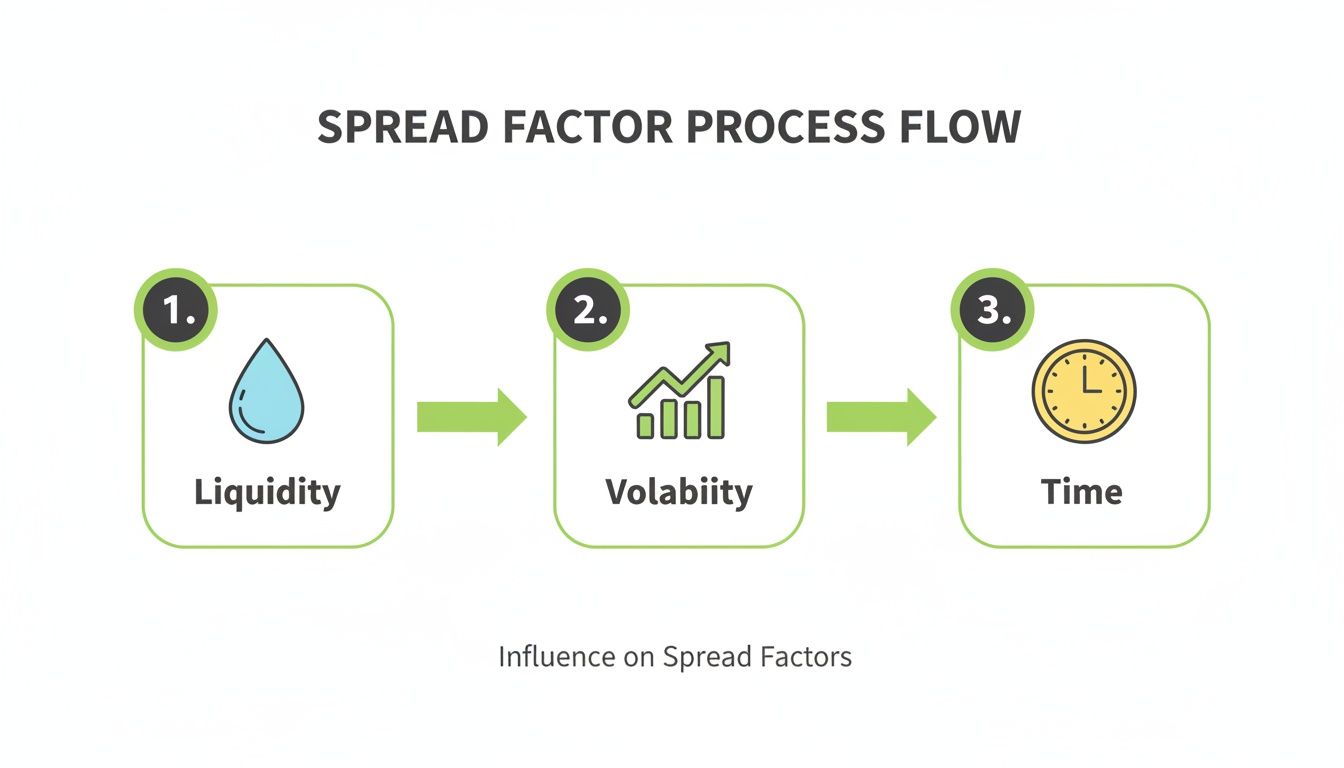
The takeaway here is clear: as liquidity drops or volatility and time-to-expiry climb, that spread gets wider. This makes your execution price even more critical. When you start measuring your potential profit against the mid-price, not just the bid, you see exactly what’s on the line. It’s the first step toward becoming a much smarter, more profitable seller.
Using Limit Orders to Capture More Premium

Now that you see how much the bid-ask spread can cost you, it’s time to take control. The single most powerful tool you have for this is the limit order. Frankly, using one is the most important change you can make to stop leaving money on the table.
When you go to place an order, your broker gives you two main choices: a market order or a limit order. A market order is the impatient option. It screams, "Sell this contract right now at whatever price you can get!" For sellers, this almost always means your order fills instantly at the bid price—the lowest price a buyer is offering.
This is a rookie mistake, and it's costly. You’re essentially telling the market you’re in a hurry and will accept the first lowball offer that comes along. With options that have wide spreads, this is like giving away a huge chunk of your potential premium just for a little speed.
Why Limit Orders Are a Must for Sellers
A limit order completely flips the script. Instead of just accepting the market's price, you set your own. It’s a simple instruction to your broker: "Sell this contract only at this specific price or a better one." This puts you back in the driver's seat.
By placing a limit order, you can aim for a price somewhere between the bid and the ask. This is often called "working the order," and it just means you're willing to be patient to get a better price.
Think of this as your playbook for every sell to open trade:
- Check the Bid and Ask: See what buyers are bidding and what sellers are asking.
- Find the Mid-Price: Just calculate the halfway point between those two numbers.
- Set Your Limit Order: Place your order to sell at or just a hair below that mid-price.
Let's say an option is quoted at $1.80 (bid) by $2.00 (ask). Instead of taking the $1.80, you could set a limit order to sell at $1.90. You might not get filled that second, but you’re actively fighting to capture an extra $10 in premium for every contract.
The Hidden Power of Price Improvement
Here’s an often-overlooked perk of using limit orders: price improvement. When you submit a limit order, your broker is required to find the best possible execution for you. Sometimes, they can actually fill your order at a price even better than your limit.
By patiently using a limit order, you give market makers time to compete for your business. This can lead to a fill that's closer to the ask, putting more cash directly into your account than you even asked for.
This is your reward for being a disciplined seller. A market order guarantees speed but sacrifices price. A limit order prioritizes price over speed. For options sellers focused on income, that trade-off is almost always worth it.
It’s a foundational technique for squeezing every last cent out of a trade and shielding your profits from the spread. For a deeper dive, our guide on the sell to open order is a great next step.
Pro Strategies for Navigating Wide Spreads
Knowing how to use a limit order is a solid defensive move. Now, let’s go on offense.
Proactively hunting for favorable trading conditions is how you consistently improve your premium capture and avoid the traps of wide, costly spreads.
The first rule is simple: trade when the market is most active. Spreads are often at their tightest during the hours just after the opening bell (9:30 AM ET) and before the final hour of trading. In contrast, the pre-market and after-hours sessions can feel like ghost towns, with dangerously wide spreads lurking.
Target High-Liquidity Options
Your best defense against a wide spread is to avoid illiquid options from the start. A liquid option has a crowd of buyers and sellers, which naturally forces the bid-ask spread to stay competitive and tight.
Before you even think about placing a trade, look for these tell-tale signs of a healthy market:
- High Open Interest: This is the total number of outstanding contracts. Seeing thousands of open contracts is a great sign.
- High Daily Volume: This tells you how many contracts traded today, confirming there's strong current interest.
- Tight Spreads: The most direct signal. If the bid and ask are only a few cents apart, you’ve likely found a winner.
Data-driven tools can do this heavy lifting for you, instantly screening for options that meet these crucial criteria.
This dashboard view from Strike Price, for instance, lays out the key metrics at a glance, helping you spot liquid opportunities in seconds.
By zeroing in on strikes with high volume and open interest, you can immediately filter out the less desirable, illiquid options that cause so many headaches.
Use Data to Your Advantage
A look at historical data reveals some fascinating patterns in the bid and ask on options. In years with high volatility, total U.S. equity options volume can explode, recently hitting 10.9 billion contracts in a single year.
For SPX weekly options, average spreads have actually tightened over time as "between-market" executions climbed to over 60% of total volume. This data points to a massive opportunity for sellers who know where and when to act. You can explore more market statistics and find out how historical data shapes trading.
By treating liquidity not as an afterthought but as a primary screening metric, you shift from reacting to bad spreads to proactively avoiding them altogether. This strategic filter is a hallmark of disciplined, profitable options selling.
Bringing It All Together for Smarter Options Selling
Mastering the bid and ask on options isn't about memorizing complex formulas. It’s about a fundamental shift in how you see the market. That little gap between the two prices? It’s not just a cost you have to eat—it's a field of play where a little patience can make a huge difference.
Successful income trading really boils down to one thing: you have to stop blindly hitting the bid. Every single time you place an order, you have a chance to negotiate a better price for yourself. This simple act, repeated over hundreds of trades, is what adds up to a real, measurable boost in your annual returns.
The road to smarter selling is paved with the concepts we've covered. It's about learning the market's language, picking the right tools for the job, and knowing which battles are worth fighting.
Your Actionable Framework
Getting better trade execution, consistently, comes down to having a process you can repeat. If you want to turn this from a game of chance into a strategic operation, drill these three actions into your routine:
- Always Use Limit Orders: Make this a hard-and-fast rule. Setting your price gives you control and is your number one defense against getting a terrible fill on a wide spread.
- Target the Mid-Price: Think of the mid-price as your starting point for what's fair. Place your limit order there first, then be ready to nudge it patiently if you don't get a fill.
- Prioritize Liquid Options: Go where the action is. Hunt for options with high trading volume and plenty of open interest. A busy, active market is your best friend for keeping spreads tight and profitable.
By making these steps second nature, you're actively working to squeeze every last penny of premium out of each covered call or cash-secured put you sell.
The goal here is to make small, consistent wins on your trade entries. An extra $5 or $10 per contract might not feel like much in the moment, but it's the disciplined accumulation of these little victories that separates the profitable sellers from everyone else.
This deliberate approach turns every trade into a calculated move, designed to stack the odds in your favor and build a more resilient income portfolio.
Frequently Asked Questions
When you're trying to apply the concepts of bid and ask to live trades, a few common questions always seem to pop up. Let's tackle some of the most frequent ones from options sellers.
What Is a Good Bid-Ask Spread for Selling Options?
What counts as a "good" spread is always relative, but here’s a solid rule of thumb: look for spreads that are less than 10% of the option's ask price.
For super-liquid tickers like SPY or QQQ, you can find spreads as tight as $0.01. That’s the dream scenario for any trader. On less common stocks, a spread between $0.05 and $0.10 can be perfectly fine.
The real danger zone is when the spread is a huge chunk of the premium you're trying to collect. For example, a $0.50 spread on a $2.00 premium is a massive red flag. It screams low liquidity and signals a high risk of getting a terrible fill.
A tight spread is the most reliable, real-time indicator of strong liquidity. If the gap between the bid and ask is small, you can be confident there are plenty of buyers and sellers ready to trade.
Why Didn't My Limit Order Get Filled at the Mid-Price?
Placing a limit order at the mid-price is a smart move, but it's not a magic bullet. For your order to fill, a buyer on the other side has to be willing to meet you there.
If the stock is moving against you, buyers might not need to come up to the midpoint to find a willing seller. Market makers have zero obligation to fill your order at that price.
So if your order is just sitting there, you have two choices: be patient and wait for the market to come to you, or start methodically adjusting your limit price closer to the bid. This tactic, often called "walking down" your order, can help attract a buyer and get the trade done.
How Can I Check an Option's Liquidity Before Trading?
You can get a quick read on an option's liquidity in two simple steps. It's a great way to get a clear picture of the trading environment before putting any capital on the line.
Check Volume and Open Interest: Take a look at the data for your specific strike. High numbers for both metrics mean you're looking at a healthy, active market with plenty of participants. Low numbers? Proceed with caution.
Examine the Spread Itself: This is the most direct signal you'll get. A tight bid-ask spread is immediate proof of strong liquidity. If the gap is just a few pennies, you know the market is competitive and efficient.
Ready to stop guessing and start making data-driven decisions? Strike Price provides real-time probability metrics and smart alerts to help you find the most liquid options and capture the best premium. Transform your options selling from a gamble into a strategic process. Get started with Strike Price today.